The Role of Mineral-Enriched Oral Rinse in Enamel Health
A mineral-enriched oral rinse functions as a mineral reservoir that helps early enamel lesions stop progressing and supports gradual remineralization when used consistently. Think of it less as a treatment and more as a daily top-up: it raises the concentration of calcium and phosphate ions around your teeth, buffers acid after meals, and gives your saliva better raw material to work with.
The core roles these rinses play:
- Remineralization support: Supplies calcium, phosphate, and biomimetic mineral particles (like nano-hydroxyapatite) that can integrate into softened enamel surfaces.
- pH buffering: Neutralizes acid after dietary challenges, buying time for saliva-driven repair before demineralization progresses.
- Sensitivity relief: Occludes exposed dentinal tubules and reduces the thermal and osmotic triggers behind sensitivity.
- Adjunctive antibacterial effects: Ingredients like xylitol shift the oral biofilm toward less acid-producing bacteria over time.
One scope note upfront: mineral rinses work best on early-stage white-spot lesions and routine enamel maintenance. They do not reverse advanced cavities. If you have a visible hole or progressive decay, a dentist visit comes first.
Table of Contents
- How mineral rinses support remineralization and enamel repair
- Which ingredients actually work in a mineral rinse?
- What does the science actually say?
- When and how to use a mineral rinse for best results
- How mineral rinses compare with other natural options
- What a well-formulated mineral rinse actually looks like
- Key Takeaways
- The case for mineral rinses is stronger than most people realize
- Selfwisebrand’s mineral rinse fits the evidence-based routine
- Useful sources
- FAQ
How mineral rinses support remineralization and enamel repair
A mineral rinse changes the chemistry at the enamel surface by raising the local concentration of calcium and phosphate ions, shifting the environment toward supersaturation. When saliva is supersaturated with these ions relative to the enamel mineral phase, net mineral gain becomes possible. The chemical basis of remineralization depends on this supersaturation: ions must be present in the right ratio, at the right pH, and for long enough to nucleate and grow into durable hydroxyapatite crystals.
Nano-hydroxyapatite (n-HAp) takes this a step further. Rather than just supplying free ions, it acts as a biomimetic scaffold that physically deposits onto the demineralized enamel surface, providing nucleation sites where new mineral can grow. Particle size and dispersion determine how well n-HAp penetrates the enamel surface layer and integrates into the demineralized matrix.
Polyphosphates and urea play supporting roles. Polyphosphates adsorb to the enamel surface and can modulate biofilm acidogenicity, while urea raises plaque pH by generating ammonia, extending the window for repair. Both mechanisms buy time for saliva to do its job.
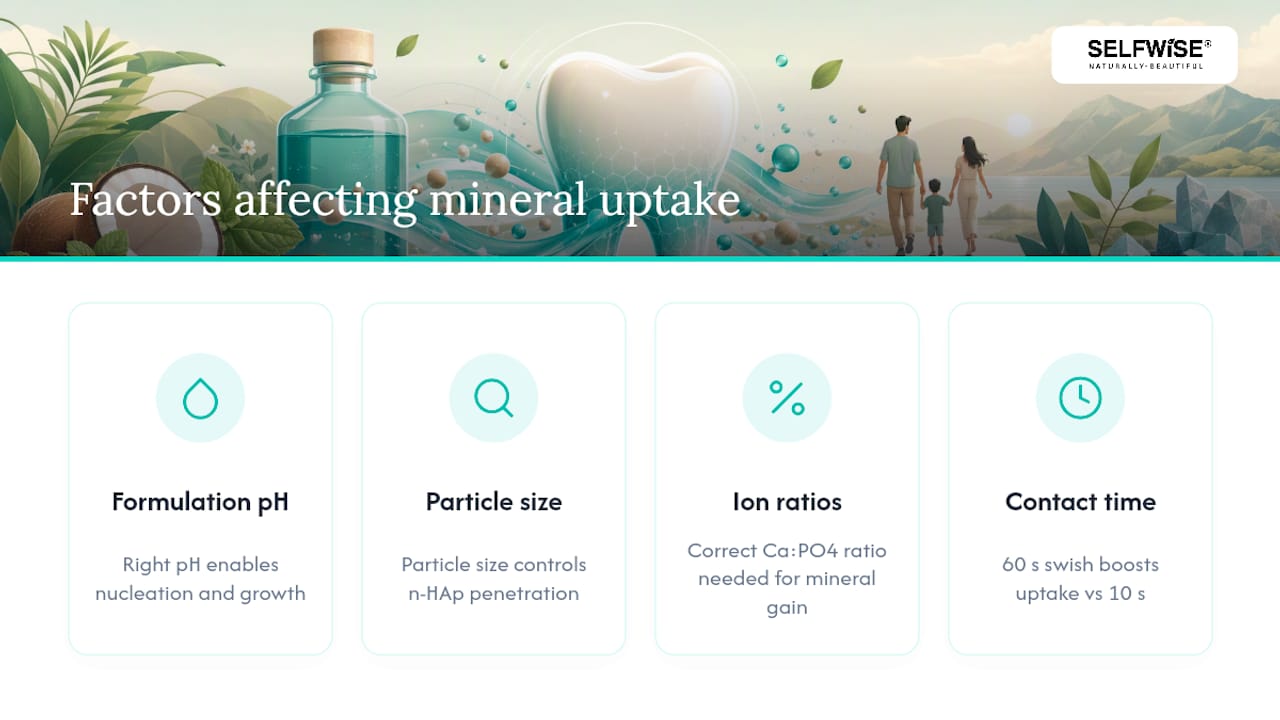
Mineral presence alone is not enough. Formulation pH, particle size, ion ratios, and how long the rinse stays in contact with enamel all determine whether meaningful mineral uptake occurs. A rinse swished for 10 seconds and immediately followed by water delivers far less than one held for 60 seconds at the right time of day.
Pro Tip: Swish for a full 60 seconds and do not eat or drink for 30 minutes afterward. The post-rinse window is when mineral deposition is most active.
Which ingredients actually work in a mineral rinse?
Knowing what to look for on a label separates a well-formulated rinse from an expensive water. The effective actives and their supporting cast:
Proven mineral actives:
Supportive ingredients:
Ingredients to treat cautiously:
- High polyphosphate concentrations: Polyphosphate systems can sequester calcium and fluoride when the anionic load is too high, potentially reducing net remineralization rather than boosting it.
Reading a label: look for n-HAp or calcium glycerophosphate near the top of the active ingredients list, a stated pH between 6.5 and 7.5, and xylitol as a supporting ingredient. Avoid formulations where polyphosphates appear as the primary active without a stated calcium:phosphate balance.
What does the science actually say?
The evidence supports adjunctive benefits, not miracles. Here is an honest summary.
A 2024 network meta-analysis across 14 in-situ studies found that adjunctive mouthwash use gave modest but statistically significant improvements in surface microhardness recovery compared with toothpaste alone. The same analysis noted that certain formulation ingredients, including polyvalent metal ions and high polyphosphate loads, can reduce fluoride-driven remineralization in some models, which underscores why formulation balance matters.
Older in-vivo intraoral appliance data adds a more striking data point: one trial reported 67% complete remineralization in the mineral-enriched mouthrinse group versus 43% in the fluoridated dentifrice group in that model. That is a meaningful difference, though the model uses artificial lesions under controlled conditions, which limits direct translation to everyday use.
A pilot clinical study found that a novel mineral mouthwash produced enamel rehardening at levels comparable to a leading sensitivity mouthwash, though some comparisons showed no significant difference between the mouthwash and no-mouthwash arms. That result is a reminder that mouthwash is an adjunct, not a standalone intervention.
What the evidence supports:
- Surface microhardness recovery in pH-cycling and in-situ models.
- Reduced sensitivity with n-HAp formulations.
- Subsurface mineral uptake with polyphosphate and calcium-phosphate systems in lab models.
- Modest, consistent clinical benefit when used as an adjunct to brushing and flossing.
What it does not support:
- Reversing established cavities or replacing restorative dentistry.
- Dramatic whitening or structural repair of heavily demineralized enamel.
- Equivalent benefit from a single use or irregular application.
The honest read: “modest but statistically significant” means you will not see a dramatic change in a week, but consistent use over months does shift the balance toward mineral gain rather than loss. For early lesions and preventive maintenance, that shift is clinically meaningful.
When and how to use a mineral rinse for best results
Timing is where most people leave benefit on the table. The 2024 NMA found bedtime use after fluoride toothpaste to be the most effective sequencing in in-situ models. Here is how to apply that in practice:
Recommended routine:
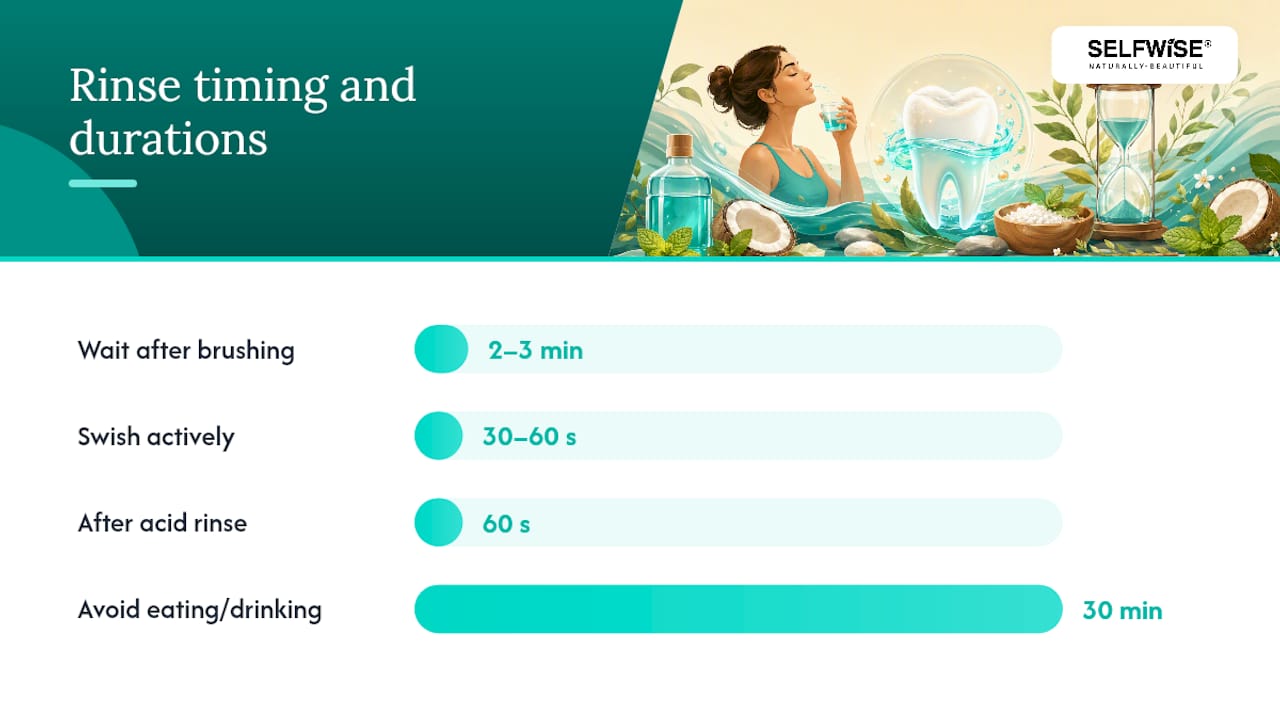
- Bedtime (primary use): Brush with your toothpaste, wait 2–3 minutes, then rinse with your mineral rinse. Salivary flow drops during sleep, so the mineral ions stay in contact with enamel longer. This is when the rinse earns most of its benefit.
- After acid challenges (secondary use): After coffee, citrus, or a sugary meal, a 60-second mineral rinse buffers the pH drop and provides ions before saliva can fully recover. Do not brush immediately after acid exposure; rinse first, wait 30 minutes, then brush.
- Mid-day (optional): For high-caries-risk individuals or those with dry mouth, a mid-day rinse maintains the mineral reservoir between meals.
How to rinse correctly:
- Use the volume specified on the label (typically 10–15 mL).
- Swish actively for 30–60 seconds, pushing the rinse between teeth.
- Expectorate fully; do not swallow.
- Avoid eating, drinking, or rinsing with water for at least 30 minutes after.
Sequencing with fluoride toothpaste:
Do not rinse immediately after brushing with a fluoride toothpaste. That washes away the concentrated fluoride film before it can act. Either use the mineral rinse at a different time of day entirely, or wait at least 2–3 minutes after spitting out toothpaste before rinsing. For a daily nano-hydroxyapatite routine, the same timing logic applies.
How mineral rinses compare with other natural options
Each rinsing approach has a different mechanism and a different evidence base. Choosing between them depends on your primary goal.
- Mineral rinse vs. salt water: Saline rinses are anti-inflammatory and mildly antimicrobial, but they do not supply calcium or phosphate in meaningful concentrations and offer no biomimetic scaffolding. Salt water is useful after oral surgery or for gum irritation; a mineral rinse is the better choice for enamel maintenance.
- Mineral rinse vs. oil pulling: Oil pulling works through a mechanical and adhesive mechanism, reducing bacterial adhesion and plaque. It does not supply mineral ions or support remineralization. The two approaches address different problems and can coexist in the same routine.
- Mineral rinse vs. fluoride mouthwash: Fluoride mouthwash has the strongest and most consistent clinical evidence base for caries prevention. A mineral rinse is the preferred choice when you want a fluoride-free or biomimetic option, or when sensitivity is the primary concern. For high caries risk, fluoride remains first-line; mineral rinses work best as an adjunct or a fluoride-free alternative for lower-risk maintenance. Protecting enamel during whitening treatments is one scenario where mineral rinses add clear value alongside cosmetic protocols.
What a well-formulated mineral rinse actually looks like
A well-formulated mineral rinse starts with biomimetic mineral sources, stabilizing buffers, and appropriate concentrations. Here is what to check:
- n-HAp particle size and dispersion: Sub-100 nm particles with good dispersion penetrate the enamel surface layer more effectively. Look for “nano-hydroxyapatite” explicitly on the label, not just “hydroxyapatite.”
- Calcium:phosphate balance: The ratio should approximate the stoichiometry of natural hydroxyapatite (roughly 1.67:1 Ca:P). Formulations that are heavily phosphate-heavy without adequate calcium may not nucleate effectively.
- pH stability: The rinse should be formulated between pH 6.5 and 7.5. Too acidic and it demineralizes; too alkaline and it can precipitate mineral before it reaches the tooth.
- No disruptive polyphosphate overload: Polyphosphates in moderate concentrations support subsurface repair; in excess, they sequester calcium and fluoride. A well-formulated product lists polyphosphates as a supporting ingredient, not the primary active.
- Complementary ingredients: Xylitol for biofilm modulation, mild buffering salts for pH stability, and no high-alcohol or harsh detergent carriers.
- Fluoride-free option: For readers who prefer to avoid fluoride, n-HAp is the most evidence-supported biomimetic alternative. Selfwisebrand’s formulations are built around this approach. For practical guidance on how to use nano-hydroxyapatite for stronger teeth, the sequencing and timing advice in that guide aligns directly with the evidence reviewed here.
Key Takeaways
Mineral-enriched oral rinses deliver modest but real adjunctive remineralization benefits when used consistently at the right time, with nano-hydroxyapatite and calcium-phosphate sources as the most evidence-supported actives.
| Point | Details |
|---|---|
| Best timing is bedtime | Use after brushing, wait 2–3 minutes, then rinse; salivary flow drops overnight, maximizing mineral contact time. |
| Sensitivity improves first | Tubule occlusion from n-HAp typically reduces sensitivity within 2–4 weeks, before structural remineralization is measurable. |
| Evidence is adjunctive | A 2024 NMA across 14 in-situ studies found modest but statistically significant microhardness recovery; mouthwash alone is not a cavity cure. |
| Formulation balance matters | Excess polyphosphates can sequester calcium and fluoride; check for n-HAp, xylitol, and a pH between 6.5 and 7.5. |
| Selfwisebrand as a natural option | Selfwisebrand’s fluoride-free n-HAp and xylitol mouthwash formulations match the evidence-based checklist for biomimetic mineral rinses. |
The case for mineral rinses is stronger than most people realize
Most oral care advice stops at “brush twice a day and floss.” That is correct but incomplete. The window between brushing sessions is when acid challenges, dietary sugars, and low salivary flow do their damage, and a mineral rinse is one of the few evidence-supported tools that addresses that window directly.
What gets underestimated is the cumulative effect. A single rinse does almost nothing measurable. Sixty days of consistent bedtime use, on the other hand, shifts the daily mineral balance in a meaningful direction. The in-vivo trial showing 67% complete remineralization in the mineral mouthrinse group versus 43% in the fluoride dentifrice group was not measuring a single application; it was measuring the result of sustained, repeated exposure.
The common misuse to avoid: treating a mineral rinse as a substitute for brushing when you are short on time. It is not. The mechanical disruption of plaque that brushing provides cannot be replaced by rinsing alone. A mineral rinse earns its place as the third step in a routine, not the only step.
One more thing worth saying plainly: the fluoride-free framing of n-HAp rinses is not anti-science. The biomimetic mechanism is well-documented, and for adults with low-to-moderate caries risk who want to avoid fluoride, n-HAp is a legitimate, evidence-backed alternative. The nuance is that for high-risk individuals, fluoride still has the strongest evidence base, and the two approaches are not mutually exclusive.
Selfwisebrand’s mineral rinse fits the evidence-based routine
If you have read this far, you know what a well-formulated mineral rinse looks like: nano-hydroxyapatite as the lead active, xylitol for biofilm support, a stable pH, no harsh alcohol or disruptive polyphosphate overload, and a fluoride-free option for those who want one. That is exactly how Selfwisebrand formulates its oral rinse line.
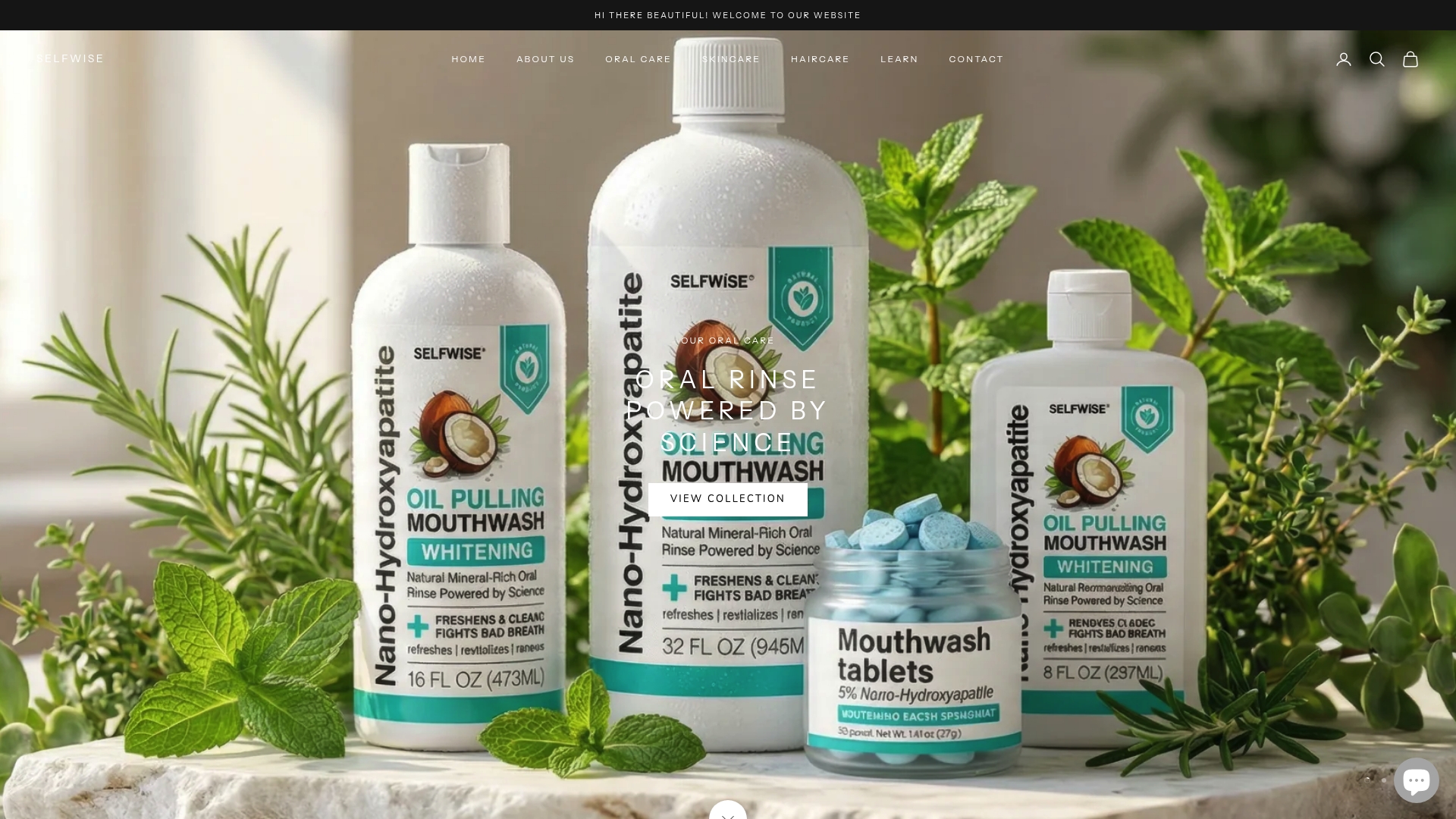
The Selfwisebrand mouthwash collection includes n-HAp mouthwash tablets and xylitol-based rinses built around simple, science-backed ingredients. No chlorhexidine, no alcohol, no fluoride. The tablet format dissolves in water, which means no plastic bottle waste and a consistent dose every time. Use it at bedtime after brushing, swish for 60 seconds, and let the mineral reservoir do its work overnight. Browse the full collection to find the formulation that matches your routine and your goals.
Useful sources
- Recent Advances in Dental Hard Tissue Remineralization: A Review of Literature - PMC
- Network meta-analysis of fluoride and mouthwash effects (2024) - Springer
- The Remineralization of Enamel from Saliva: A Chemical Perspective - PMC
- Pilot study: remineralization with mineral mouthwash - PMC
- In vivo remineralization of artificial enamel carious lesions using a mineral-enriched mouthrinse and a fluoride dentifrice - J Ped
- Polyphosphate-based systems for enamel remineralization — Frontiers in Oral Health (2026)
FAQ
What mineral rebuilds tooth enamel most effectively?
Calcium and phosphate are the primary minerals in hydroxyapatite, the compound that makes up enamel. Nano-hydroxyapatite delivers both in a biomimetic form that deposits directly onto the enamel surface, making it the most structurally accurate remineralizing agent available in oral rinses.
Does mouthwash help remineralize teeth?
Yes, when formulated with active mineral agents. A 2024 network meta-analysis found adjunctive mouthwash use produced modest but statistically significant improvements in surface microhardness recovery across 14 in-situ studies, particularly when used after fluoride toothpaste at bedtime.
Why do some dentists caution against daily mouthwash use?
The concern typically applies to antiseptic mouthwashes (especially chlorhexidine and high-alcohol formulations) that can disrupt the oral microbiome or reduce nitrate-reducing bacteria linked to cardiovascular health. Mineral-enriched rinses without strong antiseptic agents do not carry the same concern.
Can a mineral rinse fix a cavity?
No. Mineral rinses support remineralization of early-stage, subsurface lesions and white-spot areas, but they cannot reverse an established cavity with structural breakdown. Progressive decay requires restorative dental treatment.
How long before a mineral rinse produces noticeable results?
Sensitivity reduction often appears within 2–4 weeks with nano-hydroxyapatite formulations. Measurable surface hardness improvements and early lesion arrest typically require 4–12 weeks of consistent daily use, with meaningful subsurface remineralization developing over 3–6 months.