How to use nano hydroxyapatite for stronger teeth
You want stronger, healthier teeth without loading up on fluoride or synthetic chemicals. That’s not an unreasonable ask. It’s actually what a growing number of dentists and researchers are now backing with hard data. Nano hydroxyapatite (nHA) is the mineral that makes up roughly 97% of your tooth enamel, and using it topically means you’re literally feeding your teeth the building material they’re made of. Effective for remineralization comparable to fluoride, nHA is quickly becoming the cornerstone of modern natural oral care routines.
Table of Contents
- What is nano hydroxyapatite and why is it effective?
- What you need to start using nano hydroxyapatite
- How to use nano hydroxyapatite: Step-by-step routine
- How to monitor results and avoid common mistakes
- Our take: What most guides miss about nano hydroxyapatite
- Shop nano hydroxyapatite products for your oral health routine
- Frequently asked questions
Key Takeaways
| Point | Details |
|---|---|
| Science-backed alternative | Nano hydroxyapatite effectively rebuilds enamel and reduces sensitivity, rivaling fluoride as an oral care ingredient. |
| Easy daily use | You can safely use nano hydroxyapatite in toothpaste or mouthwash as part of your everyday routine. |
| Safe for all ages | nHA is suitable for adults and children, even if swallowed, offering a gentle option for sensitive mouths. |
| Results in weeks | Most users notice less sensitivity and healthier-looking teeth within 2–4 weeks of consistent use. |
| Consistency matters | To get the most from nHA, focus on brushing technique, frequency, and the right product concentration. |
What is nano hydroxyapatite and why is it effective?
Now that we’ve seen why remineralization matters, let’s get clear on what makes nHA so promising as a daily oral care ingredient.
Your enamel is under constant attack. Every sip of coffee, every acidic bite of food, every bacteria-produced acid slowly strips minerals from the surface of your teeth. That process is called demineralization, and if remineralization can’t keep up, you end up with sensitivity, white spots, and eventually cavities.
Nano hydroxyapatite is a synthetic calcium phosphate that mirrors the mineral structure of your natural enamel at an almost identical level. The “nano” part matters a lot here. These particles are small enough to fill in microcracks and tiny surface lesions on enamel, physically bonding to the tooth surface and restoring lost mineral structure. Regular hydroxyapatite particles are simply too large to access those spaces effectively.

What makes nHA genuinely exciting is that the science backs it up at a very specific level. According to research, the optimal toothpaste concentration is 10% nHA using rod-shaped particles, and it’s been deemed safe at concentrations up to 29.5% by the EU Scientific Committee on Consumer Safety (SCCS). At 10%, it’s proven to be as effective as fluoride for remineralization.
Here’s a quick comparison of how nHA stacks up against traditional fluoride:
| Feature | Nano hydroxyapatite | Fluoride |
|---|---|---|
| Mechanism | Directly rebuilds enamel structure | Converts enamel to fluorapatite |
| Systemic absorption | None | Yes, if swallowed |
| Safe for children | Yes, even if swallowed | Requires careful dosing |
| Sensitivity relief | Strong (occludes tubules) | Moderate |
| EU safety approval | Yes, up to 29.5% | Yes |
| Effective for remineralization | Yes, comparable to fluoride | Yes |
The key benefits of nHA as a daily ingredient include:
- Enamel repair at a structural level, not just surface coating
- Dentinal tubule occlusion, which directly reduces tooth sensitivity
- Biofilm disruption, making it harder for cavity-causing bacteria to stick to teeth
- Safe for all ages, since it’s not absorbed through oral tissue
- Compatible with other natural oral care tools like oil pulling and xylitol
The natural oral care guide at Selfwise shows how nHA fits into a broader routine alongside ingredients like xylitol, which has its own anti-cavity mechanism. The two work well together.
What you need to start using nano hydroxyapatite
With a clear understanding of why nHA earns its reputation, let’s walk through the basics of getting started with this innovative ingredient.
You don’t need an elaborate setup. But making the right product choices upfront will determine whether you actually see results or just burn through tubes of toothpaste without much change.
What to look for in an nHA product:
- At least 10% nHA concentration. This is the evidence-backed threshold for effective remineralization. Anything lower is unlikely to deliver the benefits you’re after.
- Rod-shaped nHA particles. Research specifically points to rod-shaped particles as more effective than spherical ones for enamel integration.
- Minimal harsh additives. Products loaded with SLS (sodium lauryl sulfate), artificial sweeteners, or aggressive abrasives can undermine the gentle repair work nHA is doing.
- No peroxide if you have sensitivity. Whitening agents can aggravate already-sensitive enamel.
Because nHA is safe if swallowed and not absorbed systemically through oral tissue, it’s genuinely appropriate for children. That makes it a practical option for families looking to move away from fluoride across the board.
Here’s a comparison of product formats to help you decide where to start:
| Product type | Best for | Use case | Notes |
|---|---|---|---|
| nHA toothpaste | Daily brushing | Morning and night routine | Most direct enamel contact |
| nHA mouthwash tablets | On-the-go or as supplement | After meals, travel, busy days | Convenient, mess-free |
| nHA powder | Advanced users | Custom mixing or layering | Less common, but effective |
| nHA serum or gel | Targeted treatment | Post-procedure sensitivity | Used under dental supervision |
For most people, starting with an nHA toothpaste plus an nHA mouthwash covers the fundamentals well. The toothpaste gives you the primary remineralization contact during brushing, and the mouthwash extends coverage to areas the brush misses. Check out these mouthwash options to understand how the liquid format works specifically.
You’ll also want to have a soft-bristled toothbrush on hand. Hard bristles are counterproductive when your goal is enamel repair. They don’t clean better; they just abrade the enamel you’re trying to protect. Add dental floss or a water flosser, because interdental cleaning removes the biofilm nHA can’t reach.
Our mouthwash tablets are a practical starting point if you want an easy, no-mess format to introduce nHA into your day.
Pro Tip: If you’re switching from fluoride toothpaste, give your routine at least four weeks before judging results. Remineralization is a gradual process. You’re rebuilding enamel architecture, not applying a whitening strip.
How to use nano hydroxyapatite: Step-by-step routine
Now you’re prepared. Let’s dig into the specifics of exactly how to use nHA and create a daily oral care ritual that actually delivers.
Consistency and technique matter far more than most people realize. A lot of users buy a quality nHA product and then undercut its benefits with rushed brushing, immediate rinsing, or skipping sessions. Here’s the routine that gets results:
-
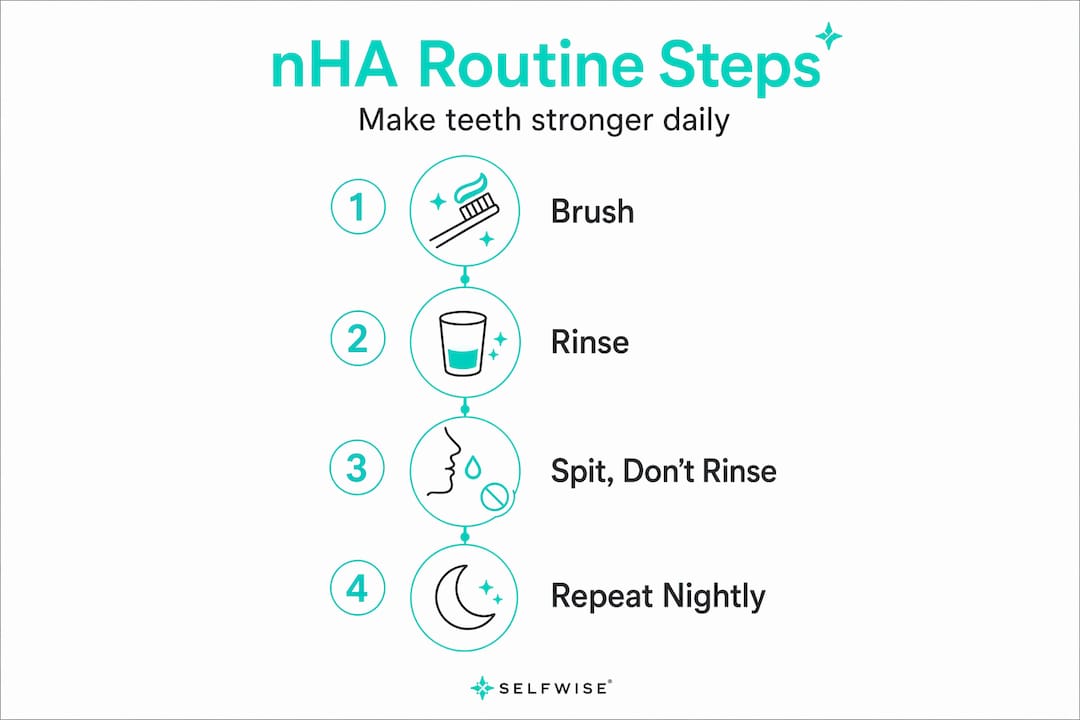
Brush twice daily, for exactly 2 minutes. This isn’t arbitrary. Research specifically shows that brushing twice daily for 2 minutes is more effective for dentinal tubule occlusion than mouthwash alone. Set a timer if you need to.
-
Use a pea-sized amount of nHA toothpaste. You don’t need more than that. Excess toothpaste gets spit out before it has time to work.
-
Brush gently with a soft-bristled toothbrush. Use small circular motions. Work systematically, covering all surfaces: outer, inner, and chewing surfaces of both upper and lower teeth.
-
Don’t rinse your mouth with water after brushing. This is probably the most important step most people skip. Rinsing washes away the nHA particles before they fully bond to the enamel. Spit out the excess and leave the residue on your teeth.
-
Use nHA mouthwash after meals or between brushing sessions. The tablets are especially convenient here. Drop one in water, let it dissolve, and swish for 30 to 60 seconds. This provides an additional remineralization boost throughout the day without replacing brushing.
-
Floss before your night brushing session. Clearing interdental spaces gives the nHA direct access to the tight areas between teeth where decay often starts.
-
Supervise children under 6. They may not have full control over spitting yet. Because nHA is safe to swallow, this isn’t a toxicity concern, but you still want to build good habits.
“Nano-hydroxyapatite has demonstrated significant effectiveness in occluding exposed dentinal tubules and remineralizing early enamel lesions when applied consistently as part of a structured oral care routine.” (BMC Oral Health, 2025)
For those exploring natural dental products more broadly, nHA pairs well with xylitol-based products, oil pulling, and mineral-rich diet changes. These aren’t competitors to nHA; they’re supporting players in the same goal.
If you deal with sensitivity specifically, there’s a great breakdown of how to pick the right formula in this guide on toothpaste for sensitive teeth. Sensitivity is often the first issue nHA addresses, sometimes within just a few weeks of consistent use.
Pro Tip: If you oil pull in the morning, do it before brushing, not after. Oil pulling works by pulling bacteria out of the oral environment. Brushing afterward with nHA toothpaste then reinforces the clean surface with remineralizing minerals.
How to monitor results and avoid common mistakes
With the steps covered, you’ll want to know what success looks like and how to optimize your results without wasting time on mistakes.
Realistic timeline for results:
Most users start noticing reduced sensitivity within 2 to 4 weeks of daily use. That’s often the first sign that nHA is doing its job, specifically by filling in the microscopic tubules in dentin that transmit pain signals. Brighter enamel can follow over 4 to 8 weeks, though this varies by individual enamel thickness and starting condition.
Signs that your routine is working:
- Decreased sensitivity to hot, cold, or sweet foods
- Teeth feel smoother to the tongue, a sign of surface mineral deposit
- Fewer “zings” from cold drinks that used to trigger discomfort
- A subtle brightening of enamel (not bleaching, but the natural translucency returning)
- More consistent clean feeling throughout the day
Here’s a quick-reference timeline for what to expect:
| Timeframe | Expected progress |
|---|---|
| Week 1 to 2 | Adjustment period, possible initial sensitivity changes |
| Week 2 to 4 | Noticeable reduction in sensitivity, improved clean feeling |
| Week 4 to 8 | Surface texture improvement, early enamel brightening |
| Month 2 and beyond | Cumulative remineralization, stronger enamel defense |
Common mistakes that slow progress:
- Rinsing immediately after brushing. We said it in the routine section, and it bears repeating. This single habit kills a huge portion of nHA’s effectiveness.
- Using less than 10% concentration products. Check your label. Many “hydroxyapatite” products on the market use concentrations too low to deliver real remineralization benefits.
- Inconsistent use. Remineralization is cumulative. Missing days or brushing once instead of twice breaks the mineral-building cycle.
- Using hard-bristled brushes. These scratch enamel, creating more surface area for acid to attack.
- Expecting whitening results. nHA restores enamel, which can improve natural brightness, but it’s not a bleaching agent. Manage expectations.
It’s also worth understanding where nHA stands with professional guidance. Dentists often recommend nHA for patients with low-to-moderate cavity risk, sensitivity concerns, or a preference for fluoride-free options. For high-risk patients, some dentists suggest alternating or combining nHA with fluoride products. nHA isn’t currently ADA or FDA approved specifically as an anti-cavity agent, but the clinical evidence supporting its use is growing steadily.
Explore the full range of hydroxyapatite mouthwash options if you want to layer in additional nHA exposure throughout your day.
Pro Tip: Take a quick close-up photo of your teeth in natural light before starting your nHA routine. It gives you an honest comparison point at 4 and 8 weeks, without relying purely on memory.
Our take: What most guides miss about nano hydroxyapatite
Most guides about nHA focus almost entirely on product selection. Pick the right toothpaste, find the right concentration, done. And while product quality matters, it represents maybe 30% of the result. The other 70% is technique, timing, and consistency.
We’ve noticed a consistent pattern: people switch to nHA, feel great about their choice, and then casually use it the same way they used conventional toothpaste. They rinse immediately. They brush for 45 seconds. They skip nights when they’re tired. Then they wonder why their sensitivity hasn’t improved after six weeks.
nHA isn’t magic. It’s a mineral. And minerals need time and surface contact to bond. The “don’t rinse after brushing” rule is the single most overlooked piece of advice in the natural oral care space, yet it has the biggest impact on whether nHA actually does anything for you.
There’s also a broader perspective worth sharing: nHA works best when it’s part of a system, not a standalone product. We built our approach around this idea. Oil pulling removes biofilm and bacteria before nHA even touches the enamel. Xylitol starves acid-producing bacteria. A low-sugar diet reduces the acid load nHA has to counteract. When you combine these elements, you’re not just protecting your teeth, you’re actively improving their baseline resilience over time.
Think of it like exercise. You can do one workout and feel good. But doing the work consistently, with the right form, while also eating well and sleeping enough? That’s when real transformation happens. Oral health is exactly the same.
The nHA overview on our site goes deeper into the mineral science if you want to understand the mechanism at a cellular level. It’s worth the read if you’re the type who likes to know why something works before you commit to it.
Shop nano hydroxyapatite products for your oral health routine
Ready to take what you’ve learned and put it into practice? Building a real nHA routine is straightforward when you have the right products backing it.
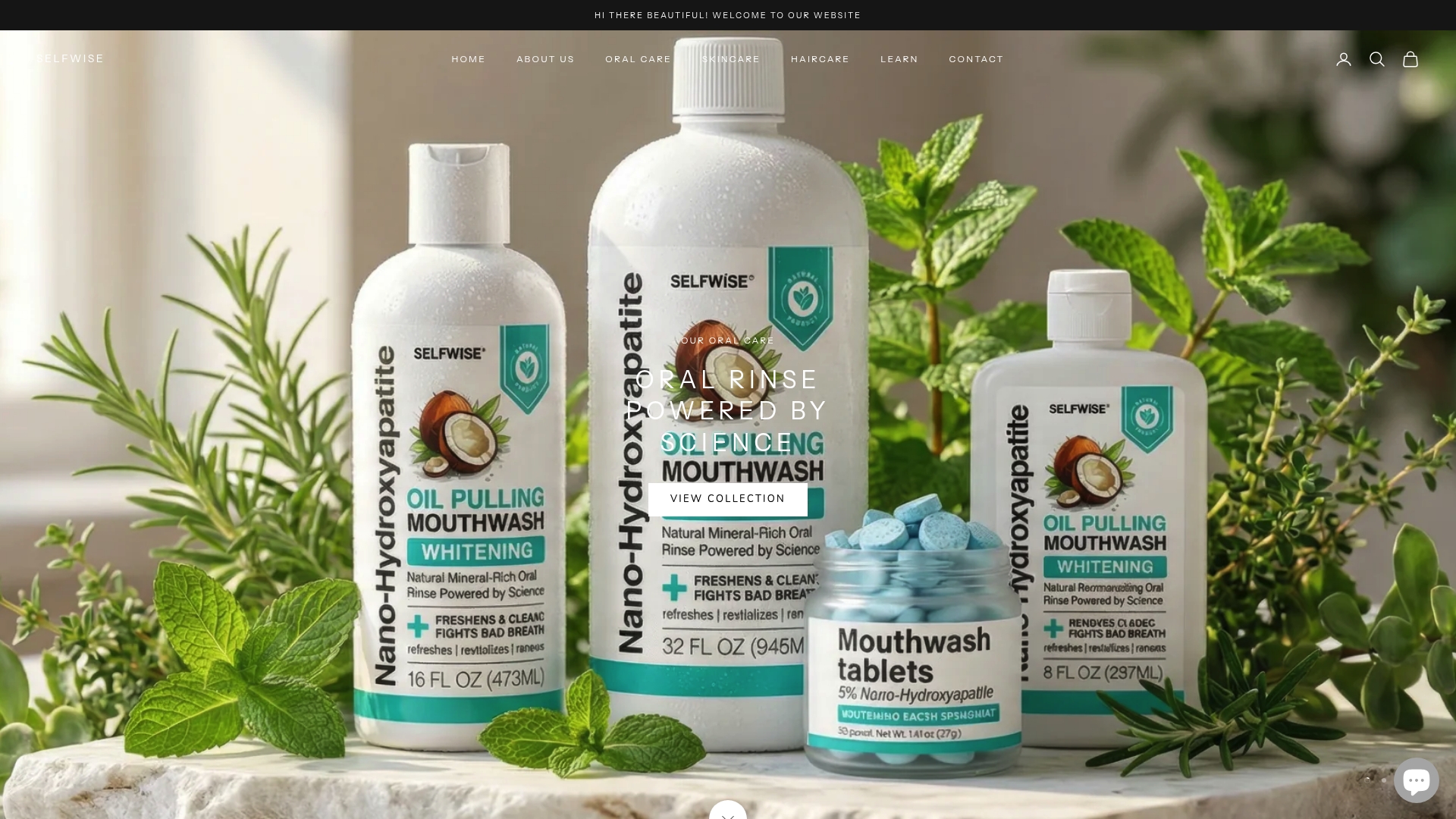
At Selfwise, every product is formulated with clean, effective ingredients that you can actually pronounce. No harsh detergents, no unnecessary fillers. Just science-backed minerals in their most bioavailable forms. Our nano hydroxyapatite mouthwash tablets are a perfect starting point for anyone who wants an easy, mess-free way to add nHA remineralization to their daily routine, especially after meals or on the go. For a more immersive experience, try our oil pulling mouthwash, which combines the ancient practice of oil pulling with the remineralizing power of nHA. Browse the full fluoride-free oral care collection to find the complete routine that works for your teeth.
Frequently asked questions
Is nano hydroxyapatite toothpaste safe for children?
Yes, nHA is safe if swallowed and is not absorbed through oral tissue, making it a suitable option for children at any age with appropriate adult supervision.
How does nano hydroxyapatite compare to fluoride for remineralizing teeth?
Research shows that nHA at 10% concentration is comparable to fluoride for remineralization, making it a credible fluoride-free alternative for daily use.
Can I use nano hydroxyapatite products daily?
Absolutely. Daily use is the whole point. Brushing twice daily for 2 minutes delivers the most consistent remineralization benefit and is more effective than mouthwash use alone.
Do dentists recommend nano hydroxyapatite toothpaste?
Many dentists recommend nHA for patients with low-to-moderate cavity risk, sensitivity, or those avoiding fluoride, though it’s not yet ADA or FDA approved specifically as an anti-cavity agent.