Protect Your Crowns With a Safe 5–10 Minute Oil Pulling Routine
Generally, yes. Oil pulling is safe for most well-fitted, modern crowns when you swish gently rather than aggressively. The real caveats involve older or loose restorations, recent oral surgery, and mercury amalgam fillings. If your crown is more than a few years old, feels off in any way, or you have amalgam fillings nearby, talk to your dentist before adding oil pulling to your routine.
TL;DR:
- Oil pulling is safe with most well-fitted crowns made of porcelain, zirconia, or titanium, especially if swished gently and for short durations.
- Older crowns, crowns with visible gaps, or those placed over amalgam fillings may pose a higher risk of bacterial infiltration or chemical interaction, warranting a dentist consultation.
- Vigorous swishing can mechanically stress compromised crowns, but normal, gentle swishing does not pose a chemical threat to dental cements or crown materials.
- Oil pulling is unlikely to affect well-sealed crowns or modern fillings, but caution is advised with loose restorations or amalgam fillings due to possible mercury concerns.
- For safety and maximum benefit, limit oil pulling to 5–10 minutes with pre-measured oils, avoid it after recent dental procedures, and always inform your dentist of your routine.
Table of Contents
- Can You Do Oil Pulling With Crowns, Bridges, and Implants?
- How Could Oil Pulling Affect Crowns and Fillings? The Actual Mechanisms
- Risks, Side Effects, and Red Flags to Watch For
- How to Oil Pull Safely if You Have Crowns
- What Does the Research Actually Show About Oil Pulling?
- When Should You Talk to Your Dentist About Oil Pulling?
- The Selfwise Take: Oil Pulling as a Smart Adjunct, Not a Miracle Fix
- Try a Formulated Oil-Pulling Mouthwash Built for Consistency
- Key Studies and Resources Cited
- Sources
- FAQ
Can You Do Oil Pulling With Crowns, Bridges, and Implants?
The materials your dentist used to build your crown are almost certainly not going to react with a tablespoon of coconut or sesame oil. Porcelain, zirconia, and titanium (the standard materials for crowns, bridges, and implants) are chemically inert. They do not absorb oil, soften, or break down through contact with fats. If crown damage from oil pulling were a common problem, dental journals would be full of case reports. They are not.
The actual point of vulnerability isn’t the crown itself. It’s the margin, meaning the microscopic seam where the crown meets your natural tooth and gets sealed with dental cement. A well-placed crown has a tight, continuous seal at that margin. An older crown, one that has developed a small gap, or one that was never perfectly seated to begin with, is a different story. That’s where bacteria can sneak in and cause decay underneath the restoration, and it’s also, in theory, where any liquid you swish around your mouth for extended periods could find its way somewhere it shouldn’t.
Screw-retained implant crowns add a wrinkle worth knowing about. Because they attach mechanically rather than with cement, there’s no margin seal to worry about at all. Cemented crowns and bridges are the ones where seal integrity actually matters.
Here’s a quick way to think about your own risk level:
- Low risk: Crown or bridge placed within the last few years, no sensitivity, no visible gaps, feels solid when you bite down.
- Check with your dentist first: Crown is older, you’ve noticed a rough edge or gap with your tongue, you feel any looseness, or you’ve had recent dental work in that area.
- Also check first: You have mercury amalgam fillings elsewhere in your mouth, even if your crowns themselves are fine.
If you fall into the low-risk category, gentle oil pulling is unlikely to cause any material harm to your crown. If you’re unsure which category you’re in, that uncertainty is itself the answer: ask before you start.
How Could Oil Pulling Affect Crowns and Fillings? The Actual Mechanisms
Two different worries get lumped together when people ask if oil pulling is risky for crowns, and they deserve separate answers.
The first is mechanical stress. Vigorous, aggressive swishing, the kind where you’re really working your jaw, can theoretically put pressure on a crown that already has a compromised margin or is coming loose. This isn’t about the oil itself doing anything; it’s about the physical motion aggravating something that was already a weak point. Gentle swishing removes this concern almost entirely.
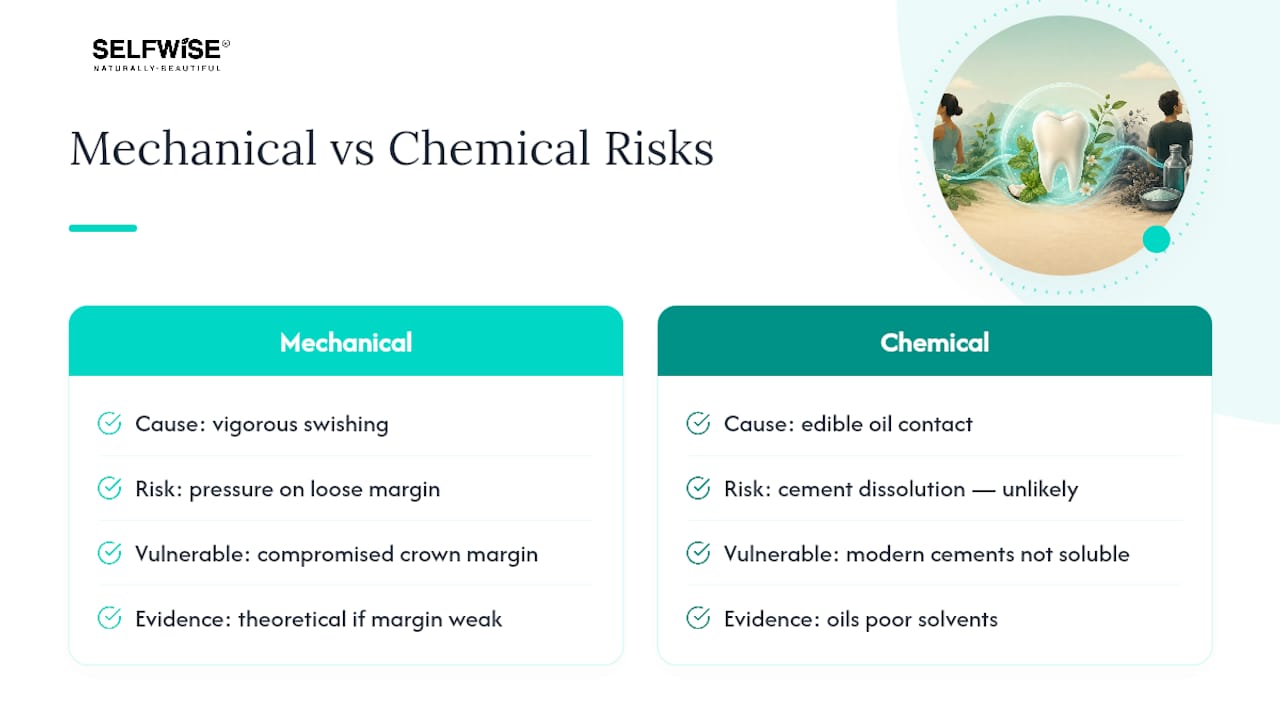
The second is chemical solvency, meaning whether oil could dissolve the cement holding a crown in place. Modern dental cements, resin-based and glass ionomer varieties among them, are not designed to be soluble in edible oils. Oil is a poor solvent for these materials. Titanium, zirconia, and porcelain are inert to it as well, so there’s no real chemical pathway for coconut or sesame oil sitting in your mouth for fifteen minutes to eat through a bonded crown.
Where things get murkier is the mercury amalgam theory floating around in some oil-pulling circles: the idea that swishing with oil could pull mercury out of old amalgam fillings because mercury is fat-soluble. This is a theoretical concern rather than a demonstrated one in clinical research, and it applies to amalgam fillings specifically, not to crowns made of porcelain or zirconia. If you have amalgam fillings and this worries you, it’s a reasonable thing to raise with your dentist rather than something to self-diagnose.
Pro Tip: If you’re at all nervous about an older crown, do a “test swish” with plain water first. If you feel any looseness, sharp edges, or shifting, that’s your answer, regardless of what you swish with next.
Risks, Side Effects, and Red Flags to Watch For
Most of the real risk in oil pulling has nothing to do with your crowns specifically. It has to do with technique and timing.
- Aspiration risk. Swishing oil for extended periods, especially while talking, lying down, or multitasking, raises the chance of accidentally inhaling small amounts. In rare documented cases, aspirated oil has led to lipoid pneumonia, a lung inflammation caused by fat particles. The fix is straightforward: stay upright, swish gently, and don’t talk with oil in your mouth.
- Recent oral surgery. If you’ve just had a crown placed, an implant seated, or any oral surgery, skip oil pulling until your dentist clears you. Healing tissue and fresh cement need time to set without added movement or pressure.
- Loose or failing restorations. A crown that already wiggles or has a visible gap should be evaluated before you start any new swishing routine, oil-based or otherwise.
- Masking symptoms. Oil pulling can freshen breath and reduce surface bacteria, which can create a false sense that everything under a crown is fine. If you have pain, sensitivity, or odor near a restoration, oil pulling is not a substitute for having it checked. Dental professionals are consistently clear that oil pulling should never replace routine dental care or delay treatment for an active problem.
- Children. Young kids often can’t reliably swish and spit without swallowing, which makes oil pulling a poor fit for them regardless of restoration status.
How to Oil Pull Safely if You Have Crowns
If your crowns and bridges check out as low risk, here’s a routine built specifically to minimize any theoretical stress on restorations while still getting the benefit.
- Pick your oil. Coconut oil and sesame oil both have research behind them, and either is a reasonable starting point. If you’d rather skip measuring and mixing, a formulated oil-pulling mouthwash doses the oil for you, which removes the guesswork of “how much is a tablespoon, really.”
- Use about a tablespoon. Too much oil makes swishing awkward and increases the odds you’ll need to spit early or risk gagging.
- Swish gently, not aggressively. Slow, easy movements. You’re not trying to work out a piece of stuck food; you’re coating your teeth and gums.
- Time it to your comfort level. The traditional recommendation runs 15 to 20 minutes, but if you’re at all concerned about an older crown or just new to the practice, a conservative 5 to 10 minutes is a fine place to start.
- Spit into the trash, not the sink. Oil can clog pipes over time.
- Rinse with water, then brush and floss normally. Oil pulling supplements your regular routine; it doesn’t replace it.
- Aim for daily or near-daily use, and bring it up at your next dental checkup so your dentist can factor it into how they’re monitoring your restorations.
Pro Tip: Do your oil pulling before brushing, not after. Swishing first loosens surface debris, and brushing afterward clears it away instead of just pushing it around.
For anyone shopping around for oil options, this evidence-based guide to oil choice breaks down how coconut, sesame, and sunflower oil compare.
What Does the Research Actually Show About Oil Pulling?
The clinical evidence on oil pulling is more mixed than most wellness blogs let on, and that mix is worth understanding before you decide how much to expect from it.
A 2022 meta-analysis of randomized trials found that oil pulling reduces salivary bacterial colony counts compared with doing nothing. However, the same analysis did not find a consistent significant difference in plaque index or gingival index across the pooled studies, meaning the bacteria count drops, but that doesn’t always translate into visibly less plaque or healthier-looking gums.
More recent research complicates the picture in a good way. A randomized, examiner-blinded study tracking daily sesame oil pulling over eight weeks found a greater reduction in full-mouth plaque compared to distilled water swishing alone; this difference was statistically significant. The biggest gains showed up on anterior and approximal tooth surfaces, the spots that are notoriously hard to reach with a toothbrush alone.
A few things temper how much weight to put on any single study:
- Trials use different oils, different durations, and different comparison groups (water versus chlorhexidine versus nothing), which makes results hard to stack against each other.
- Sample sizes tend to be small, and protocols aren’t standardized across research groups.
- Advanced periodontal disease and implant cases are often excluded from trial enrollment, so there’s limited direct evidence for how oil pulling performs on more complex restoration situations.
The honest read: oil pulling looks like a legitimate adjunct for reducing bacterial load and modestly improving plaque in some studies, not a treatment that replaces brushing, flossing, or professional cleanings. Researchers and dental commentators have compared it to a Band-Aid, useful for surface-level support, but incapable of resolving deeper issues like subgingival disease. If you want a deeper breakdown of the mechanism behind the plaque numbers, this look at why oil pulling reduces plaque walks through it.
When Should You Talk to Your Dentist About Oil Pulling?
Certain symptoms mean you should call your dentist rather than wait for your next scheduled cleaning.
- New looseness or movement in a crown or bridge
- Sensitivity that wasn’t there before, especially to hot or cold
- Persistent pain near a restoration
- Swelling, tenderness, or an unusual taste near a crown
When you do talk to them, mention how often you oil pull, which oil you use, and when any symptoms started relative to when you began the practice. That timeline helps your dentist rule things in or out quickly. If something feels wrong, pause oil pulling and get evaluated before restarting, rather than trying to wait it out.
The Selfwise Take: Oil Pulling as a Smart Adjunct, Not a Miracle Fix
Oil pulling earns its place in an natural oral care routine when it’s treated as what the research actually supports: a gentle assist, not a cure. For readers with sound, well-sealed crowns, there’s no compelling reason to avoid it. The mistake is expecting it to fix a problem that needs a dentist’s attention, or swishing so hard you stress a margin that was already compromised. Technique and honesty about your own dental history matter more than which oil sits in the bottle.
— Viktor
Try a Formulated Oil-Pulling Mouthwash Built for Consistency
Selfwise makes oil pulling simpler for exactly the situation this article walks through: you want the benefits without second-guessing your measurements or your technique. The nano hydroxyapatite oil pulling mouthwash is pre-formulated, so there’s no eyeballing a tablespoon or wondering if you used too much coconut oil.
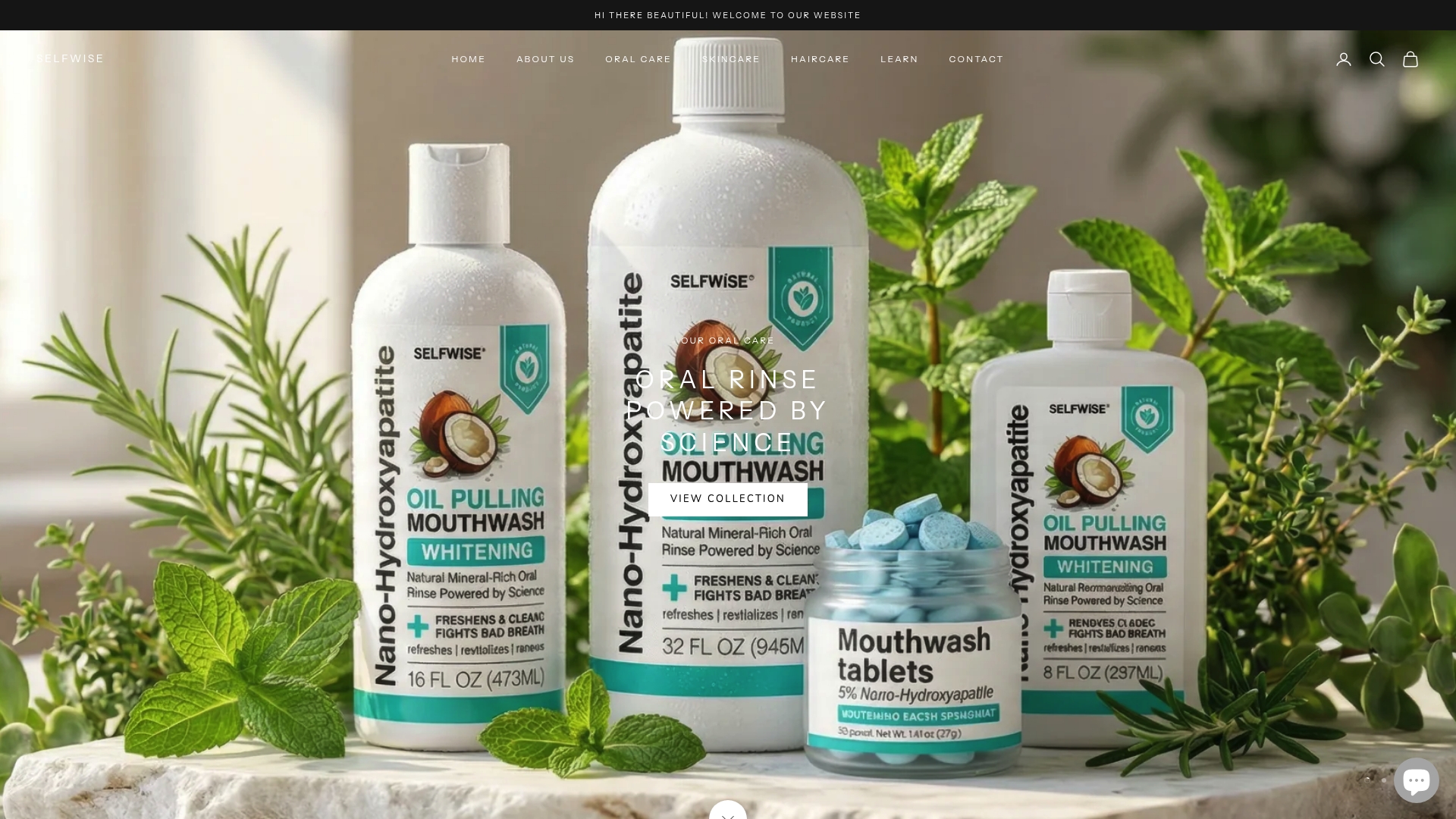
It’s fluoride-free and alcohol-free, built around nano hydroxyapatite for enamel support alongside the oil-pulling base, which fits naturally into the gentle, crown-conscious routine outlined above. If pre-measured convenience matters more to you than mixing your own oils, the mouthwash tablets offer a travel-friendly alternative worth a look, or browse the full mouthwash collection to compare options. Pick the format that fits your routine and add it to your next order.
Key Studies and Resources Cited
- Effectiveness of Oil Pulling for Improving Oral Health: A Meta-Analysis: pooled trial data on bacterial, plaque, and gingival outcomes
- Sesame oil plaque-reduction RCT: eight-week randomized study on full-mouth plaque index
- CU Anschutz commentary on oil pulling: clinical perspective on limits and appropriate use
- Case reports on oil aspiration and lipoid pneumonia: safety background for swishing technique
- Crowns and bridges materials overview: clinician-facing explanation of restoration types
Sources
- Effectiveness of Oil Pulling for Improving Oral Health: A Meta-Analysis
- The plaque reducing efficacy of oil pulling with sesame oil: a randomized-controlled clinical study | Clinical Oral Investigations
FAQ
Why Do Dentists Not Recommend Oil Pulling?
Most dentists aren’t against oil pulling outright; they’re cautious about it being used as a replacement for brushing, flossing, and professional cleanings rather than an addition to them, since it cannot treat active decay or gum disease.
Is It Harder to Pull a Tooth With a Crown?
This question usually refers to tooth extraction, not oil pulling, and yes, extracting a tooth with a crown can be more complex because the crown itself may need to be considered or removed during the procedure; it has no connection to swishing oil.
Does Oil Pulling Remove Tartar?
No. Tartar is hardened, calcified plaque that has bonded to the tooth surface, and only professional scaling can remove it; oil pulling may reduce surface bacteria and soft plaque but does not dissolve tartar.
Does Oil Pulling Mess With Fillings?
Standard edible oils are not solvents for modern filling materials or dental cements, so gentle oil pulling is unlikely to affect a well-placed filling; the caveat is older amalgam fillings, where some raise theoretical fat-solubility concerns worth discussing with your dentist.
Can You Oil Pull With Dental Implants?
Yes, gentle oil pulling is generally fine with dental implants, since titanium is chemically inert; screw-retained implant crowns have no cement margin at all, which removes one of the main theoretical risk points that applies to traditional crowns.