SCCS Limits for Consumers: Nano Hydroxyapatite Safe to 29.5%
Nano hydroxyapatite is safe for oral care use when the particles are properly characterized and kept within tested concentration limits, according to the Scientific Committee on Consumer Safety (SCCS). The verdict comes with real conditions attached: particle shape, size, and coating status all change the risk profile. Get those specs wrong, and “safe” stops applying.
TL;DR:
- The safety of nano hydroxyapatite depends on proper particle shape, size, coating, and concentration, with rod-shaped uncoated particles up to 122 nanometers being deemed safe.
- Most safety concerns stem from older studies using poorly characterized or irregularly shaped particles, not from well-characterized, standardized tests showing safety at regulated levels.
- Regulatory limits specify up to 29.5% in toothpaste and 10% in mouthwash only for specific particle geometries and uncoated, rod-shaped particles, excluding other forms like needle-shaped or coated variants.
- Clinical trials at 10-15% concentrations demonstrate the ingredient’s effectiveness in reducing dentin hypersensitivity with no safety issues reported during short-term use.
- Consumers should verify particle shape, coating, and concentration on product labels or datasheets, as many marketed products do not meet the specific criteria tested by regulatory authorities.
Table of Contents
- What the Scientific Evidence Shows About Nano Hydroxyapatite Safety
- Regulatory Conclusions and the Exact Limits They Set
- How Particle Size, Shape, and Coatings Change the Safety Picture
- Human Clinical Evidence on Safety and Efficacy
- How to Choose a Nano Hydroxyapatite Product Safely
- How Selfwisebrand Approaches Nano Hydroxyapatite Formulation
- Where to Read the Original Safety Data
- The Regulatory Shift Nobody’s Talking About Enough
- Sources
- FAQ
What the Scientific Evidence Shows About Nano Hydroxyapatite Safety
Most of the alarm around nano hydroxyapatite traces back to older, poorly documented studies where researchers never specified what shape or size particle they actually tested. That gap matters more than it sounds. A 2023 review covering nanohydroxyapatite in dentistry found few consistent signs of cytotoxicity across the well-characterized studies, while isolated reports of cells absorbing particles tended to trace back to materials nobody had properly measured or classified before testing.
That distinction between “characterized” and “uncharacterized” material runs through nearly every safety debate on this ingredient. When a lab knows exactly what shape, size, and surface chemistry it put into a petri dish, the results tend to look reassuring. When a study just says “nano hydroxyapatite” without specifying the particle geometry, results become far less predictable, and far less useful for judging real products.
Statistic Callout: A Scientific Reports study tested a commercial rod-shaped nano-HAp material against human gingival fibroblasts and found it cytocompatible, meaning the cells stayed viable and functional. The same material also passed HET-CAM assays, a standard test that checks for irritation on a membrane model, with no irritation detected under exposure conditions meant to simulate normal brushing.
That single study captures the pattern seen across multiple labs:
- Gingival fibroblast models (the cells that make up your gum connective tissue) showed no drop in viability at concentrations used in real toothpaste and mouthwash formulas.
- Three-dimensional oral mucosa models, which better mimic how your cheek and gum tissue actually behave than a flat cell culture, also showed no irritation at realistic exposure levels.
- HET-CAM testing, borrowed from ophthalmic and dermal safety science, found no mucosal irritation in the tested rod-shaped samples.
- Broader reviews of oral mucosa cytotoxicity data reached the same conclusion: nano-HAp at product-relevant concentrations does not reduce tissue viability after typical use durations, according to research summarized in in vitro oral mucosa studies.
None of this means every nano-HAp product on a shelf has been tested this thoroughly. It means the materials that have been tested this way, using standardized assays and characterized particles, keep coming back clean. The older, scarier headlines about hydroxyapatite toxicity almost always trace back to studies using needle-shaped particles or materials with no documented size distribution at all. Shape turns out to be doing most of the work in these safety differences, which is exactly what the next section digs into.
Regulatory Conclusions and the Exact Limits They Set
The SCCS didn’t just say “nano hydroxyapatite is fine.” It set numbers. The committee concluded that hydroxyapatite (nano) is safe in toothpaste at concentrations up to 29.5% and in mouthwash up to 10%, provided the particles meet a specific set of morphological requirements.
That last clause is the one most marketing copy skips. The opinion doesn’t cover “nano hydroxyapatite” as a generic category. It covers a particular type of particle, defined with real precision:
- Rod-shaped particles only, not needles, plates, or irregular fragments.
- A maximum particle length of roughly 122 ± 43 nanometers, meaning most particles cluster tightly around that size rather than spanning a wide range.
- Constrained aspect ratio (the ratio of a particle’s length to its width), which limits how elongated or needle-like the rods can be.
- Uncoated surfaces. Coated variants and other manufacturing modifications fall outside the scope of this specific opinion.
Toothpaste sits on teeth briefly and gets rinsed away, while mouthwash bathes broader oral tissue, including mucous membranes, for the length of a rinse. The RIVM public health summary of the SCCS findings notes that high-quality in vitro data showed no mutagenic hazard, cytotoxicity, or inflammatory response for the assessed materials at these respective exposure routes.
Here’s what the opinion explicitly does not bless: needle-shaped hydroxyapatite particles, coated nanoparticles, and any manufacturing variant that hasn’t been separately assessed against the same battery of tests. A brand can legally call its ingredient “nano hydroxyapatite” while using a particle shape the SCCS never evaluated. That’s not illegal labeling, but it does mean the regulatory safety finding doesn’t automatically transfer. Reading past the marketing claim to the actual particle specification is the only way to know whether a product falls inside or outside the tested envelope.
How Particle Size, Shape, and Coatings Change the Safety Picture
Shape is the variable doing the heavy lifting in nearly every hydroxyapatite toxicity debate. Needle-shaped nanoparticles carry a mechanical risk that rod-shaped particles largely avoid: a sharp, elongated structure can physically pierce or stress a cell membrane in ways a smooth, short rod simply can’t. Some studies have linked needle-like morphologies to elevated genotoxic signals, and that pattern is exactly why regulators drew their safety line at particle geometry rather than at the ingredient name alone.
Three physical properties drive most of the difference between a benign particle and a concerning one.
- Aspect ratio. A high aspect ratio (long and thin) increases surface contact with cell membranes and raises the odds of mechanical disruption compared to a short, blunt rod.
- Surface area. Smaller particles pack more surface area into the same mass, which can influence how much material interacts with tissue and how readily it dissolves.
- Coatings. A surface coating changes dissolution rate, cellular uptake, and the potential for reactive oxygen species (ROS) generation, a marker of oxidative cell stress. Coated particles need their own safety evaluation because a coating can make an otherwise well-behaved particle core behave differently.
None of these factors act alone. A rod-shaped particle with a narrow aspect ratio and no coating, the exact profile the SCCS opinion describes, minimizes membrane stress, keeps surface area predictable, and avoids the added variable a coating introduces. Change any one of those three properties and you’re technically looking at a different safety question, even if the label still reads “hydroxyapatite.”
Pro Tip: When you see “nano hydroxyapatite” on an ingredient list, that phrase alone tells you almost nothing about safety. The particle shape and coating status are what determine whether a product falls inside the tested, regulator-approved profile.
This is also where formulation choices on the manufacturing side matter more than most consumers realize. A brand that controls its synthesis process tightly enough to produce consistently rod-shaped, uncoated particles with a narrow size distribution can more closely replicate the exact material regulators evaluated. A brand that sources cheaper, less-controlled material with a broader size range or an irregular shape mix is technically selling a different substance under the same ingredient name, even though nothing on the label distinguishes the two.
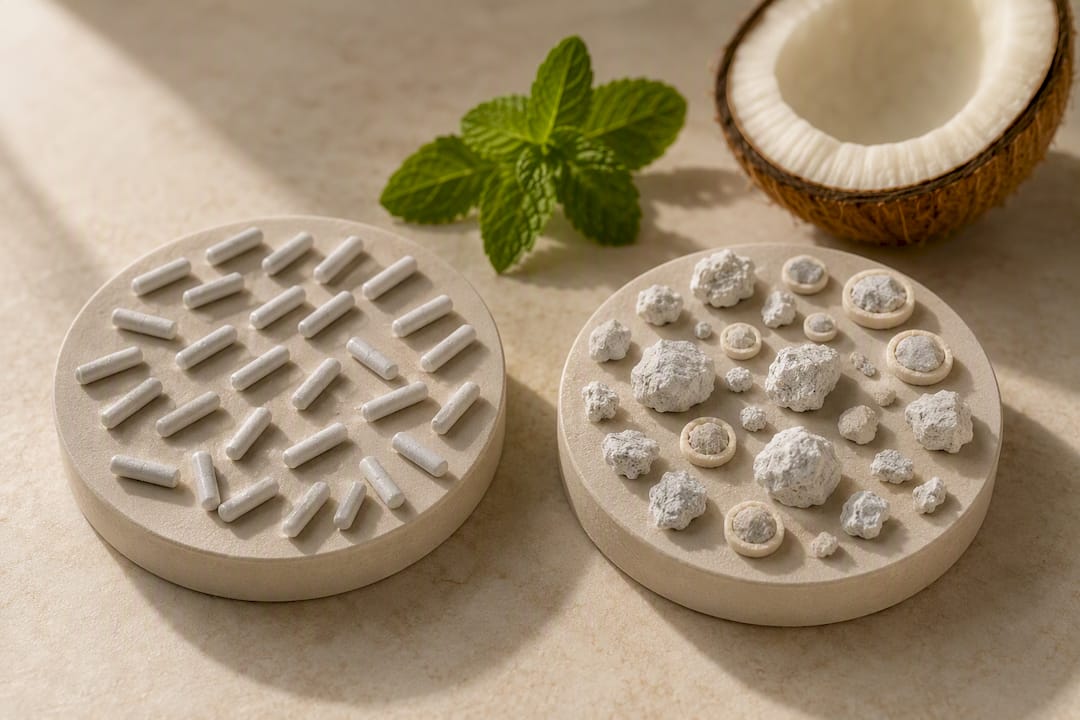
For manufacturers, this translates into a practical obligation: safety claims should come with particle characterization data, not just a category name. For readers, it translates into a label-reading habit worth building. The next section covers what that habit looks like in practice, but the short version is this: shape and coating status are the two questions worth asking before concentration.
Human Clinical Evidence on Safety and Efficacy
Lab data tells you what happens to cells in a dish. Clinical trials tell you what happens in an actual mouth, which is the evidence most readers actually want.
A randomized, double-blind trial testing toothpastes with 10% and 15% nano-HAp concentrations found both formulations reduced dentin hypersensitivity, the sharp, short pain triggered by cold, heat, or sweet stimuli, comparably to a commercial desensitizing dentifrice. Patients rated their pain using a visual analog scale, and both nano-HAp concentrations produced statistically significant reductions. No significant safety concerns turned up in the trial’s reporting at either concentration.
That trial matters for two reasons. First, it confirms the ingredient does something functional beyond a marketing claim; sensitivity relief is a real, measurable clinical outcome, not a subjective feeling. Second, it demonstrates safety data collected directly from human use at concentrations toothpaste brands actually sell, rather than relying entirely on cell-culture extrapolation.
Where the evidence gets thinner is anticaries research, the data on whether nano-HAp actually prevents cavities as effectively as fluoride. The signal here is promising but not yet built on the decades of large-scale, long-term trials that back fluoride’s cavity-prevention track record. That’s not a strike against the ingredient. It’s a reflection of how much longer fluoride has been studied, and a fair caveat for anyone comparing the two head to head.
A few limitations worth keeping in mind when you read clinical trial claims for nano-HAp products:
- Sample sizes in most published trials run smaller than the pivotal fluoride studies that shaped modern dental guidelines.
- Follow-up periods tend to run weeks to a few months, not the multi-year windows some fluoride research covers.
- Formulation variability between studies makes direct comparisons tricky. A 10% nano-HAp toothpaste from one manufacturer isn’t guaranteed to behave like a 10% formula from another, especially if particle shape or coating differs.
None of this undercuts the sensitivity-relief findings, which are genuinely solid. It does mean anyone expecting nano-HAp to have the same decades-deep evidence base as fluoride for cavity prevention should calibrate expectations accordingly, especially in the near term as more long-term trials accumulate.
How to Choose a Nano Hydroxyapatite Product Safely
Reading a label the right way takes about thirty seconds once you know what to look for. Here’s the practical checklist that translates the regulatory and clinical data into something you can actually use at the store or checkout page.
- Check the concentration. Clinical trials showing sensitivity relief used 10% to 15% nano-HAp. The SCCS tested toothpaste up to 29.5% and mouthwash up to 10%. If a product lists a concentration, compare it against those ranges; if it doesn’t list one at all, that’s a gap worth noting.
- Look for particle characterization. Credible brands sometimes publish technical datasheets or safety summaries describing particle shape and size. A product that only says “contains nano hydroxyapatite” with nothing more is asking you to trust a name rather than a specification.
- Follow the directions and avoid swallowing. Oral care products are formulated for topical use in the mouth, not ingestion. If a small amount is swallowed accidentally, gastric dissolution studies suggest hydroxyapatite particles dissolve rapidly in simulated gastric fluid, which limits concern about nanoparticle-specific systemic exposure from an isolated accidental swallow.
- Supervise young children. Toddlers and infants swallow toothpaste reflexively rather than spitting it out. Standard pediatric toothpaste guidance, using a rice-grain or pea-sized amount depending on age, applies to nano-HAp formulas just as it does to fluoride ones.
- Flag open wounds or immune compromise. Anyone with active oral sores, recent oral surgery, or a compromised immune system should run any new oral care product past a dentist first, regardless of which active ingredient it contains.
- Watch for red flags in marketing copy. Vague “nano” claims with no characterization data, no stated concentration, or hints of needle-shaped particle structure are all signs a product sits outside the evidence base this article covers.
Pro Tip: If a product page doesn’t mention particle shape, concentration, or a link to safety data, it’s fair to email the brand and ask directly. A company confident in its formulation should have a straightforward answer.
How Selfwisebrand Approaches Nano Hydroxyapatite Formulation
A brand’s nano-HAp formulas often focus on key variables regulators flagged as decisive: particle shape, coating status, and concentration. That’s not a coincidence. It’s the practical takeaway from everything the SCCS opinion and the underlying lab studies point toward, and it’s why formulation details show up front and center rather than buried in fine print.
The brand’s nano hydroxyapatite mouthwash tablets are formulated without fluoride, alcohol, or harsh chemical additives, giving people who want a nanoparticle-based remineralizing option a fluoride-free path that still leans on the ingredient science covered above. For readers curious about how the ingredient behaves in a rinse-based delivery format rather than a paste, the nano hydroxyapatite oil pulling mouthwash combines traditional oil pulling with the same active ingredient.
Selfwisebrand also publishes plain-language breakdowns of the evidence behind how particle shape and concentration affect side-effect risk, along with a deeper look at the remineralization evidence at 10% concentration. Both resources exist so customers can check the formulation logic against the same regulatory framework this article walks through, rather than taking an ingredient name at face value. For anyone incorporating a mouthwash tablet into a daily routine for the first time, following the usage guidance on the product page, once or twice daily, dissolved with water rather than swallowed, keeps use aligned with the exposure levels the clinical trials actually tested.
Where to Read the Original Safety Data
For readers who want to check the primary sources rather than take secondhand summaries at face value, the SCCS scientific opinion on hydroxyapatite (nano) is the regulatory document setting the concentration and particle-shape limits discussed above. The RIVM public summary translates that opinion into plainer language. For the underlying science, the PMC review on nanohydroxyapatite in dentistry and the dentin hypersensitivity clinical trial cover the lab and human-trial evidence in full detail.
The Regulatory Shift Nobody’s Talking About Enough
The most underappreciated part of this whole story isn’t that nano hydroxyapatite passed a safety review. It’s how narrowly the SCCS defined what actually passed. Most coverage of the opinion treats it as a blanket endorsement of “nano hydroxyapatite” as an ingredient category, when the committee was explicit about shape, size, and coating status. That’s a meaningful gap between what got approved and what gets marketed.
Conventional advice tends to stop at “check if it’s fluoride-free” or “look for nano-HAp on the label.” That’s not wrong, but it’s incomplete. The particle geometry question matters just as much, and almost no consumer-facing content asks it. If you take one thing from the regulatory and lab data covered here, prioritize checking whether a brand can speak to particle shape and concentration, not just whether the ingredient name appears on the box. That single habit does more to separate a well-characterized product from a vague one than any other label check available to a shopper right now.
— Viktor
This article is general information, not a substitute for advice from a qualified doctor. Consult a qualified healthcare professional about your own circumstances before acting on anything here.
Sources
- SCCS scientific opinion on hydroxyapatite (nano)
- Nanohydroxyapatite in dentistry: A comprehensive review
- New safety data confirms hydroxyapatite in nanoform is safe for oral care products | RIVM
- Nano-hydroxyapatite in oral care cosmetics: characterization and cytotoxicity assessment | Scientific Reports
FAQ
Why don’t dentists recommend hydroxyapatite more often?
Fluoride has decades more large-scale clinical trial data behind it for cavity prevention, so many dentists default to familiar, long-studied recommendations. Nano hydroxyapatite’s clinical evidence for sensitivity relief is solid, but its long-term anticaries data is still catching up.
Can nano hydroxyapatite cause health issues?
Well-characterized, rod-shaped, uncoated nano-HAp particles tested within SCCS concentration limits have not shown cytotoxic, irritant, or mutagenic effects in lab and clinical studies. Poorly characterized or needle-shaped particles are the versions linked to safety concerns in older research.
Does nano hydroxyapatite get into your bloodstream?
Gastric dissolution studies show hydroxyapatite nanoparticles dissolve rapidly in simulated gastric fluid, which limits the likelihood of intact nanoparticles entering systemic circulation after accidental swallowing during normal oral care use.
What are the downsides of hydroxyapatite toothpaste?
The main downside is inconsistency across brands: without published particle characterization or concentration data, you can’t verify whether a given product matches the shape and size profile regulators actually tested. Clinical evidence for cavity prevention is also less extensive than fluoride’s long-term trial record.
Is nano hydroxyapatite safe for children?
Standard pediatric toothpaste guidance, small amounts, supervised brushing, and spitting rather than swallowing, applies to nano-HAp formulas the same way it applies to fluoride toothpaste, since young children are more likely to swallow product during brushing.