2–8 Weeks Relief With Nano Hydroxyapatite for Sensitive Teeth
Yes, nano hydroxyapatite reduces dentin hypersensitivity for most people who use it consistently, and the clinical trial data backs that up with real numbers, not marketing claims. Some trials show noticeable relief within 48 hours, with steadier, more reliable improvement building over two to eight weeks of twice-daily use. It works alongside good dental habits, not instead of them, and it will not fix sensitivity caused by decay, a cracked tooth, or an infection that needs a dentist’s attention.
TL;DR:
- Nano hydroxyapatite at 10% to 15% concentration can provide noticeable relief from dentin hypersensitivity, especially when combined with potassium nitrate.
- Faster results, within 48 hours, are possible with optimized formulas containing higher concentration and specific formulation tweaks like doping with magnesium or zinc.
- The majority of clinical evidence is based on controlled trials lasting up to eight weeks, showing significant improvements against common triggers like cold air and tactile stimuli.
- Safety reviews indicate no cytotoxicity or genotoxicity concerns at typical toothpaste concentrations, especially for rod-shaped nano particles, when used as directed.
- Proper use involves twice-daily gentle brushing, avoiding immediate rinsing, and selecting formulas with at least 10% nHA for effective and reliable sensitivity reduction.
Table of Contents
- What Causes Sensitivity, and How Nano Hydroxyapatite Sensitivity Relief Actually Works
- What the Clinical Trials and Reviews Actually Found
- How to Use Nano Hydroxyapatite Toothpaste for Sensitivity
- Is Nano Hydroxyapatite Safe? Addressing the Real Concerns
- When Sensitivity Needs More Than Toothpaste
- Why Selfwisebrand Talks About the Science, Not Just the Sales Pitch
- A Realistic Take on Nano Hydroxyapatite and Sensitivity
- Try Nano Hydroxyapatite Without the Fluoride or the Guesswork
- Sources
- FAQ
What Causes Sensitivity, and How Nano Hydroxyapatite Sensitivity Relief Actually Works
Sensitivity starts with exposed dentin. When enamel wears thin or gums recede, tiny channels called dentinal tubules are left uncovered, and fluid inside those tubules shifts every time you bite into ice cream or breathe in cold air. That fluid movement tugs on nerve fibers deep in the tooth, and your brain reads it as a sharp jolt of pain. This is the hydrodynamic theory of dentin sensitivity, and it explains why plugging those tubules is the whole game.
Nano hydroxyapatite is a synthetic mineral that closely resembles the natural mineral structure of tooth enamel. Because the particles are engineered at nanoscale, they are small enough to physically lodge inside dentinal tubules and settle onto the tooth surface, where they build a mineral layer that blocks fluid movement. A comprehensive review of nHA in dentistry describes this dual action clearly: the particles occlude the tubules directly, and they also act as a reservoir of calcium and phosphate ions that encourages new apatite crystals to form on the tooth over time.
That second mechanism matters more than people realize. It is not just a physical plug, like wax pressed into a crack. The mineral layer that forms is chemically similar to your own enamel, so it integrates with the tooth rather than sitting on top of it as a coating that eventually wears off.
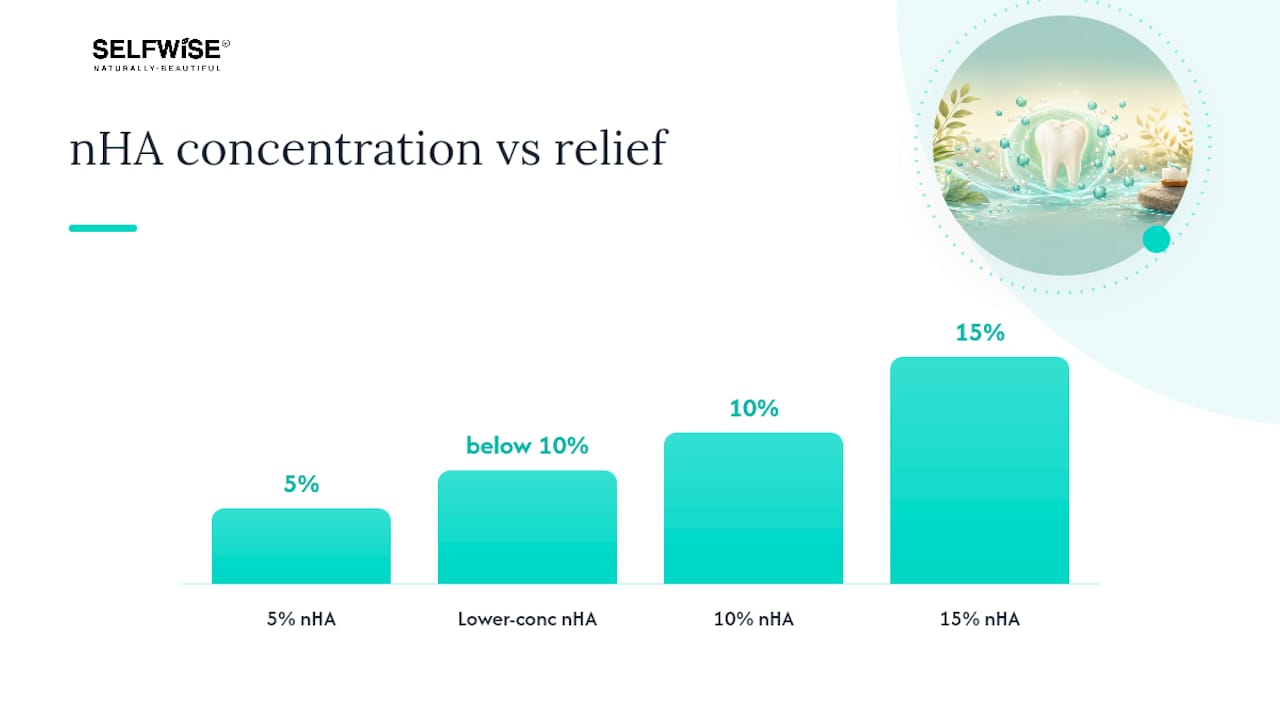
Particle size and concentration change how well this works. Larger, nonunion hydroxyapatite particles are often too big to enter the tubules at all, which is why the nano version outperforms it for this specific job. Concentration matters too:
- Lower-concentration formulas (often below 10%) provide gradual surface remineralization but slower relief for active sensitivity.
- 10% nHA formulations, especially when combined with potassium nitrate, show strong results in clinical trials for tubule occlusion.
- 15% nHA formulations tend to produce the fastest and most consistent reductions in sensitivity scores in head-to-head trials.
One clinical trial comparing zinc and magnesium doped nHA against standard nHA found the doped version produced faster reductions in Schiff sensitivity scores within two to four weeks, suggesting formulation tweaks beyond concentration alone can matter. The takeaway for anyone shopping for a toothpaste or mouthwash: check the concentration on the label, because 5% nHA and 15% nHA are not interchangeable products for treating active sensitivity.
What the Clinical Trials and Reviews Actually Found
The evidence for nHA and sensitivity is not a single study or a marketing claim recycled across blogs. It is a body of randomized controlled trials and at least one systematic review with meta-analysis, which is about as strong as evidence gets in dental research outside of large multi-year cohort studies.
The nHA formulations performed as well as or better than the CSPS toothpaste across the full eight weeks, with both nHA groups showing significant reductions in hypersensitivity scores from baseline. That trial matters because it puts nHA in direct competition with an established, widely recommended desensitizing agent rather than testing it against nothing.
Timelines from individual trials vary, but a pattern shows up repeatedly. One clinical study on a toothpaste combining nHA, potassium nitrate, sodium monofluorophosphate, and antioxidants found 52% to 76% improvement in sensitivity at 48 hours, climbing to 70% to 84% improvement at the two-week mark. Those numbers come from a specific combination formula, not from nHA in isolation, so the potassium nitrate is likely doing meaningful work alongside the nHA in that particular product.
Key clinical findings at a glance:
- 15% nHA and 10% nHA plus potassium nitrate performed comparably to CSPS toothpaste over an eight-week trial.
- One combination formula showed 52 to 76% improvement at 48 hours and 70 to 84% at two weeks.
- A single professional application of 15% nHA produced measurable relief that held up at the four-week mark in a separate clinical trial.
A systematic review and meta-analysis pooling multiple randomized trials found that n-HAP produced significantly better desensitizing effects than comparison treatments for evaporative stimuli (think a puff of cold air) and tactile stimuli (a dental probe test), with high-quality pooled evidence behind those two categories. Results for cold-stimulus testing, like biting into something frozen, were more mixed across the included studies. That distinction is worth sitting with: nHA looks strongest against the kind of everyday triggers people actually complain about, and less consistently proven against the most extreme cold challenges researchers use in a lab setting.
None of this means the evidence is flawless. The trials behind these numbers tend to run on the smaller side, typically dozens to a couple hundred participants, and follow-up windows rarely extend past eight to twelve weeks. Formulation also varies a lot between studies. A product tested at 15% nHA with potassium nitrate is a different animal than a 5% nHA rinse with no added actives, and lumping them together would be misleading. Read concentration and formulation details before assuming a study’s results apply to whatever tube is sitting in your bathroom cabinet.
How to Use Nano Hydroxyapatite Toothpaste for Sensitivity
The trials that produced these results followed a fairly consistent protocol, and matching it gives you the best shot at similar outcomes.
- Brush twice daily with an nHA toothpaste, morning and night, for at least two full minutes. This matches the dosing schedule used in the eight-week RCT and most other trials in this space.
- Use gentle pressure and a soft-bristled brush. Aggressive scrubbing near the gumline is often what exposed the dentin in the first place, and it can undo the mineral layer nHA is trying to build.
- Avoid rinsing immediately after brushing if your product’s label recommends letting it sit. A quick water rinse can wash away active particles before they’ve had a chance to settle into the tubules.
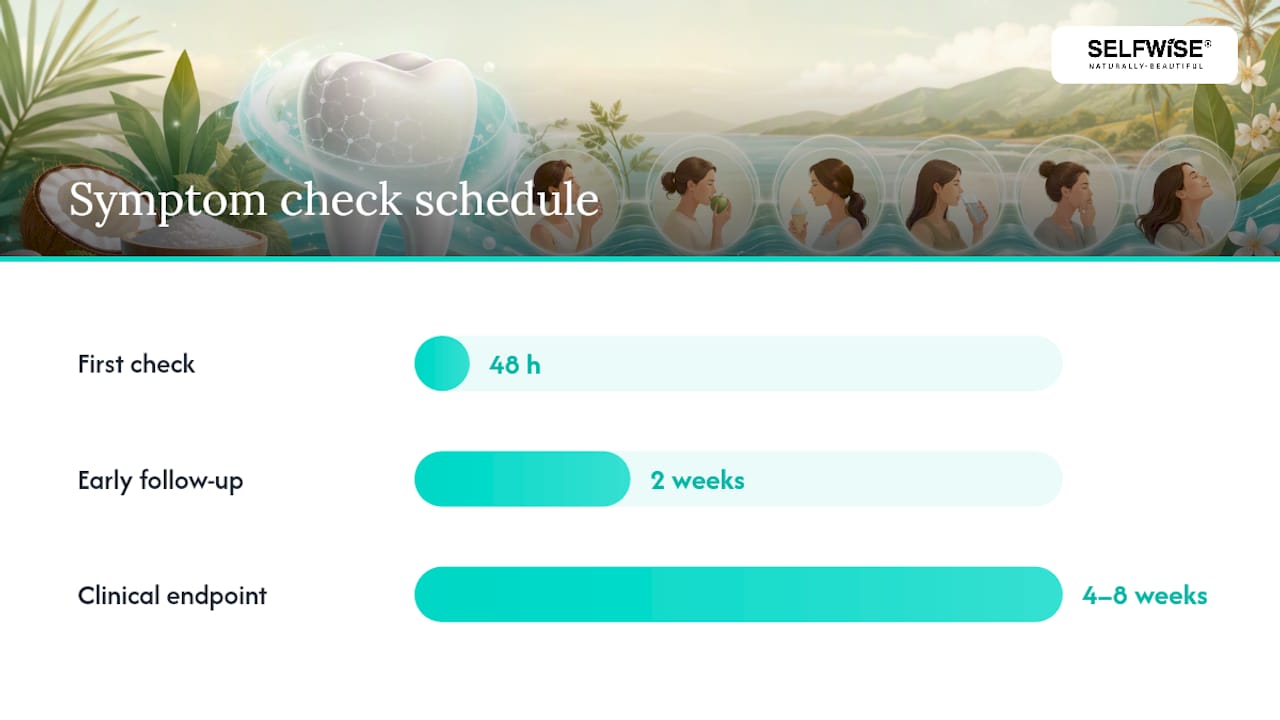
- Track your symptoms using a simple 0 to 10 scale, similar to the visual analog scale researchers use, and note it at 48 hours, two weeks, and four to eight weeks. This mirrors the check-in points used in clinical trials and gives you an honest read on whether it’s working for you specifically.
- Look for combination formulas that pair nHA with potassium nitrate if your sensitivity is significant, since that pairing shows some of the strongest early results in the research.
If your sensitivity is severe or you want faster results, ask your dentist about a professional in-office application. For guidance on picking the right concentration and building a full routine, Selfwisebrand’s breakdown of how to use nano hydroxyapatite for stronger teeth walks through product selection in more detail.
Pro Tip: If you have dental restorations like crowns, veneers, or composite fillings, nHA toothpaste is generally considered compatible since it doesn’t rely on abrasion. Still, mention any restorative work to your dentist so they can flag anything specific to your case.
Is Nano Hydroxyapatite Safe? Addressing the Real Concerns
The safety question around nHA usually comes down to one worry: nanoparticles, ingestion, and what happens if you swallow toothpaste. It’s a fair question, and it has a fairly reassuring answer backed by more than marketing copy.
Safety reviews and regulatory assessments have looked specifically at rod-shaped nano-hydroxyapatite, the form most commonly used in toothpaste and mouthwash. These reviews report no evidence of cytotoxicity, genotoxicity, or inflammatory effects at the concentrations used in consumer toothpaste products, and note that swallowed nHA dissolves in gastric fluid much like any other calcium compound. A 2025 opinion from the European Commission’s Scientific Committee on Consumer Safety reached a similar conclusion, finding no nano-specific safety concern for rod-shaped hydroxyapatite at the concentrations typically used in toothpaste and mouthwash.
That said, a few honest caveats belong here:
- Long-term ingestion data specifically in children remains limited, which is why most nHA toothpaste is labeled and marketed for adult use.
- Particle shape matters. The safety data centers on rod-shaped particles, not every possible nHA morphology, so it’s not a blanket statement covering every formulation on the market.
- Parents should follow product labels closely for pediatric use and choose products explicitly formulated and approved for children when brushing kids’ teeth.
The practical safety advice is simple: buy from brands that state their concentration and particle form, follow label directions for age and frequency, and treat “more is better” as false when it comes to unregulated or unlabeled products. Selfwisebrand’s deeper look at how particle shape affects hydroxyapatite side-effect risk covers this concentration and morphology distinction if you want to dig further.
When Sensitivity Needs More Than Toothpaste
Nano hydroxyapatite treats the symptom, not every possible cause behind it. If sensitivity comes with any of the following, skip the wait-and-see approach and book a dentist appointment:
- Pain that is constant or throbbing, rather than triggered only by hot, cold, or sweet stimuli.
- Visible dark spots, holes, or a rough texture on the tooth surface, which can signal decay.
- Swelling, fever, or a bad taste near the affected tooth, all signs of possible infection.
- Sensitivity that started right after an injury or a hard bite down on something unexpected.
- No meaningful improvement after four to eight weeks of consistent, correct nHA toothpaste use, matching the window where clinical trials show results.
A dentist can rule out cracked tooth syndrome, deep decay, or an exposed root that needs a graft or bonding rather than a topical desensitizer. Nano hydroxyapatite is genuinely effective for garden-variety sensitivity from thinning enamel or mild gum recession, but it cannot rebuild a cracked cusp or treat a cavity. For more on managing sensitivity day to day alongside professional care, this guide on fighting sensitive teeth covers the professional-care side of the equation.
Why Selfwisebrand Talks About the Science, Not Just the Sales Pitch
Sensitivity relief only means something if you understand why an ingredient works, not just that a bottle claims it does. That is the whole premise behind Selfwisebrand’s educational content, including a deeper explainer on what nano hydroxyapatite is and how it works, which lays out the mechanisms and evidence in plain language before any product ever enters the conversation.
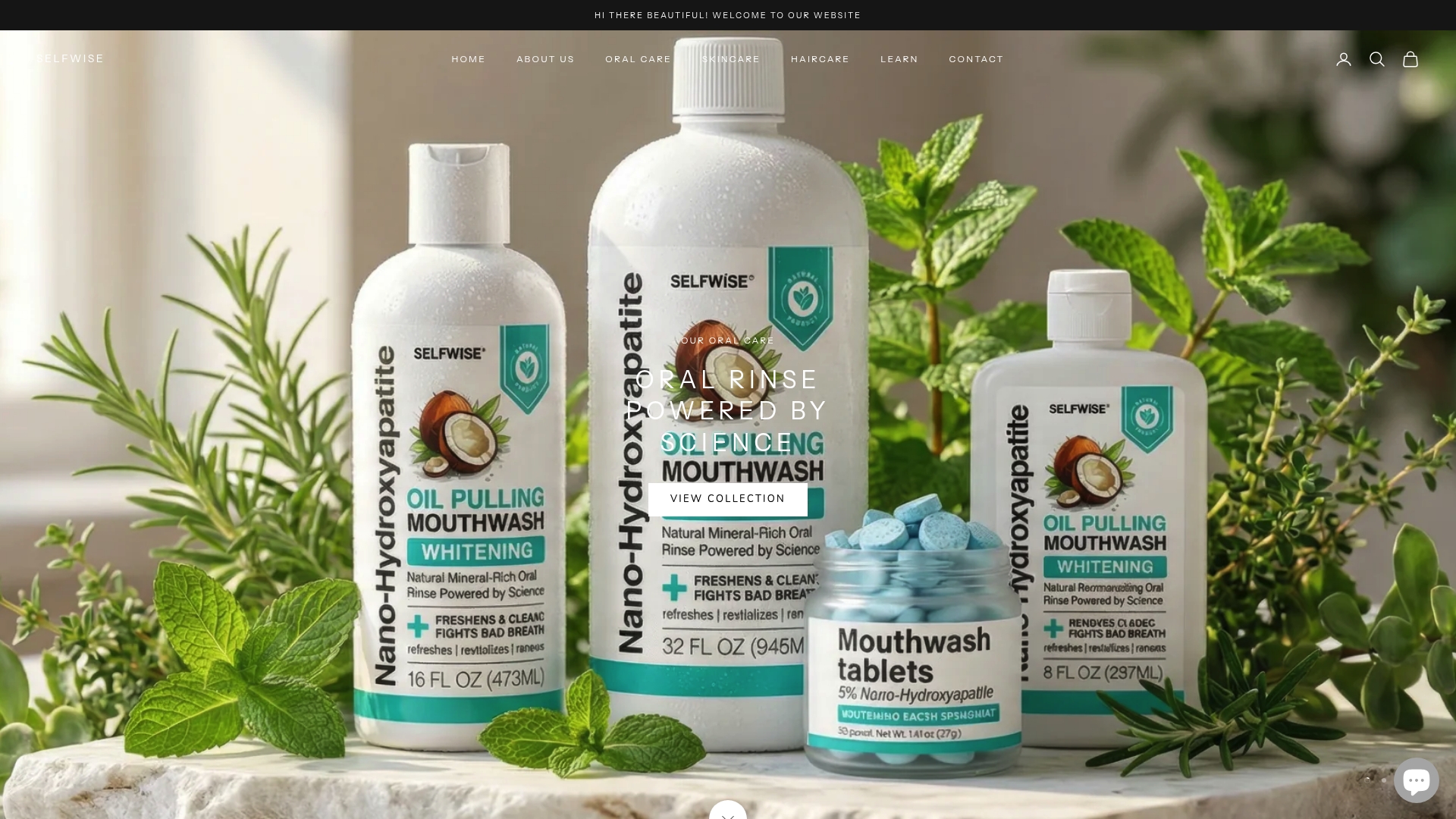
Some natural oral care brands build lines around fluoride-free nHA delivery in formats that fit different routines, such as dissolvable mouthwash tablets for people who want a mess-free rinse, and oil-pulling mouthwashes that combine nHA with the traditional practice of oil pulling. Neither format substitutes for a toothbrush and a dentist. Both exist because sensitivity relief works best when it’s easy to stick with twice a day, every day, not just when you remember.
A Realistic Take on Nano Hydroxyapatite and Sensitivity
Nano hydroxyapatite is a solid, evidence-backed first move for mild-to-moderate sensitivity, especially for people who want to skip fluoride without giving up something that actually performs in clinical trials. It won’t outrun a cavity or fix a cracked molar, and it works best paired with regular brushing, flossing, and dental checkups rather than as a replacement for them. If you’re dealing with occasional zings from cold drinks or a cold breeze, this is worth trying before anything more invasive.
— Viktor
Try Nano Hydroxyapatite Without the Fluoride or the Guesswork
Selfwisebrand builds its oral care line around the same ingredient the clinical trials above are testing, delivered in formats that fit an actual daily routine instead of sitting in a cabinet half used. The nano hydroxyapatite mouthwash tablets give you a fluoride-free rinse in solid form, no measuring, no spilling, no alcohol burn. The nano hydroxyapatite oil pulling mouthwash pairs the same remineralizing mineral with the traditional oil-pulling method for people who already work that into their morning.
If you’re ready to try a routine built on the mechanisms covered above rather than vague claims, browse the full oral care collection and pick the format that fits how you actually brush and rinse.
Sources
The clinical claims here draw on peer-reviewed research, not manufacturer copy. The eight-week randomized trial comparing nHA toothpaste concentrations against CSPS anchors the concentration and timeline discussion. The PMC4378071 trial on combination formulas supplies the 48-hour and two-week improvement figures. The systematic review and meta-analysis provides the pooled evidence across multiple trials, and the comprehensive review of nHA in dentistry covers the broader mechanism and application data.
This article is general information, not a substitute for advice from a qualified doctor. Consult a qualified healthcare professional about your own circumstances before acting on anything here.
- Clinical efficacy of nano-hydroxyapatite in dentin hypersensitivity: A systematic review and meta-analysis - PubMed
- Nanohydroxyapatite in dentistry: A comprehensive review - PMC
FAQ
What is the controversy with nano-hydroxyapatite?
The main controversy centers on nanoparticle ingestion safety, since some people worry about swallowing engineered nanomaterials. Current safety reviews and a 2025 SCCS opinion found no cytotoxicity or genotoxicity concerns for rod-shaped nHA at typical toothpaste concentrations, though long-term pediatric ingestion data remains limited.
Why do dentists not recommend hydroxyapatite?
Most dentists don’t reject hydroxyapatite outright. Some caution that it lacks fluoride’s decades-long evidence base for preventing cavities in high-risk patients, so dental experts generally frame it as a strong option for sensitivity and remineralization rather than a universal fluoride replacement.
Do people in Japan use nano-hydroxyapatite toothpaste?
Hydroxyapatite toothpaste has a long history of use in Japan, where it was originally developed and studied for enamel remineralization decades before it gained popularity in Western markets.
Is hydroxyapatite banned in the EU?
No, hydroxyapatite is not banned in the European Union. The European Commission’s Scientific Committee on Consumer Safety issued a 2025 opinion finding rod-shaped nano-hydroxyapatite safe at concentrations commonly used in toothpaste and mouthwash.
How long does it take for nano hydroxyapatite to reduce sensitivity?
Some clinical trials show improvement within 48 hours, with more consistent and pronounced reductions building between two and eight weeks of twice-daily use. Results depend on the formulation’s concentration and whether it includes potassium nitrate.
Can I use nano hydroxyapatite toothpaste with dental crowns or fillings?
Yes, nHA toothpaste is generally compatible with crowns, veneers, and composite fillings because it works through mineral deposition rather than abrasive polishing. Mention any restorative work to your dentist if you have specific concerns.