The Real Role of Preservatives in Toothpaste, Explained
Preservatives exist in toothpaste to stop microbial growth and keep the product safe and stable from the day it’s manufactured until the tube is empty, often a year or more later. Two things make this necessary: most toothpaste is 20 to 32 percent water, and every brushing session dips a used toothbrush back into the tube or introduces damp fingers to the cap. Both create real opportunities for contamination. Common preservatives you’ll see on an ingredient label include sodium benzoate, potassium sorbate, and parabens like methylparaben, though how necessary they are depends heavily on the rest of the formula. If you’d rather avoid conventional preservatives altogether, water-free and high-humectant formats offer a genuine alternative, covered later in this article.
- Toothpaste’s water content (often 20 to 32 percent) creates a hospitable environment for bacteria and mold without some form of microbial control.
- Repeated contact with a wet toothbrush and bathroom humidity reintroduces contamination every time the tube is opened.
- Sodium benzoate and parabens are the most common preservatives, but formulation choices can reduce or eliminate the need for them.
Key Takeaways
Toothpaste preservatives exist primarily to control microbial growth from repeated water exposure and extend safe shelf life, and formulation choices like humectants or water-free formats can reduce or remove that need entirely.
| Point | Details |
|---|---|
| Primary function | Preservatives like sodium benzoate control microbial growth introduced through water content and toothbrush contamination. |
| Typical concentration | Preservative levels commonly range from 0.2 to 1.5 percent by weight depending on the formula. |
| Safety status | Approved preservatives meet current regulatory limits, though long-term cumulative exposure research is still developing. |
| Formulation alternatives | High-humectant pastes, water-free tablets, and intrinsic antimicrobials can reduce reliance on added preservatives. |
| Manufacturing safeguard | Microbiological challenge testing verifies whether a preservative system, or its absence, actually controls microbial growth. |
Table of Contents
- What Preservatives Are Used in Toothpaste
- Why Manufacturers Add Preservatives in the First Place
- How Toothpaste Preservatives Actually Work
- Are Preservatives Safe in Toothpaste?
- Preservative-Free and Low-Preservative Alternatives
- How Selfwisebrand Approaches Preservative Minimization
- Why the Preservative Debate Misses the Real Question
- Sources
- FAQ
What Preservatives Are Used in Toothpaste
Walk down any oral care aisle and flip a few tubes over, and you’ll spot the same handful of names repeating on the ingredient panel. That’s not a coincidence. A small group of preservatives has dominated toothpaste formulation for decades because they’re cheap, well studied, and effective across a wide pH range.
Sodium benzoate is probably the most common. It works best in acidic to neutral formulas and is popular partly because it’s inexpensive and has a long track record in food and cosmetics. Potassium sorbate does a similar job and is often chosen when a formulator wants strong activity against mold and yeast specifically. Parabens, usually methylparaben or ethylparaben, show up less often now than they did fifteen years ago, but they still appear in some formulas because they cover a broad spectrum of bacteria and fungi and remain stable over long shelf periods. Phenoxyethanol is another option, frequently used in formulas marketed as gentler, since it’s often paired with natural or naturally-derived ingredient claims.
On the concentration side, preservative usage in toothpastes without an ionic surfactant tends to land around 0.2% w/w, while broader formulation guides list a range closer to 0.2 to 1.5 percent depending on the rest of the recipe.
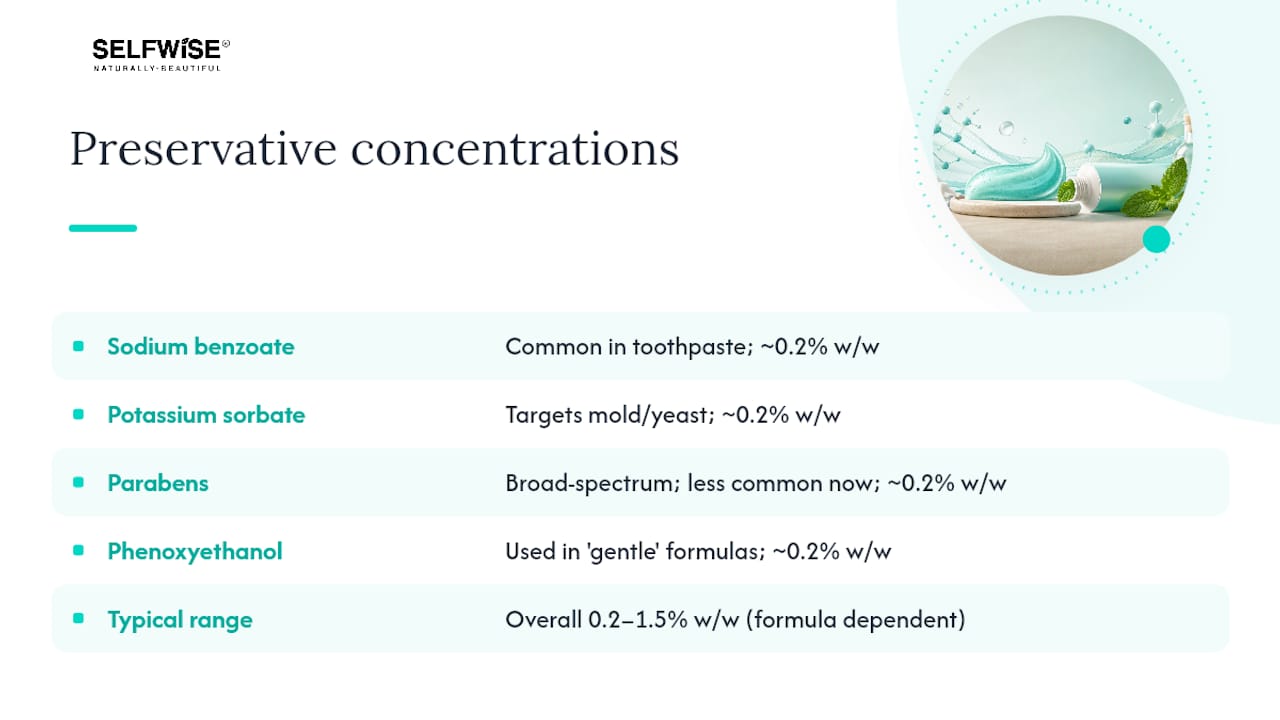
Statistic callout: Preservatives typically make up less than 1.5 percent of a toothpaste formula by weight, yet they’re doing the work of keeping the other 98-plus percent, much of it water and humectants, microbiologically stable for the product’s entire shelf life.
On the label, preservatives appear under their INCI (International Nomenclature of Cosmetic Ingredients) name. That means “sodium benzoate” is written exactly that way, while parabens usually show up as “methylparaben” or “propylparaben” rather than the umbrella term. If you’re scanning ingredient lists to understand what’s actually in your toothpaste, these are the terms to look for. Related products such as gentle oral rinses formulated for sensitive mouths often list far shorter ingredient panels precisely because they avoid this category altogether.
Why Manufacturers Add Preservatives in the First Place
The honest answer is that toothpaste’s own convenience creates its vulnerability. You unscrew a cap, dip a wet brush into the opening, and reseal it in a steamy bathroom, sometimes multiple times a day, for months. Every one of those actions is a small opportunity for bacteria, mold, or yeast to hitch a ride into the tube.
- Toothbrush dipping transfers oral bacteria and residual food particles directly into the paste.
- Bathroom humidity and warm storage conditions favor microbial growth inside a partially used tube.
- Damp caps and nozzles create a moist microclimate right where contamination enters the product.
Without some form of microbial control, that combination leads to spoilage: visible mold, off odors, color shifts, or the paste separating into layers as its emulsion breaks down. None of that is just cosmetically unpleasant. A contaminated tube used near broken skin, gum tissue, or mucous membranes carries a real infection risk, which is part of why regulators expect manufacturers to demonstrate microbial stability before a product reaches shelves.
There’s a second, less obvious reason preservatives matter: protecting the actives. Fluoride, enzymes, and other functional ingredients can degrade faster in a microbially unstable base, meaning a toothpaste that isn’t properly preserved may lose potency well before its stated expiration date. A peer-reviewed formulation review covering dentifrice ingredient function notes that stability, not just microbial safety, is part of what preservatives and humectants jointly deliver over a product’s shelf life.
How Toothpaste Preservatives Actually Work
Preservatives don’t all fight microbes the same way, and understanding the mechanism explains why formulators mix strategies rather than relying on one ingredient alone.
- Membrane disruption. Many preservatives, sodium benzoate among them, work by penetrating the cell membranes of bacteria and fungi, interfering with the barrier that keeps the organism’s internal chemistry intact.
- Metabolic inhibition. Others interfere with enzyme systems microbes need to generate energy, essentially starving them rather than rupturing them outright.
- pH-dependent activity. Sodium benzoate’s effectiveness rises sharply in acidic conditions, which is one reason formulators track a toothpaste’s pH closely rather than treating the preservative as a standalone fix.
What’s less obvious to most consumers is how much the rest of the formula does to help. High concentrations of humectants like glycerin and sorbitol, often 40 to 60 percent of the total recipe, pull water away from microorganisms through osmotic pressure. That’s the same principle that keeps honey from spoiling: enough dissolved sugar or polyol in a low-water system makes the environment inhospitable to most bacteria, independent of any added preservative.
Certain surfactants and metal-containing actives add another layer of protection almost by accident. Ionic surfactants used for foaming can have antimicrobial side effects, and stannous ion-based actives contribute incidental microbial resistance on top of their primary job. Formulators often stack these overlapping controls, humectant load, surfactant choice, pH, and a preservative, so that no single ingredient carries the entire burden.
On the manufacturing side, the preservative is typically dissolved into the aqueous or liquid phase before the thickening agents and abrasives are blended in, ensuring even distribution throughout the batch. Before any formula ships, it has to pass microbiological challenge testing, in which the product is deliberately inoculated with standard microorganisms and monitored to confirm the preservative system, whatever combination it uses, actually controls growth over time.
Pro Tip: If you’re comparing two toothpaste formulas, check the humectant percentage as well as the preservative. A formula heavy in glycerin or sorbitol relies less on the preservative to do the heavy lifting, which sometimes shows up as a shorter, simpler ingredient list.
Are Preservatives Safe in Toothpaste?
This is where most of the search traffic on this topic actually lands, and it deserves a straight answer rather than reassurance dressed up as science.
Standard preservatives used in toothpaste, sodium benzoate, potassium sorbate, and the parabens still in circulation, meet current regulatory safety thresholds at the concentrations used in oral care. That said, recent scientific commentary points out something worth taking seriously: evidence on cumulative, lifelong exposure to certain additives across many personal care products is still an active area of study, not a settled question. Meeting today’s regulatory bar isn’t the same as having decades of longitudinal data on daily, repeated use starting in childhood.
- Allergic contact reactions to preservatives, including mouth or gum irritation, are uncommon but do occur, and people with a history of contact dermatitis or mucosal sensitivity are more likely to notice them.
- Parabens draw the most consumer concern online, largely due to hormone-disruption debates, even though current regulatory reviews treat approved concentrations as safe for topical and oral care use.
- If you’ve had a reaction to a preservative in skincare or cosmetics before, it’s reasonable to check toothpaste labels for the same ingredient.
Statistic callout: Regulatory bodies cap paraben and benzoate concentrations well below the levels used in the studies establishing their safety margins, which is why current approved use is considered low-risk, even as researchers continue studying cumulative, long-term exposure.
Practically, if you’re sensitive or simply prefer a shorter ingredient list, read the INCI panel and cross-reference anything unfamiliar. A guide on common artificial additives can help you spot ingredient names worth questioning. And if you’ve had a reaction after a recent teeth-whitening treatment or other cosmetic dental procedure, it’s worth mentioning your oral care ingredient list to your dentist, since repeated chemical exposure from multiple products can compound irritation.
Preservative-Free and Low-Preservative Alternatives
The cleanest way to sidestep the entire preservative question is to remove the thing preservatives are fighting: water. Toothpaste tablets, tooth powders, and other water-free formats eliminate the aqueous environment microbes need to establish themselves, which is why these formats can often skip conventional preservatives entirely rather than just reduce them.
- Water-free tablets and powders remove the microbial niche at the source instead of controlling it chemically.
- High-humectant, low-water pastes lean on osmotic pressure from glycerin or sorbitol to suppress microbial growth, a strategy detailed in formulation literature on dentifrice stability.
- Ionic surfactants and mineral-based actives, including xylitol, contribute some intrinsic antimicrobial character. However, on their own they can’t universally replace a validated preservative system without dedicated testing.
- Plant-derived antimicrobial alternatives are appealing on paper but carry real limits in consistency and reliability compared with well-studied synthetic preservatives.
- Trade-offs to expect: water-free formats can cost more per use, dissolve less uniformly than a paste, and sometimes require getting used to a different brushing texture.
If you’re weighing these options for a sensitive mouth, a natural toothpaste guide for sensitive teeth walks through what to expect from the switch.
How Selfwisebrand Approaches Preservative Minimization
Selfwisebrand builds its oral care line around formats that sidestep the preservative question rather than debate it. Nano hydroxyapatite mouthwash tablets are water-free until the moment you use them, which removes the microbial niche that liquid formulas have to manage chemically. Xylitol contributes its own mild antimicrobial character. Oil pulling formats work in an entirely different medium that never needed a water-based preservative system to begin with.
- Choose solid or tablet formats when you want to minimize reliance on conventional preservatives.
- Store any oral care product with a dry cap and avoid leaving tubes open in humid bathrooms.
- Check for high humectant content or a water-free format as label cues that a product needs less preservative support.
For readers who want the formulation science behind specific products, Viktor’s guides dig into ingredient choices product by product.
Why the Preservative Debate Misses the Real Question
Most consumer conversation about toothpaste preservatives fixates on whether sodium benzoate or parabens are “toxic,” which misses the more useful question: does this formula need a preservative at all, and what did the brand do instead? A formula loaded with water and light on humectants genuinely needs a robust preservative system to stay safe. A water-free tablet or a high-glycerin paste doesn’t carry the same burden.
The conventional advice, just check the ingredient list for scary-sounding names, treats every preservative as interchangeable and every formula as identical. It isn’t. What actually matters is the whole system: water content, humectant load, pH, and packaging format working together. If you want to reduce your exposure to conventional preservatives, prioritize format first. A tablet, powder, or oil-based product solves the underlying problem instead of just swapping one chemical for another with a “natural” label.
Sources
- Formulation ingredients for toothpastes and mouthwashes (Vranic et al.)
- An Introduction to Toothpaste - Its Purpose, History and Ingredients
- Manufacture of toothpaste (Silverson application report)
- Review on formulation choices and antimicrobial strategies (PMC9585602)
FAQ
What ingredients should I avoid in toothpaste?
If you’re sensitive to preservatives, watch for parabens (methylparaben, propylparaben) and triclosan, though triclosan has been phased out of most major formulas. Checking the INCI list for names you don’t recognize is the most reliable habit.
What do the Japanese use instead of fluoride?
Some Japanese oral care brands emphasize alternative remineralizing ingredients and traditional formulations, though fluoride toothpaste remains widely available and used in Japan as well; formulation philosophy varies by brand rather than by national standard.
What do the Amish use for toothpaste?
Amish communities often favor simple, homemade recipes using ingredients like baking soda, salt, or natural oils rather than commercial preservative-based formulas, reflecting a broader preference for minimal processed ingredients.
What preservatives are commonly used in toothpaste?
Sodium benzoate, potassium sorbate, and parabens like methylparaben are the most common, typically making up 0.2 to 1.5 percent of the formula by weight.
Are preservatives in toothpaste actually safe?
Approved preservatives meet current regulatory safety thresholds at the concentrations used in oral care, though researchers continue studying cumulative, lifelong exposure across multiple personal care products.