Common Artificial Toothpaste Additives: What to Avoid
Most tubes of toothpaste contain more than fluoride and mint. The most common artificial toothpaste additives include sodium lauryl sulfate (SLS), artificial sweeteners like saccharin, aspartame, and sucralose, preservatives such as methylparaben and propylparaben, whitening agents like titanium dioxide, high-RDA abrasives, FD&C color dyes, propylene glycol, and historically, triclosan. A recent narrative review raised concerns about systemic absorption of synthetic additives through the oral mucosa, and the American Dental Association confirms that non-cariogenic sweeteners and flavoring agents are common in formulas. The cleaner path: scan labels for these names, and favor products built around nano hydroxyapatite and xylitol, like those from Selfwisebrand.
At a glance, the additives worth knowing:
- Surfactants: Sodium lauryl sulfate (SLS), sodium laureth sulfate
- Artificial sweeteners: Saccharin (sodium saccharin), aspartame, sucralose
- Preservatives: Methylparaben, propylparaben, sodium benzoate
- Whitening/opacity agents: Titanium dioxide (CI 77891), peroxide compounds
- High-RDA abrasives: Activated charcoal, some silica blends
- Colorants: FD&C Blue 1, FD&C Red 40, listed as “color” or CI codes
- Other synthetics: Propylene glycol, PEGs, triclosan (removed from U.S. products)
Table of Contents
- What are the common artificial additives in toothpaste?
- Who should pay close attention to these ingredients?
- How do you read a U.S. toothpaste label to spot these additives?
- What natural alternatives actually work?
- How do you switch to a natural toothpaste or mouthwash?
- What does the ADA and FDA say about toothpaste ingredients?
- Key Takeaways
- Why ingredient simplicity is the point, not a trend
- Selfwisebrand’s natural oral care line fits what this article recommends
- Useful sources
- FAQ
What are the common artificial additives in toothpaste?
Every ingredient in your toothpaste serves a purpose, but not all of them serve you. Here is what each category actually does and what to look for on the label.
| Additive Category | Common INCI Names | Purpose |
|---|---|---|
| Surfactant | Sodium Lauryl Sulfate, Sodium Laureth Sulfate | Foaming, cleaning action |
| Artificial sweetener | Saccharin Sodium, Sucralose, Aspartame | Masking bitter taste |
| Preservative | Methylparaben, Propylparaben, Sodium Benzoate | Extending shelf life |
| Whitening/opacity agent | Titanium Dioxide (CI 77891), Hydrogen Peroxide | Whitening, color opacity |
| Abrasive | Hydrated Silica, Calcium Carbonate, Charcoal | Stain and plaque removal |
| Colorant | FD&C Blue 1, FD&C Red 40, CI codes | Aesthetic appearance |
| Humectant/dispersant | Propylene Glycol, PEG-12 | Moisture retention, texture |
Surfactants like sodium lauryl sulfate are in most conventional toothpastes because they foam well and cost very little. SLS is an anionic surfactant derived from coconut or palm oil, and it does clean, but foaming is a sensory preference, not a cleaning requirement.
Artificial sweeteners show up in kids’ formulas and flavored varieties most often. Saccharin sodium appears on the DailyMed ingredient list for major brands alongside sucralose. These are non-cariogenic, meaning they don’t feed cavity-causing bacteria, but some reviews flag potential microbiome effects at repeated exposure.
Parabens like methylparaben and propylparaben extend shelf life. They appear under those exact INCI names and have drawn scrutiny for potential endocrine effects, though human risk at toothpaste exposure levels remains debated.
Titanium dioxide (CI 77891) gives toothpaste its bright white color. A systematic review screening 1,248 records identified TiO2 nanoparticles among ingredients warranting longer-term scrutiny, alongside triclosan, parabens, and DEA.
Abrasives are where RDA (Relative Dentin Abrasivity) matters. Activated charcoal formulas often have high RDA values, which are associated with enamel damage with daily use. Standard silica and calcium carbonate formulas tend to sit well below that.
Who should pay close attention to these ingredients?
Not everyone reacts the same way to the same formula. Which additive matters most depends entirely on the person.
“The most harmful ingredient varies by individual. SLS is the primary concern for canker-sore-prone people, while others need to watch high-RDA abrasives. Choosing natural, chemical-free alternatives sidesteps these individualized risks.” — Dr. Eleni Rowe, VitaDent Labs
Canker-sore sufferers are the clearest case. SLS is thought to disrupt the protective mucus layer in the mouth and has been linked to increased aphthous ulcer frequency in some studies. If you get canker sores regularly, SLS is the first thing to cut.
People with sensitive enamel should watch abrasive load. High-RDA products, especially charcoal-based ones, can accelerate enamel wear with daily brushing. The RDA number is rarely printed on the box, but manufacturers often publish it, and third-party databases list it.
Allergic or chemically sensitive people face a trickier problem: the “flavor” or “aroma” listing on a label can hide dozens of synthetic compounds, including essential oils that trigger perioral dermatitis or cheilitis. There’s no way to know what’s inside that umbrella term without contacting the manufacturer.
The 2025 narrative review also raised a broader concern: because the oral mucosa is highly vascularized, synthetic preservatives and sweeteners may absorb systemically more readily than previously assumed. This is an area of active research, not a settled verdict, but it’s a reasonable reason to prefer simpler formulations.
Quick reference for who should avoid what:
- Canker-sore prone: avoid SLS / sodium lauryl sulfate
- Sensitive enamel: avoid high-RDA abrasives, activated charcoal
- Chemical sensitivities: avoid parabens, propylene glycol, vague “flavor” listings
- General caution: avoid titanium dioxide (CI 77891) if concerned about nanoparticles
How do you read a U.S. toothpaste label to spot these additives?
U.S. toothpaste labels follow FDA drug-labeling rules. Active ingredients (like fluoride) appear first, separately. Everything else falls under “inactive ingredients,” listed in descending order by concentration. That’s where most synthetic additives live.
- Scan for SLS first. Look for “Sodium Lauryl Sulfate,” “Sodium Dodecyl Sulfate,” or “SDS.” If it’s in the top five inactive ingredients, it’s at a meaningful concentration.
- Check for CI 77891. That’s titanium dioxide. It often appears near the end of the list since it’s used in small amounts for whitening.
- Look for paraben names. “Methylparaben” and “Propylparaben” are always spelled out. No abbreviations.
- Find the sweeteners. “Saccharin Sodium,” “Sucralose,” and “Aspartame” appear by their full names. Kids’ toothpastes often have two of these.
- Flag dispersants and humectants. Terms like “Carbomer,” “PEG-12,” “PEG-32,” and “Propylene Glycol” signal synthetic texture agents that can cause irritation in sensitive individuals.
RDA is almost never on the label. Your best options: check the brand’s website, search the ingredient name plus “RDA” in a dental database, or ask your dentist. As a rule, any charcoal-based formula warrants that extra check.
Pro Tip: Scan from the bottom of the inactive ingredient list upward. Preservatives and colorants typically appear last, and spotting them quickly tells you a lot about how much the formula relies on synthetic stabilizers.
What natural alternatives actually work?
The good news: the science-backed alternatives are not obscure. They’re increasingly available and clearly labeled.
| Natural Ingredient | What It Does | Evidence Level |
|---|---|---|
| Nano hydroxyapatite | Remineralizes enamel, fills micro-lesions | Multiple recent reviews; strong |
| Xylitol | Non-cariogenic sweetener; inhibits Streptococcus mutans | Well-established; ADA-recognized |
| Sodium N-lauroyl sarcosinate | Mild surfactant; less mucosal irritation than SLS | Supported in dental literature |
| Cocamidopropyl betaine | Gentle foaming agent | Cosmetic ingredient reviews |
| Low-RDA silica | Effective cleaning without enamel damage | Standard dental recommendation |
Nano hydroxyapatite is the standout. It’s the same mineral that makes up 97% of tooth enamel, and it works by filling micro-lesions and supporting remineralization. Several reviews now position it as a viable alternative or complement to fluoride in non-fluoride formulas. Selfwisebrand’s nano hydroxyapatite guide covers the mechanism in detail.
Xylitol handles sweetness without feeding cavity bacteria. The ADA recognizes non-cariogenic sweeteners as acceptable in toothpaste, and xylitol specifically has well-documented anti-cavity properties. It also supports a healthier oral microbiome, which is more than saccharin can claim.
Mild surfactants like sodium N-lauroyl sarcosinate give you the foam without the mucosal disruption. They’re less common but increasingly found in natural formulas. If a product lists this instead of SLS, that’s a meaningful upgrade for anyone prone to mouth sores.
Pro Tip: When a label clearly lists “nano hydroxyapatite” and “xylitol” by name, that’s a signal the brand is being transparent about what’s doing the work. Vague terms like “natural flavors” or “mineral complex” are the opposite of that.
If you’re curious about extending that ingredient-transparency mindset beyond oral care, chemical-free personal care follows the same label-reading logic.
How do you switch to a natural toothpaste or mouthwash?
Switching is straightforward. The adjustment period is real but short.
- Decide what you’re avoiding. SLS? Parabens? All synthetic additives? Knowing your priority makes product selection faster.
- Pick a trial product with nano hydroxyapatite or xylitol clearly listed. Check that it’s free of your flagged ingredients using the label steps above.
- Run a 2–4 week trial. Taste and foam will feel different at first. That’s normal. Your mouth adjusts within days; any sensitivity or remineralization benefits take longer.
- Monitor and adjust. New irritation or increased sensitivity? Try a different formula or lower-RDA option. No issues? You’re done.
- Add complementary habits. Oil pulling, flossing, and tongue scraping pair well with a natural toothpaste routine. A natural oral care routine can layer these in gradually.
Dentin hypersensitivity affects a significant portion of adults, so if you notice quick improvement after switching away from high-RDA abrasives, that’s expected. If sensitivity persists or worsens, consult your dentist before continuing.
What does the ADA and FDA say about toothpaste ingredients?
The ADA’s position is clear on one point: fluoride is the only anticaries agent that qualifies a toothpaste for an ADA anticaries claim. Non-cariogenic sweeteners and flavoring agents are permitted and common, but they don’t earn that seal on their own.
The ADA allows non-cariogenic sweeteners in toothpaste but emphasizes that anticaries claims require fluoride. Consumers who want to go further can choose xylitol and remineralizing agents while discussing their fluoride needs with a dentist.
The FDA regulates toothpaste as an over-the-counter drug when it carries therapeutic claims (anticavity, antigingivitis). That means active ingredients are subject to monograph requirements, but inactive ingredients face less scrutiny. RDA limits, for instance, are not federally mandated on labels.
Triclosan is the clearest example of regulatory action working. Once common as an antimicrobial in toothpaste, it was removed from most U.S. products following concerns about endocrine disruption and antibiotic resistance. Internationally, regulatory status still varies.
If you’re considering a non-fluoride formula, talk to your dentist first, especially if you have a higher caries risk. Natural doesn’t automatically mean right for every mouth.
This article is general information, not professional dental advice. Confirm ingredient choices and fluoride needs with your dentist for your specific situation.
Key Takeaways
Most conventional toothpastes contain synthetic additives that serve cosmetic or manufacturing purposes, and choosing simpler, evidence-backed formulas with nano hydroxyapatite and xylitol reduces exposure without sacrificing effectiveness.
| Point | Details |
|---|---|
| Top additives to know | SLS, saccharin, parabens, titanium dioxide, and high-RDA abrasives appear most often in conventional formulas. |
| Who’s most affected | Canker-sore sufferers should avoid SLS; sensitive enamel warrants low-RDA abrasives; chemical sensitivities call for paraben-free, clear-label products. |
| Label-reading shortcut | Scan inactive ingredients for “Sodium Lauryl Sulfate,” “CI 77891,” “Methylparaben,” and “Saccharin Sodium” first. |
| Switching timeline | Taste and foam adjust within days; remineralization or sensitivity benefits take weeks to months. |
| Selfwisebrand option | Selfwisebrand formulates with nano hydroxyapatite and xylitol, no SLS, no parabens, and clear ingredient labeling. |
Why ingredient simplicity is the point, not a trend
There’s a version of the “natural toothpaste” conversation that gets stuck on what to remove. Fewer chemicals, shorter lists, nothing scary. That framing is fine as far as it goes, but it misses the more interesting question: what should actually be in there?
The case for nano hydroxyapatite and xylitol isn’t that they’re natural. It’s that they have a clear mechanism, a growing body of evidence, and a track record. Xylitol actively disrupts the bacteria that cause cavities. Nano hydroxyapatite physically integrates into enamel. These aren’t passive “gentle” alternatives. They do something.
The synthetic additives this article covers, by contrast, are mostly there for manufacturing convenience: SLS foams cheaply, parabens extend shelf life, titanium dioxide looks white. None of those are reasons to harm the person using the product, but they’re also not reasons to accept them uncritically when better options exist.
The real shift isn’t from “chemical” to “natural.” It’s from ingredients chosen for the factory to ingredients chosen for the person brushing. That’s a meaningful distinction, and it’s one worth making at the label before you buy.
Selfwisebrand’s natural oral care line fits what this article recommends
If you’ve read this far and want a product that actually matches the guidance above, Selfwisebrand’s oral care line is built around exactly that: nano hydroxyapatite, xylitol, no SLS, no parabens, and ingredient lists you can read without a chemistry degree.
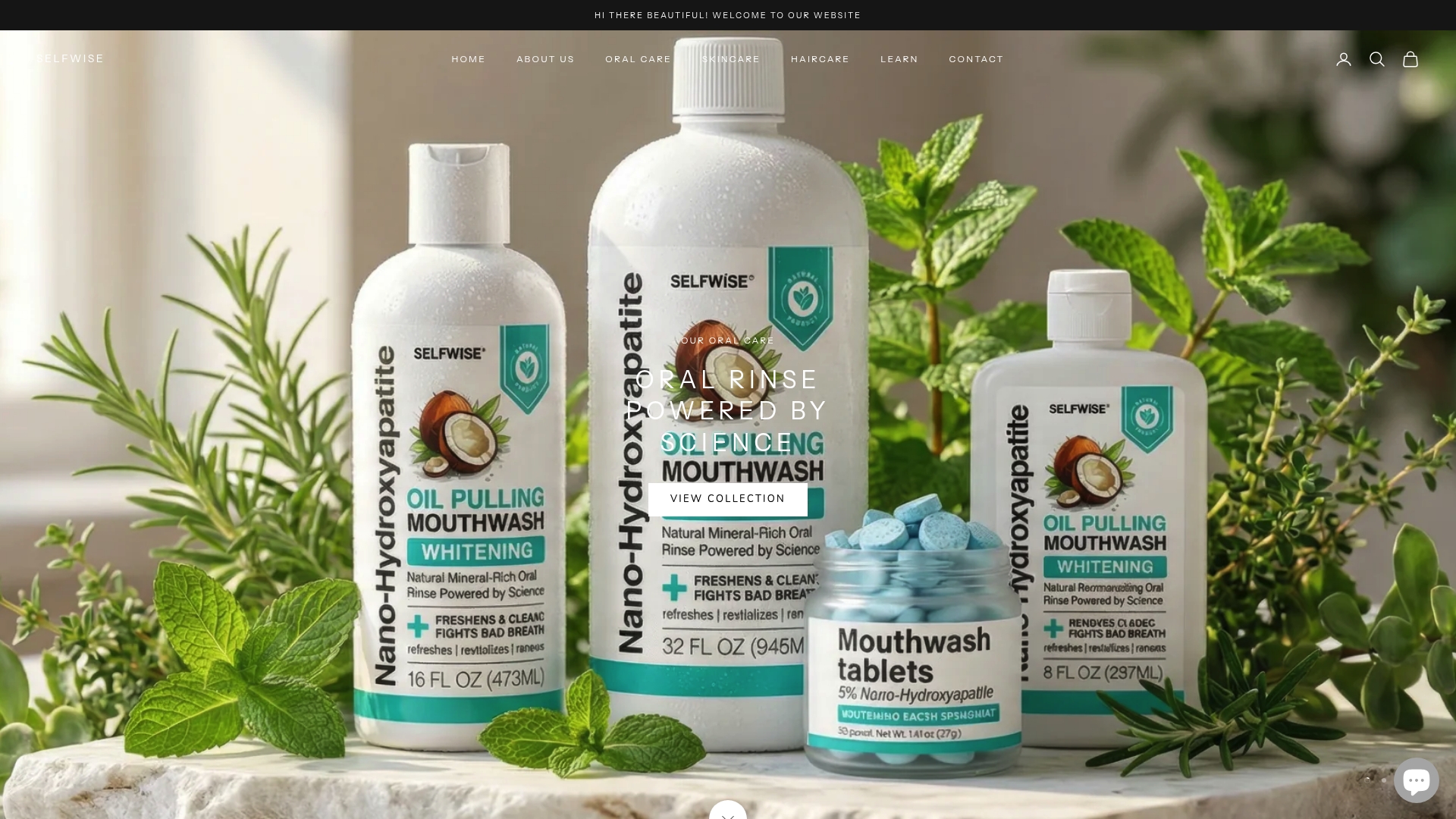
The xylitol mouthwash with nano hydroxyapatite combines both evidence-backed ingredients in one formula, fluoride-free and alcohol-free. The nano hydroxyapatite mouthwash tablets are a solid option if you want a travel-friendly, zero-waste format with a clean ingredient list. Both are part of the broader Selfwisebrand mouthwash collection, which covers oil pulling, remineralizing rinses, and fluoride-free options.
If you have high caries risk, check with your dentist before going fluoride-free. For everyone else, this is a practical place to start.
Useful sources
- American Dental Association: Toothpastes
- The Deleterious Systemic Effects of Common Oral Care Products: A Narrative Review (2025)
- Toothpaste Ingredients and Potential Carcinogenic Risks: A Systematic Review and Meta-Analysis
- VitaDent Labs: Toothpaste Ingredients to Avoid
- Are All Additives of Toothpastes Rational? (LWW)
- Selfwisebrand: Hydroxyapatite Calcium Natural Oral Care Benefits
- Selfwisebrand: Oral Care Collection
FAQ
What are the most common artificial additives in toothpaste?
The most common are sodium lauryl sulfate (SLS), artificial sweeteners like saccharin and sucralose, parabens, titanium dioxide, high-RDA abrasives, and FD&C color dyes. Most appear in the inactive ingredients section of U.S. labels.
Is SLS in toothpaste harmful?
SLS is considered safe for most people, but it’s linked to increased canker sore frequency in susceptible individuals by disrupting the mouth’s protective mucus layer. Switching to an SLS-free formula is the simplest fix for anyone who gets mouth ulcers regularly.
What natural ingredients should I look for instead?
Nano hydroxyapatite and xylitol are the two most evidence-backed natural alternatives. Nano hydroxyapatite supports enamel remineralization; xylitol inhibits cavity-causing bacteria without feeding them. Selfwisebrand’s formulas combine both.
Does the ADA approve natural toothpaste?
The ADA’s anticaries seal requires fluoride as the active ingredient, so fluoride-free natural toothpastes won’t carry that seal. The ADA does allow non-cariogenic sweeteners and flavoring agents, and it recommends discussing non-fluoride options with your dentist based on your caries risk.
How long does it take to adjust to natural toothpaste?
Taste and foam differences resolve within a few days. Benefits like reduced sensitivity or early remineralization support typically take several weeks to a few months to notice, depending on your starting point and the formula you choose.


,%20artificial%20sweeteners%20like%20saccharin...)