Why Microplastics Show Up in Your Toothpaste
Microplastics turn up in toothpaste because manufacturers add synthetic polymers on purpose, as abrasives, binders, and texture agents, and because the tube itself, your toothbrush, and even dental work shed plastic into your mouth over time. This isn’t a fringe contamination issue. It’s baked into how many formulas are built.
Here’s what’s actually driving it:
- Formulation additives: polymers like polyethylene (PE) and polymethyl methacrylate (PMMA) get added deliberately for texture, whitening, or shine.
- Product wear: soft plastic components in packaging and applicators degrade slowly and shed fragments.
- Manufacturing contamination: production lines and shared equipment can introduce trace plastic particles unintentionally.
- Cross-contamination from other oral-care items: toothbrush bristles and floss shed fibers that end up counted in oral-care microplastic totals.
A narrative review of oral-care products found polymers including PE, PP, PET, and PMMA across toothpaste, toothbrushes, and dental materials. Separately, one analysis estimated that toothbrush use alone contributes roughly 48,910 particles per person annually, a scale that puts toothpaste’s contribution into perspective rather than isolating it as the sole culprit.
Key Takeaways
Toothpaste contains microplastics primarily because manufacturers use synthetic polymers as abrasives, binders, and film-formers, and switching to mineral-based, silica, or nano hydroxyapatite formulations meaningfully reduces that exposure.
| Point | Details |
|---|---|
| Polymers are functional, not accidental | PE, PP, PET, PMMA, PTFE, and EVA appear in toothpaste for texture, abrasion, and binding, not by contamination alone. |
| Toothbrushes rival toothpaste as a source | Bristle wear alone contributes an estimated 48,910 particles per person annually in one analysis. |
| Health evidence remains preliminary | Inflammation and oxidative stress appear in lab and animal studies, but human clinical data is still limited. |
| Detection methods shape reported numbers | Nile Red screening plus FTIR or Raman confirmation is the current best-practice combination for accurate polymer identification. |
| Regulatory gaps persist | Microbead bans covered spherical beads in rinse-off cosmetics but left fragment-generating ingredients largely unaddressed. |
| Natural alternatives sidestep the issue | Selfwisebrand’s nano hydroxyapatite and xylitol formulations avoid synthetic polymer abrasives entirely. |
Table of Contents
- Why Microplastics Are Found in Toothpaste: The Evidence So Far
- Which Toothpaste Ingredients Contain Microplastics?
- How Do Microplastics From Toothpaste Reach the Environment?
- Are Microplastics in Toothpaste Actually Bad for Your Health?
- How to Avoid Microplastics in Your Oral Care Routine
- How Scientists Actually Detect Microplastics in Toothpaste
- What Regulations Actually Cover Microplastics in Oral Care
- Beyond Toothpaste: Your Toothbrush and Dental Work Matter Too
- Why This Issue Deserves Your Attention, Not Your Anxiety
- Making the Switch to Plastic-Free Oral Care
- Sources
- FAQ
Why Microplastics Are Found in Toothpaste: The Evidence So Far
The short version: yes, multiple peer-reviewed surveys detect microplastics in commercial toothpaste, but concentrations and particle types vary enormously depending on formulation, brand, and how researchers measure them.
That variability is the story most headlines miss. A whitening gel and an herbal paste can come from wildly different plastic footprints even if they sit next to each other on the same store shelf. Whitening formulas often lean on harder synthetic abrasives to scrub away stains, while gel and herbal varieties may substitute silica or natural mineral abrasives instead. Both categories can still contain film-forming polymers unrelated to their abrasive system, which is why “natural-sounding” doesn’t automatically mean plastic-free.
Reviews consistently flag five polymer families as the recurring suspects: polyethylene (PE), polypropylene (PP), polyethylene terephthalate (PET), polymethyl methacrylate (PMMA), and occasionally polytetrafluoroethylene (PTFE) or ethylene vinyl acetate (EVA). A 2024 ecotoxicology review tied PE specifically to abrasive and texturizing roles in toothpaste, noting that formulation type strongly predicts which polymer shows up and in what amount.
Geography matters too. Studies conducted in different countries report different baseline levels, partly because regulatory environments differ and partly because “toothpaste” as a product category is not standardized worldwide. A gel toothpaste sold in one region may use a completely different binder system than a paste marketed under the same name elsewhere. Add to that the fact that labs use different detection thresholds, sample prep methods, and confirmation techniques, and you get a spread of reported values that looks inconsistent even when the underlying phenomenon (plastic in the paste) is real and repeatable.
Here’s how a few representative approaches compare:
| Study Focus | Sample Scope | Detection Method | Headline Finding |
|---|---|---|---|
| Oral-care product survey | Multiple product types, single-country market | Visual sort + spectroscopic confirmation | Fragments and fibers detected across product categories, including toothpaste |
| Ecotoxicology mechanism study | Laboratory simulation of product use | Mechanical/chemical stress testing | Mechanical friction and pH/thermal shifts drive particle release from oral-care items |
| Narrative review synthesis | Cross-study polymer identification | Literature synthesis of published detections | PE, PP, PET, and PMMA consistently identified across toothpaste and dental materials |
The narrative review in the Saudi Dental Journal goes further, treating toothpaste as just one node in a broader dentistry-related exposure network that includes floss, aligners, and resin restoratives. That framing matters for how you read prevalence numbers: a study measuring “oral microplastic burden” isn’t always isolating toothpaste’s specific contribution, so headline statistics about total particle counts often blend multiple sources together.
One number worth flagging: earlier research on rinse-off personal care products estimated releases in the thousands to tens of thousands of particles per use for some product categories, though methods and product types varied widely in that estimate. That range predates much of the current toothpaste-specific literature, but it explains why regulators started paying attention to rinse-off cosmetics well before oral care specifically came under scrutiny.
Which Toothpaste Ingredients Contain Microplastics?
Reading an ingredient list for plastic content isn’t intuitive, because the polymers rarely say “plastic” on the label. They show up under chemical names tied to their function in the formula.
Here’s what to actually look for:
- Polyethylene (PE): often used as a mild abrasive or in microbead form historically; still appears in some whitening formulas for texture.
- Polypropylene (PP): sometimes used in packaging components that can shed into the product over time.
- Polyethylene terephthalate (PET): occasionally present as a film-forming or structural additive.
- Polymethyl methacrylate (PMMA): used for its hardness in some abrasive systems, particularly in whitening pastes.
- Polytetrafluoroethylene (PTFE): less common, but flagged in some formulations for its smooth, non-stick texture properties.
- Ethylene vinyl acetate (EVA): a binder and film-former that helps hold a paste’s texture together.
There’s an important distinction buried in that list. Primary microplastics were the original problem, plastic microbeads intentionally manufactured at microscopic size and added directly to a formula, usually for exfoliation or visual appeal. Many of those got phased out or banned in specific rinse-off product categories over the past decade. Secondary fragments, by contrast, aren’t added as beads. They’re polymer materials used for a functional purpose (binding, thickening, texturizing) that break down into smaller particles through normal wear, storage, or use. A toothpaste can be technically “microbead-free” and still contain plastic-derived ingredients that shed fragments.
This is exactly where marketing language gets slippery. A product boasting “natural exfoliating beads” might use plant-derived material, or it might use a polymer that simply looks and feels similar. The phrase itself guarantees nothing.
Pro Tip: Scan ingredient lists for anything ending in “-ylene,” “-ate,” or “-acrylate” alongside terms like “polymer,” “microbead,” or “film former.” If you’re unsure whether an ingredient is plastic-derived, most brands will answer directly if you email their customer service team asking specifically about polymer content.
How Do Microplastics From Toothpaste Reach the Environment?
Every time you spit and rinse, plastic particles from your toothpaste travel down the drain into household wastewater, and from there into a treatment system that wasn’t originally designed to filter something this small.

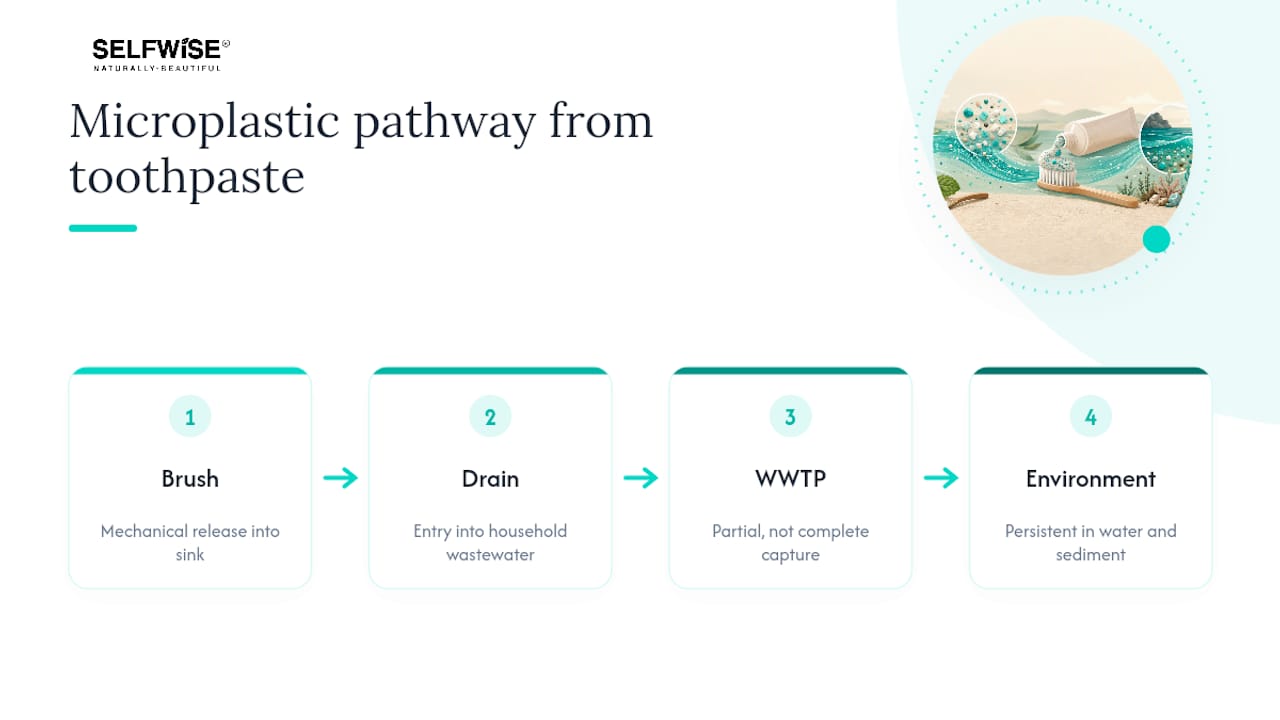
The pathway is straightforward: sink drain → household wastewater → wastewater treatment plant (WWTP) → receiving waters and sediment. Treatment plants are effective at removing many contaminants, but microplastic capture isn’t universal or guaranteed across all systems and particle sizes. Some particles pass through screening and filtration stages entirely intact, ending up in rivers, lakes, or coastal waters depending on where the treated water gets discharged.
Once in the environment, these polymers don’t break down quickly. UNEP’s assessments of global microplastic pollution describe persistence as the core problem: plastic particles resist natural degradation for years, sometimes decades, depending on polymer type and environmental conditions. That persistence creates two compounding risks. First, plastic particles can adsorb other pollutants (heavy metals, industrial chemicals) onto their surface, effectively acting as a delivery vehicle for contaminants that wouldn’t otherwise concentrate in one place. Second, smaller organisms ingest these particles, which raises the possibility of bioaccumulation moving up the food chain, from plankton to fish to larger predators.
The narrative review on oral cavity health points specifically to this persistence and pollutant-binding behavior as the primary reason rinse-off oral-care products deserve environmental scrutiny, separate from any human health question.
Picture the full loop as four stages: brush (mechanical release into your mouth and the sink), drain (entry into household wastewater), WWTP (partial, not complete, capture), and environment (rivers, sediment, and marine systems where persistence takes over). Each stage represents a point where reduction is possible, but right now most consumer attention focuses only on the first stage.
Wastewater treatment infrastructure varies significantly by region and by plant age, which means the “capture efficiency” you’d get in one city’s system may look nothing like another’s. That inconsistency is part of why environmental groups have pushed for reducing microplastic inputs at the source (in the product itself) rather than relying entirely on downstream filtration to catch everything.
Are Microplastics in Toothpaste Actually Bad for Your Health?
The honest, evidence-first answer is this: researchers haven’t found direct clinical proof that microplastics in toothpaste cause specific human diseases, but laboratory and animal studies show plausible mechanisms for harm, and the uncertainty itself is a legitimate reason for caution.
That’s a nuanced position, and it’s worth sitting with rather than rounding up to “toothpaste is dangerous” or down to “there’s nothing to worry about.” Both extremes oversimplify what the research actually shows.
What the evidence points to:
- In vitro (cell-culture) studies have shown microplastic and nanoplastic particles triggering inflammatory responses and oxidative stress in exposed cells.
- Animal studies have documented similar inflammatory signals and, in some cases, effects on gut or oral microbiome composition after plastic particle exposure.
- The oral cavity presents a unique exposure interface. Unlike ingested food that passes relatively quickly through the mouth, some oral-care residue lingers on mucosal tissue and between teeth, creating repeated, low-level contact.
The Saudi Dental Journal review specifically flags oral mucosa interaction and possible systemic translocation (particles crossing from the mouth into broader circulation) as areas needing more research, not settled conclusions. That’s an important distinction: a plausible mechanism isn’t the same as a proven pathway.
Where toothpaste ranks in your total exposure. This matters because toothpaste is rarely, if ever, the dominant source of microplastic exposure in a person’s daily life. Diet (particularly seafood, salt, and bottled water), airborne dust, and synthetic textiles all contribute substantially, and toothbrushes alone may contribute tens of thousands of particles annually through bristle wear, a figure that in some estimates exceeds toothpaste’s contribution. That doesn’t make toothpaste irrelevant. It means the conversation should be about cumulative exposure across your whole routine, not a single product in isolation.
What researchers still don’t know:
- The dose-response relationship: how much exposure, over what timeframe, actually produces a measurable biological effect in humans.
- Long-term epidemiological data: no large-scale human studies currently track microplastic exposure against health outcomes over years or decades.
- Nanoplastic behavior specifically: particles small enough to potentially cross cellular barriers behave differently than larger microplastic fragments, and this size class is harder to detect and study with current methods.
- Whether oral microbiome disruption from plastic exposure has any measurable downstream effect on gum health, cavity risk, or systemic inflammation.
This gap between “plausible mechanism” and “confirmed human harm” is exactly why several reviews call for precautionary reduction rather than panic. You don’t need proof of harm to justify choosing formulations with fewer synthetic polymers, especially when alternatives exist that don’t require the tradeoff at all.
How to Avoid Microplastics in Your Oral Care Routine
The fastest way to cut your exposure is to swap products built around synthetic polymers for ones built around natural, non-plastic ingredients, starting with your toothpaste and toothbrush.
Here’s a practical sequence:
- Scan the ingredient list before you buy. Look for the polymer names covered earlier (PE, PP, PET, PMMA, PTFE, EVA) and treat vague terms like “polymer blend” as a red flag worth investigating.
- Choose silica-based abrasives over synthetic polymer abrasives. Hydrated silica is a mineral, not a plastic, and it does the same mechanical cleaning job without the fragment-shedding concern.
- Verify plastic-free claims rather than assuming them. Marketing terms like “natural” or “eco-friendly” aren’t regulated definitions. If a brand makes a plastic-free claim, check whether they list a full ingredient breakdown to back it up.
- Address your toothbrush, not just your toothpaste. Nylon bristles shed fibers with every use. Low-shed alternatives or more frequent replacement schedules reduce this often-overlooked source.
- Consider oil pulling or nano hydroxyapatite rinses as complements to your routine. These approaches work through mechanical or mineral action rather than synthetic polymer additives, which sidesteps the fragment-shedding question entirely.
A quick shopping checklist:
- Ingredient list free of PE, PP, PET, PMMA, PTFE, or EVA
- Abrasive system based on silica, calcium carbonate, or another mineral source
- No unexplained “polymer” or “film former” listed without further detail
- Toothbrush with biodegradable or low-shed bristle technology
- Brand transparency about sourcing and manufacturing
Pro Tip: Abrasive formulations that rely on harder synthetic particles to scrub stains can also accelerate bristle wear on your toothbrush, which means you’re potentially shedding more plastic from two directions at once. Pairing a gentler, silica-based paste with a well-maintained brush cuts down on both fronts simultaneously.
If you’re specifically trying to build a lower-plastic routine, Selfwisebrand’s approach centers on formulations that skip synthetic polymer abrasives entirely in favor of nano hydroxyapatite and xylitol, ingredients chosen for their mineral and functional properties rather than as plastic substitutes dressed up in natural branding.
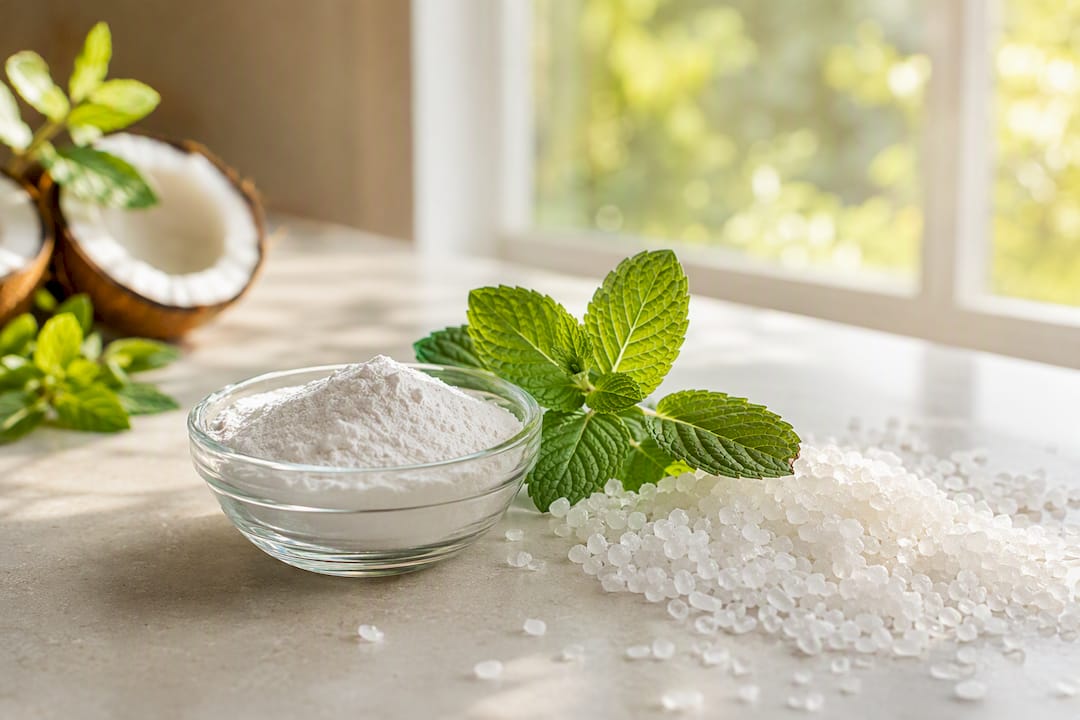
How Scientists Actually Detect Microplastics in Toothpaste
Lab detection isn’t as simple as looking through a microscope and counting specks. It’s a multi-step process, and the method chosen directly affects what gets reported.
The standard workflow typically starts with visual sorting under magnification to separate suspected particles from the rest of a sample. From there, researchers often apply Nile Red staining, a fluorescent dye that binds to plastic surfaces and makes particles glow under specific light wavelengths, which speeds up screening across large sample volumes. But Nile Red alone can produce false positives, since some natural materials fluoresce similarly. That’s why confirmation typically requires micro-FTIR (Fourier-transform infrared spectroscopy) or micro-Raman spectroscopy, techniques that identify a particle’s exact chemical signature and confirm whether it’s actually a specific polymer type rather than an organic look-alike.
- Visual sorting: initial physical separation of candidate particles by size and shape.
- Nile Red screening: fluorescent dye staining for rapid, broad detection.
- Micro-FTIR/Raman confirmation: spectroscopic identification of exact polymer chemistry.
- Size threshold limits: most detection methods struggle below a certain particle size, meaning nanoplastics often go undercounted.
This is exactly why study results vary so widely from one paper to the next. Sample preparation introduces its own contamination risk (airborne fibers from lab clothing or equipment can skew results if labs don’t use strict clean-room protocols), and researchers combining Nile Red screening with spectroscopic confirmation currently represent the most reliable approach for reducing false positives. When you see a headline citing a specific particle count, it’s worth asking which method produced that number, because two labs studying the same toothpaste can report meaningfully different results based on technique alone.
What Regulations Actually Cover Microplastics in Oral Care
Some microbead bans successfully eliminated spherical plastic beads from specific rinse-off cosmetic categories, but plenty of formulations and irregular plastic fragments still fall outside those original rules.
That’s the gap most consumers don’t realize exists. Microbead legislation, including regulatory action referenced in FDA cosmetics guidance, targeted intentionally manufactured spherical microbeads used for exfoliation, largely in rinse-off products like facial scrubs and some toothpaste formulas. The bans worked for what they targeted. But secondary fragments from film-formers, binders, and abrasive polymers that aren’t spherical beads were never covered by that legislation in the first place.
A rough timeline of the regulatory response:
- Early microbead-specific bans: targeted intentionally added spherical plastic beads in rinse-off cosmetics.
- Ongoing regulatory review of broader cosmetics categories: agencies continue evaluating where polymer ingredients fit within existing cosmetics frameworks.
- Voluntary industry phase-outs: some manufacturers proactively reformulated away from microbeads ahead of, or beyond, what regulation required.
- Continued gaps for fragment-generating ingredients: binders, film-formers, and non-bead abrasive polymers remain largely unaddressed by current rules.
Voluntary industry action has filled some of that gap, but inconsistently. A brand that proactively removes all polymer-based ingredients does so by choice, not obligation, which means ingredient transparency currently depends heavily on which company you’re buying from rather than a uniform baseline every product must meet.
Beyond Toothpaste: Your Toothbrush and Dental Work Matter Too
Toothpaste gets most of the attention, but it’s often not even the largest source of oral-related microplastic exposure in your daily routine. Toothbrushes, dental restorations, and even in-office procedures all contribute.
Nylon bristle wear is a big piece of this. Every time you brush, mechanical friction sheds microscopic fibers directly into your mouth, and one analysis of oral healthcare products estimated toothbrush-related exposure at roughly 48,910 particles per person annually. Fragments and fibers dominated the particle types detected across the product categories studied, which suggests bristle wear isn’t a minor side note. It’s a comparable contributor to toothpaste exposure.
Dental materials add another layer. Resin-based restorations and prosthetics can shed microscopic fragments over years of normal wear, and the polishing or adjustment procedures performed during dental visits can generate aerosolized particles in clinical settings. Choosing more stable restorative materials and minimizing unnecessary polishing where clinically appropriate are both mitigation strategies flagged in recent dental literature.
- Toothbrush bristle wear contributes a substantial share of oral-related particle exposure, in some estimates exceeding toothpaste’s contribution.
- Resin restorations and prosthetics shed fragments gradually through normal use.
- Dental procedures involving polishing or adjustment can generate aerosolized particles.
- The oral cavity offers a unique, repeated-contact interface with the microbiome, unlike a one-time ingestion event.
This is where practical mitigation actually lives: it’s not just about picking a plastic-free toothpaste. It’s about looking at your entire routine, brush type, replacement frequency, and even how you approach dental work, as connected pieces of the same exposure picture. Selfwisebrand’s focus on nano hydroxyapatite and xylitol formulations reflects this broader view: reducing synthetic polymer reliance across a routine matters more than optimizing a single product in isolation.
Why This Issue Deserves Your Attention, Not Your Anxiety
I think the microplastics-in-toothpaste story gets told wrong most of the time, either as an alarmist “everything is contaminated” narrative or dismissed entirely because human health data isn’t conclusive yet. Neither extreme serves you well.
What actually matters is that plausible mechanisms exist, environmental persistence is well documented, and better alternatives are already on the market at no meaningful sacrifice in effectiveness. You don’t need certainty about long-term health effects to justify choosing a mineral-based abrasive over a synthetic polymer one, especially when nano hydroxyapatite offers real remineralization benefits on top of sidestepping the plastic question entirely. That’s the kind of precautionary choice that costs you nothing and asks nothing of you except reading a label. Selfwisebrand built its formulations around that logic from the start.
Making the Switch to Plastic-Free Oral Care
Nano hydroxyapatite rinses, xylitol mouthwashes, and oil-pulling formulas avoid microplastics because they’re built around mineral and plant-based mechanisms instead of synthetic polymer abrasives or film-formers.
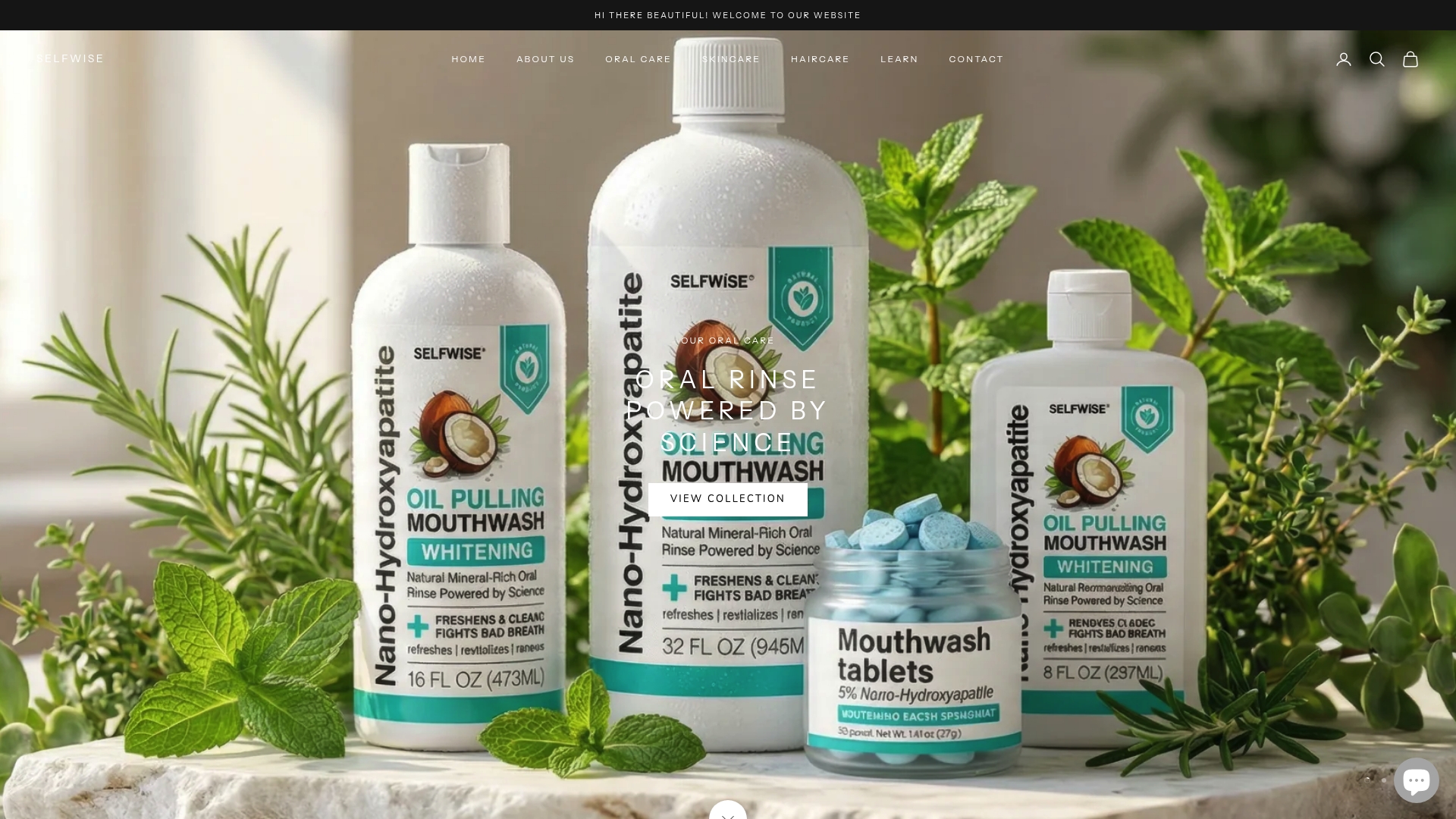
Selfwisebrand formulates every product without the polymer ingredients covered throughout this article, no PE, PMMA, or synthetic film-formers standing in for function that minerals and natural compounds already handle well. The nano hydroxyapatite mouthwash tablets support enamel remineralization in a solid, low-waste format that skips liquid packaging concerns entirely, while the nano hydroxyapatite oil pulling mouthwash combines a traditional practice with modern mineral science for readers who want both approaches in one step. If cavity prevention is your priority, the xylitol mouthwash with nano hydroxyapatite pairs both ingredients without fluoride or synthetic additives.
Every formula’s ingredient list is published in full, so you can verify exactly what you’re putting in your mouth rather than taking a marketing claim at face value. Browse the full mouthwash collection or check the fluoride-free collection to find the formula that fits your routine, and start reading labels on everything else in your bathroom cabinet while you’re at it.
Sources
- Micro- and Nanoplastics and the Oral Cavity: Implications for Oral and Systemic Health, Dental Practice, and the Environment—A Narrative Review - PMC
- The unseen perils of oral-care products generated micro …
- Micro and nanoplastics in dentistry: emerging sources, health implications, and mitigation pathways: a narrative review | The Saudi Dental Journal | Springer Nature Link
- Microplastics in oral healthcare products (OHPs) and their environmental health risks and mitigation measures ☆
- Wedocs
- Fda
This article is general information, not a substitute for advice from a qualified doctor. Consult a qualified healthcare professional about your own circumstances before acting on anything here.
FAQ
Which Toothpaste Has No Microplastics?
Look for toothpaste formulated with silica-based abrasives and nano hydroxyapatite instead of synthetic polymers like PE or PMMA, and verify the full ingredient list rather than relying on “natural” marketing claims.
Is Toothpaste Full of Microplastics?
Not all toothpaste contains significant microplastic levels, but multiple peer-reviewed reviews confirm that many commercial formulations contain detectable polymers used as abrasives, binders, or film-formers.
What Is the Biggest Source of Microplastics in Oral Care?
Toothbrush bristle wear is often as significant as, or larger than, toothpaste itself, with one analysis estimating roughly 48,910 particles per person annually from toothbrush use alone.
How Do You Avoid Microplastics in Toothpaste?
Scan ingredient lists for polymer names like PE, PP, PET, PMMA, PTFE, and EVA, choose silica or mineral-based abrasive systems, and consider nano hydroxyapatite or xylitol formulations that skip synthetic polymers entirely.