Parabens in Oral Care Products: Safety and Alternatives
Parabens in oral care products are chemical preservatives that prevent bacterial and fungal growth in water-based formulas like toothpaste and mouthwash. You’ll find them listed as methylparaben, propylparaben, butylparaben, or ethylparaben on ingredient labels. The FDA and the Cosmetic Ingredient Review (CIR) panel consider parabens safe at concentrations up to 0.8%. Still, growing consumer interest in cleaner formulas has pushed many people to question whether these preservatives belong in their daily oral care routine.
1. What are parabens in oral care products?
Parabens are a family of synthetic preservatives identified by the “-paraben” suffix on ingredient labels. Their job is straightforward: stop bacteria, mold, and yeast from growing inside a product. Without them, a tube of toothpaste sitting in a warm, humid bathroom becomes a contamination risk within weeks.

Oral care products are especially vulnerable to microbial growth because they contain significant water. Water creates the ideal environment for microbes to thrive. Parabens solve this problem cheaply and reliably, which is why formulators have used them for decades.
The four most common types you’ll encounter are:
- Methylparaben: The most widely used, effective against mold and yeast
- Propylparaben: Often paired with methylparaben for broader coverage
- Butylparaben: Stronger activity, now restricted in EU children’s products
- Ethylparaben: Less common, used in combination formulas
Pro Tip: When reading a toothpaste or mouthwash label, scan the last third of the ingredient list. Preservatives like parabens appear at the end because they’re used in tiny amounts.
Parabens are also valued for their low cost and stability compared to natural alternatives. They don’t react with other ingredients, don’t affect taste or color, and work across a wide pH range. That combination makes them hard to replace without trade-offs.
2. Are parabens harmful in dental care?
The short answer is: not at the concentrations found in oral care products, according to current regulatory science. The FDA has not restricted parabens in toothpaste or mouthwash, and the CIR reaffirmed their safety profile as recently as 2026.
That said, the science is not entirely settled. Lab studies have shown that parabens can mimic estrogen at the cellular level, raising endocrine disruption concerns. No study has established a causal link between paraben use in oral care and hormonal disease in humans. The concern exists at the theoretical level, not the clinical one.
“Parabens are among the most studied preservatives in the world. More than 300 studies support their safety profile. Removing them without proven alternatives increases the real risk of microbial contamination and product-related infections.” — Skeptical Inquirer, 2026
Allergic reactions are a more documented concern. A 2026 study in Scientific Reports found that parabens and other oral care additives can trigger contact stomatitis and cheilitis in sensitive individuals. If you notice mouth irritation, lip swelling, or unexplained soreness after using a product, parabens are worth investigating as a possible cause.
Regulatory differences between the US and EU also reflect different risk tolerances:
| Regulatory Body | Stance on Parabens | Notable Restrictions |
|---|---|---|
| FDA (United States) | Safe at up to 0.8% total | No restrictions in oral care |
| European SCCS (EU) | More cautious approach | Butylparaben banned in children under 3 |
| Cosmetic Ingredient Review (CIR) | Reaffirmed safety in 2026 | Recommends concentration limits |
The EU’s stricter stance reflects the precautionary principle rather than proven harm. The US FDA takes no regulatory action at the federal level for parabens in oral care. Both positions are defensible given the current evidence.
3. Which oral care products commonly contain parabens?
Parabens show up most often in products with high water content. Toothpaste and mouthwash are the primary categories. Oral rinses, whitening gels, and some fluoride treatments also commonly contain them.
Products that are anhydrous (water-free), like certain oil-based treatments or dry tooth powder, rarely need parabens because microbes cannot survive without moisture. If you use an oil pulling product or a dry tooth powder, the paraben question is largely irrelevant.
The most common paraben-containing oral care products include:
- Conventional mouthwash: High water content makes preservation critical
- Standard toothpaste: Most mass-market tubes contain methylparaben or propylparaben
- Whitening rinses: Often water-based with extended shelf life requirements
- Fluoride gels: Used in clinical settings, sometimes preserved with parabens
Pro Tip: The label claim “paraben-free” is meaningful but not regulated by the FDA. Always cross-check the full ingredient list rather than relying on front-of-pack claims alone.
Oral care is unique because you use these products on mucosal surfaces twice a day, every day. Some toothpaste gets swallowed, especially by children. That repeated daily exposure on sensitive tissue is why many health-conscious consumers want to understand exactly what they’re putting in their mouths. Checking the ingredient list for the “-paraben” suffix takes about ten seconds and gives you a clear answer.
4. How to read labels and spot parabens
Reading an oral care label is a skill worth developing. Ingredients are listed in descending order by concentration. Parabens appear near the bottom, usually after thickeners and flavoring agents.
Look for any word ending in “-paraben.” The four most common are methylparaben, propylparaben, butylparaben, and ethylparaben. Some products list them as “methyl 4-hydroxybenzoate,” which is the chemical name for methylparaben. If you see “hydroxybenzoate” on a label, that’s a paraben under a different name.
The toothpaste ingredients to avoid list extends beyond parabens. Sodium lauryl sulfate, artificial sweeteners, and certain colorants are also worth knowing. Understanding the full ingredient picture helps you make a genuinely informed choice rather than reacting to one ingredient in isolation.
5. What are safe and natural alternatives to parabens?
Natural preservatives exist, but none match parabens on every metric. The most common alternatives used in paraben-free oral care products include:
- Essential oils (tea tree, clove, thyme): Broad antimicrobial activity, but can cause allergic reactions in sensitive individuals
- Organic acids (citric acid, sorbic acid): Effective at low pH, less reliable in neutral-pH formulas
- Xylitol: Inhibits bacterial adhesion and growth, especially Streptococcus mutans, and also supports remineralization
- Ethanol: Used in some mouthwashes as a preservative, though it can dry out oral tissue
- Zinc compounds: Antimicrobial and anti-plaque, often used in combination with other preservatives
Natural alternatives can trigger dermatitis and may not fully replace parabens’ efficacy across a product’s full shelf life. That’s not a reason to avoid them. It’s a reason to choose brands that invest in proper stability testing rather than simply swapping one ingredient for another and calling it “clean.”
Xylitol stands out as a particularly well-studied option. It reduces cavity-causing bacteria while also acting as a mild preservative. Products combining xylitol with nano hydroxyapatite offer both antimicrobial protection and enamel support, making them a genuinely functional alternative to conventional formulas.
Natural oral care products without parabens are rising in popularity as consumer demand for transparent ingredient labeling grows. The best paraben-free dental products back their formulas with stability data and clear ingredient disclosure, not just marketing claims.
Pro Tip: When evaluating a paraben-free oral care product, look for a stated shelf life and storage instructions. A well-formulated natural product will tell you exactly how long it stays effective and under what conditions.
Understanding what “evidence-based natural beauty” actually means helps you cut through marketing noise. The evidence-based natural beauty framework applies directly to oral care: a natural label only means something when the formula has been tested for both safety and efficacy.
6. How to reduce your overall paraben exposure
Oral care products contribute a small fraction of your total paraben load. Parabens are found in 44% of personal care products, and the majority of exposure comes from leave-on products like moisturizers, lotions, and deodorants. That’s where dermal absorption is highest and most sustained.
Reducing paraben exposure across your full routine produces faster results than focusing on toothpaste alone. Here’s a practical order of priority:
- Audit leave-on skin products first. Moisturizers, body lotions, and sunscreens stay on your skin all day. They represent the largest share of paraben absorption.
- Switch deodorant and antiperspirant. Underarm skin is thin and highly absorptive. Paraben-free deodorant options are widely available.
- Review children’s products carefully. The EU bans butylparaben in products for children under 3. Applying the same caution makes sense regardless of where you live.
- Address oral care products. Toothpaste and mouthwash produce minimal systemic exposure due to short contact time and low ingestion. Still, switching to paraben-free options is straightforward.
- Check hair care products. Shampoos and conditioners often contain parabens and are rinsed off quickly, but daily use adds up.
The good news: parabens clear from the body rapidly once exposure stops. Reducing your use produces measurable drops in body burden within days. You don’t need a complete overnight overhaul. Systematic, category-by-category changes work well.
Pregnant women and young children represent the groups where precautionary reduction makes the most practical sense. The science doesn’t confirm harm, but the precautionary logic is sound given developing endocrine systems and higher sensitivity to hormonal signals.
Key takeaways
Parabens are effective, well-studied preservatives, and the decision to avoid them in oral care is best driven by allergy, sensitivity, or personal preference rather than proven toxicity at regulated concentrations.
| Point | Details |
|---|---|
| Regulatory safety | FDA and CIR confirm parabens are safe in oral care at up to 0.8% total concentration. |
| Allergy risk is real | Parabens can cause contact stomatitis and cheilitis in sensitive individuals. |
| Oral exposure is low | Toothpaste and mouthwash contribute a minor fraction of total paraben body burden. |
| Natural alternatives work | Xylitol, essential oils, and nano hydroxyapatite offer effective paraben-free preservation. |
| Reduce leave-on products first | Moisturizers and deodorants drive the majority of paraben absorption, not oral care. |
Viktor’s take on parabens and oral care choices
The paraben debate frustrates me because it gets framed as a binary: either parabens are totally safe or they’re poison. Neither is accurate, and that false choice pushes people toward decisions that aren’t grounded in evidence.
Here’s what I’ve found after years of following this topic closely. Parabens are genuinely effective preservatives with a strong safety record at the concentrations used in oral care. The endocrine disruption concern is real as a hypothesis, but it has not translated into demonstrated harm in humans at typical exposure levels. If you’re avoiding parabens because of a confirmed allergy or sensitivity, that’s a clear, rational reason. If you’re avoiding them because of a fear that isn’t backed by clinical evidence, you deserve better information.
That said, I think the shift toward paraben-free oral care is a net positive. Not because parabens are dangerous, but because it’s pushing brands to be more transparent about every ingredient they use. When a brand removes parabens and replaces them with xylitol and nano hydroxyapatite, you get a formula that’s both preservative-effective and actively beneficial for enamel. That’s a genuine upgrade, not just a marketing swap.
My practical advice: check the full ingredient list before buying any oral care product, paraben-free or not. A “clean” label means nothing without transparency about what replaced the parabens and why. Choose brands that show their work.
— Viktor
Paraben-free oral care from Selfwisebrand
If you’ve decided to move away from parabens in your oral care routine, the next step is finding products that actually deliver on their ingredient promises.
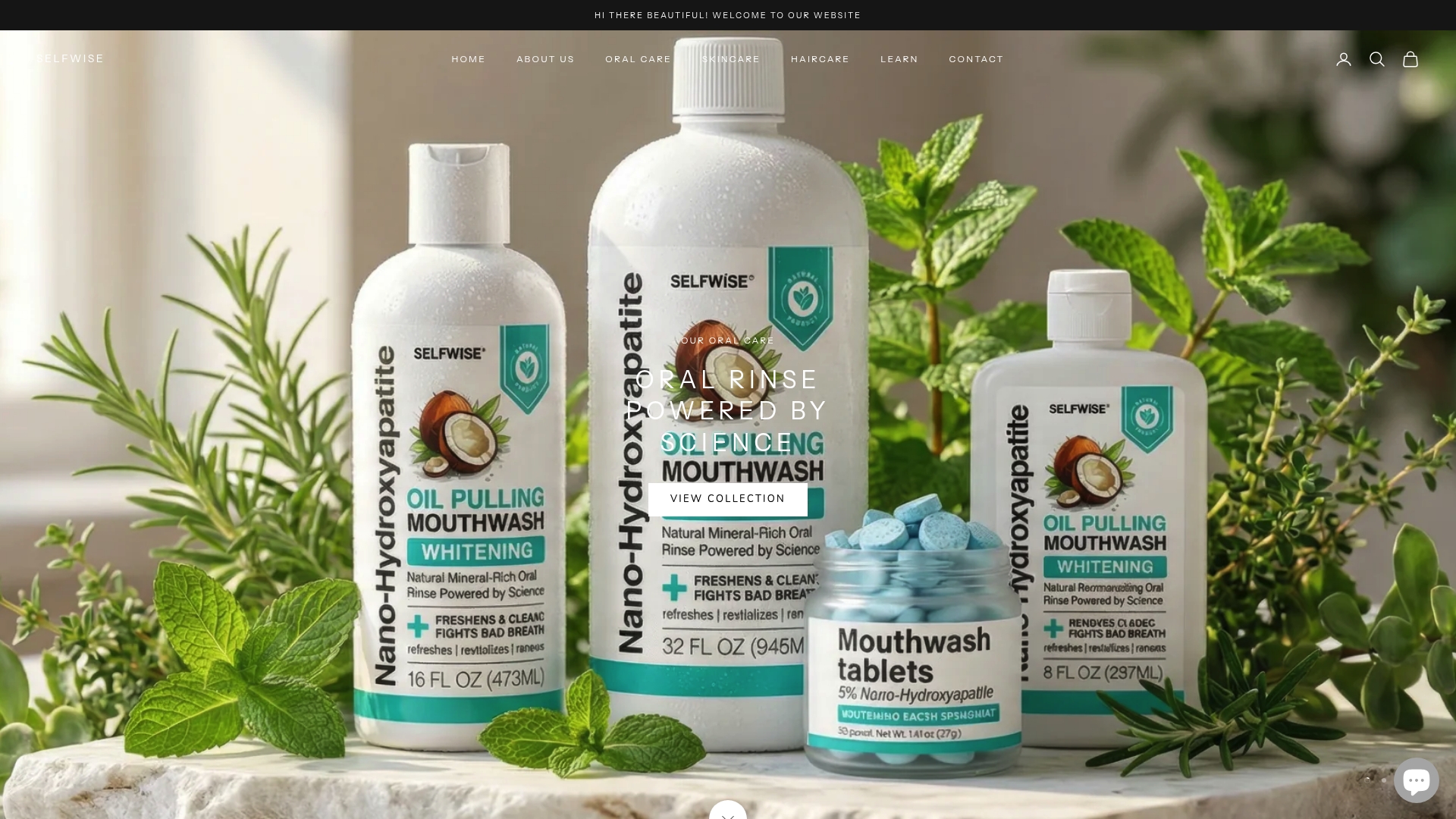
Selfwisebrand formulates its natural mouthwash collection without parabens or synthetic preservatives. The nano hydroxyapatite mouthwash tablets use nano hydroxyapatite and xylitol to support enamel remineralization and inhibit bacterial growth, with no need for paraben-based preservation. For a full paraben-free routine, the fluoride-free collection covers toothpaste alternatives and oil pulling products formulated with simple, transparent ingredients. Every product lists its full formula clearly, so you know exactly what you’re putting in your mouth.
FAQ
What are parabens used for in toothpaste?
Parabens prevent bacterial and fungal growth in water-based toothpaste formulas, extending shelf life and protecting against contamination. They appear on labels as methylparaben, propylparaben, or similar “-paraben” names.
Are parabens in mouthwash safe?
The FDA and CIR consider parabens safe in oral care at concentrations up to 0.8%. Oral care products produce minimal systemic exposure due to short contact time, though sensitive individuals may experience allergic reactions.
What are the best paraben-free dental products?
The best paraben-free dental products use alternatives like xylitol, nano hydroxyapatite, or essential oils and provide full ingredient transparency. Look for products with stated shelf life and stability testing rather than relying on front-of-pack claims alone.
How do I know if my oral care product contains parabens?
Scan the ingredient list for any word ending in “-paraben” or the chemical term “hydroxybenzoate.” Parabens appear near the end of the ingredient list because they’re used in small concentrations.
Do parabens in oral care cause hormonal disruption?
Lab studies show parabens can mimic estrogen at the cellular level, but no clinical study has established a causal link between oral care paraben use and hormonal disease in humans at typical exposure levels.