The Role of Medium Chain Triglycerides in Oral Care
Most people researching oil pulling eventually stumble on MCT oil and assume it’s just a purer form of coconut oil. That assumption leads to a lot of confusion. The role of medium chain triglycerides in oral care is genuinely distinct from what coconut oil does, and conflating the two means you’re probably not getting the results you’re looking for. This article breaks down exactly what separates purified MCTs from coconut oil, what the current evidence actually supports, and how to use MCT oil intelligently as part of a natural oral hygiene routine.
Table of Contents
- Key Takeaways
- The role of medium chain triglycerides in oral care starts with composition
- What the clinical evidence actually says
- How MCT oil interacts with biofilm and gum tissue
- How to build MCT oil into your oral hygiene routine
- Comparing MCT oil to other natural oils in oral care
- My take: cautious optimism, not hype
- Try Selfwisebrand’s natural oral care line
- FAQ
Key Takeaways
| Point | Details |
|---|---|
| MCTs differ from coconut oil | Purified MCT oils contain C8 and C10 fatty acids with no significant lauric acid, changing how they behave in the mouth. |
| Evidence favors coconut oil | Most clinical trials study coconut oil; MCT-specific oral care data is limited and should be interpreted carefully. |
| MCTs modulate biofilm gently | MCT oil loosens and restructures oral biofilm rather than aggressively disrupting it, which may preserve beneficial bacteria. |
| Floss before oil pulling | Breaking up interproximal plaque before rinsing significantly improves oil access to hard-to-reach areas. |
| Combine with proven ingredients | Pairing MCT oil with nano hydroxyapatite or xylitol-based products adds measurable enamel and microbiome support. |
The role of medium chain triglycerides in oral care starts with composition
Before you can evaluate what MCT oil does in your mouth, you need to understand what makes it chemically different from coconut oil. These are not interchangeable terms, and the distinction matters more than most wellness articles acknowledge.
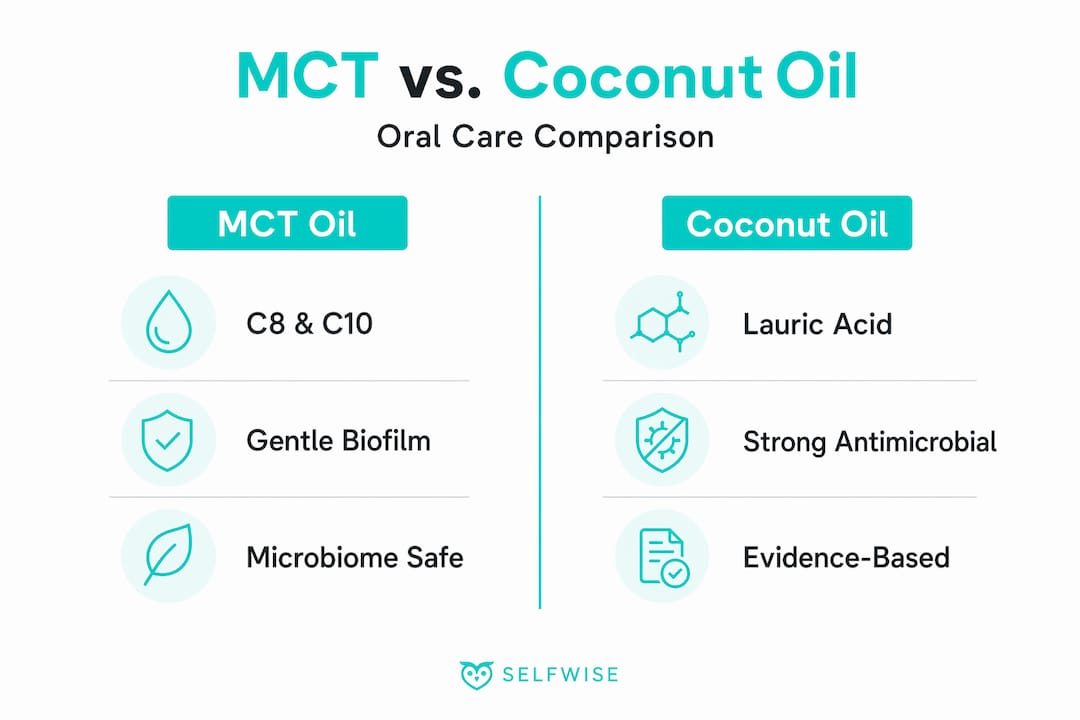
Coconut oil is roughly 50% lauric acid, a 12-carbon fatty acid (C12). Lauric acid is responsible for most of coconut oil’s documented antimicrobial effects in oral research. Purified MCT oils, by contrast, contain 95–100% C8 and C10 fatty acids (caprylic and capric acid) with negligible lauric acid. That single compositional difference changes the mechanism of action, the antimicrobial spectrum, and how each oil interacts with oral tissues.
In the mouth, oils interact with saliva, biofilm, and soft tissue simultaneously. Lauric acid works partly because it disrupts the cell membranes of gram-positive bacteria like Streptococcus mutans. C8 and C10 fatty acids do have antimicrobial properties, but their mechanisms differ and their specific effects on oral pathogens are less studied. Treating them as equivalent is where most MCT oral care claims fall apart.
| Property | MCT Oil (C8/C10) | Coconut Oil (C12 dominant) |
|---|---|---|
| Lauric acid content | Negligible | ~50% |
| Antimicrobial mechanism | Membrane disruption (mild) | Strong membrane lysis via lauric acid |
| Biofilm interaction | Loosening, restructuring | Aggressive disruption |
| Saponification potential | Lower | Higher |
| Texture in mouth | Light, liquid | Solidifies below 76°F |
| Clinical oral care trials | Very limited | Multiple RCTs available |
Pro Tip: When buying MCT oil for oral use, check the label for C8 and C10 percentages. Products marketed as “MCT” that list lauric acid as an ingredient are closer to fractionated coconut oil, not purified MCT oil.
What the clinical evidence actually says
The honest answer is that most of what you read about “MCT oil pulling” is actually extrapolated from coconut oil research. There is limited direct clinical evidence for purified MCT oils specifically in oral hygiene. The studies that do exist focus on coconut oil, and the results are genuinely promising for that ingredient.
Randomized controlled trials show that coconut oil reduces Plaque Index and Gingival Index at levels comparable to chlorhexidine mouthwash. That is a meaningful finding. But those results are driven in large part by lauric acid’s antimicrobial action and coconut oil’s saponification with salivary enzymes, which creates soap-like compounds that help mechanically dislodge biofilm. Purified MCT oils lack the lauric acid content to replicate this mechanism.
Here is what the evidence base currently looks like for oil-based oral care:
- Coconut oil pulling studies consistently show reductions in plaque and gingival inflammation, with effects attributed mainly to lauric acid’s antimicrobial action.
- No robust randomized controlled trials have been published specifically on purified MCT oils (C8/C10 only) for dental or gum health outcomes.
- A 2026 literature review confirms that coconut oil’s antimicrobial effects are attributed primarily to lauric acid, and MCT-specific oral efficacy remains unestablished.
- Oil adjuncts beyond coconut oil are showing promise in periodontal research: a triple-blind trial found that ozonated olive oil with probiotics significantly reduced plaque, bleeding, and pocket depth over 30 days.
- Delivery format and study design matter enormously. Consistent use and active ingredient pairing produce better outcomes than general oil rinsing alone.
This does not mean MCT oil has no place in oral hygiene. It means you should approach MCT-specific claims with appropriate skepticism and understand that its benefits likely operate through different mechanisms than coconut oil’s.
How MCT oil interacts with biofilm and gum tissue
This is where MCT oil’s actual oral health case gets more interesting. Rather than aggressively disrupting microbial membranes the way lauric acid does, MCT oil modifies biofilm by thinning and loosening the extracellular matrix. Think of it less as a sledgehammer and more as a solvent that gradually unglues the scaffold holding plaque together.
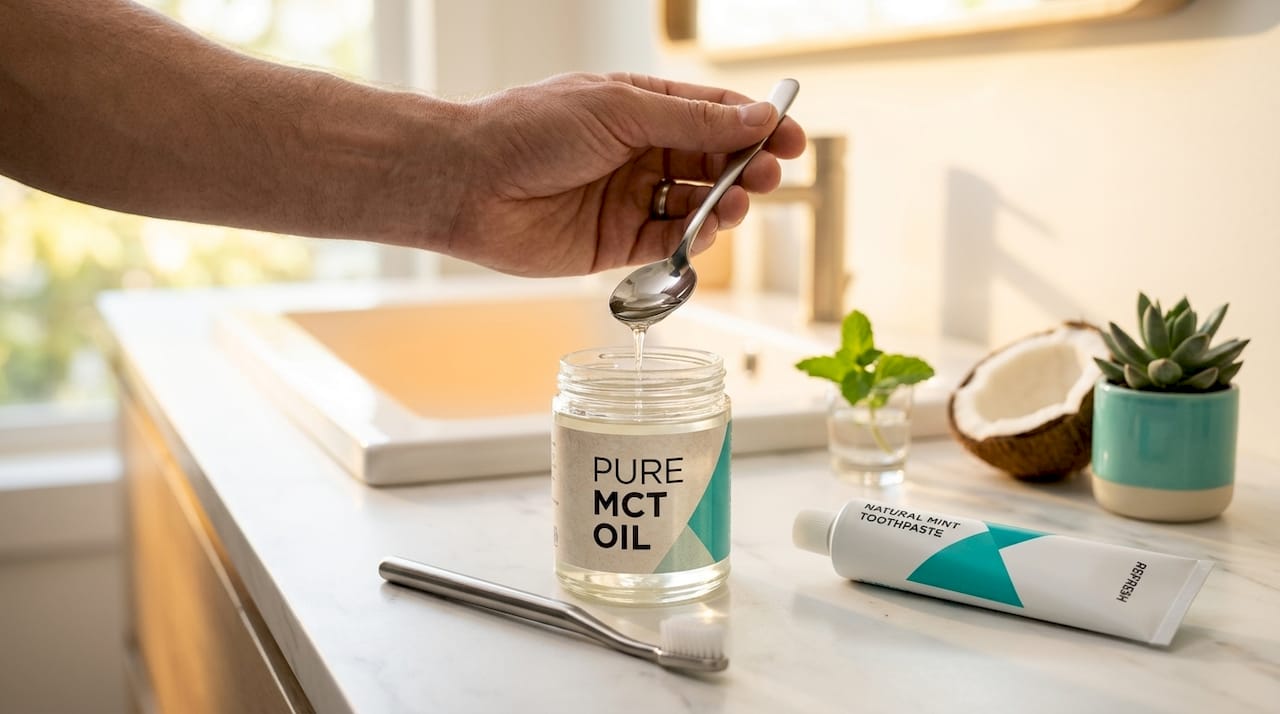
That distinction has real implications for your oral microbiome. MCT oil provides gentler biofilm modulation compared to coconut oil, which suggests it may preserve more of the beneficial bacteria in your mouth while still reducing pathogenic accumulation. Your oral microbiome is not the enemy. A thriving population of commensal bacteria actually protects you from pathogens, and aggressive antimicrobial treatments can disturb that balance.
A few practical considerations for getting the most out of MCT oil in your oral routine:
- Floss before oil pulling. Breaking plaque bridges before rinsing allows oil to reach interproximal spaces that are otherwise inaccessible. Most clinical protocols skip this step, which likely underestimates oil pulling’s effectiveness.
- Consider MCT blends that include co-actives like CoQ10 or bromelain. CoQ10 supports gum tissue health and bromelain has anti-inflammatory properties that may complement MCT’s biofilm effects.
- Be realistic about absorption. Questions remain about whether MCT oil’s fatty acids are absorbed directly through oral mucosal tissue and whether any systemic anti-inflammatory benefit occurs at rinsing concentrations.
Pro Tip: If you want the microbiome-protective angle of MCT oil and the antimicrobial strength of lauric acid, some practitioners suggest alternating MCT oil pulling days with coconut oil days rather than replacing one with the other entirely.
How to build MCT oil into your oral hygiene routine
Practical guidance here is necessarily adapted from coconut oil protocols, since no standard MCT-specific dosing protocol exists for oral care. Use this as a starting framework and adjust based on your own tolerance and results.
You can also explore natural oral care tips from Selfwisebrand for additional context on building an effective routine.
- Start with 10 mL. Common oil pulling studies use 10 to 15 mL. Begin at the lower end, especially if MCT’s lighter texture feels unusual compared to coconut oil.
- Pull for 2 to 10 minutes. Starting at 2 minutes and working toward 10 is reasonable. There is no clinical evidence that 20-minute sessions with MCT oil provide greater benefit than 10 minutes, given the different viscosity and mechanism.
- Floss first, then rinse. As noted above, mechanical preparation before oil pulling improves results. Make it a consistent step.
- Follow with brushing. Oil pulling should precede brushing, not replace it. Use a fluoride-free mouthwash or xylitol-containing rinse after brushing for layered protection.
- Store MCT oil properly. Unlike coconut oil, liquid MCT fractionated oil stays pourable at room temperature and does not need warming. Keep it sealed and away from direct sunlight.
- Be consistent for at least 4 weeks. Most oil pulling trials measure outcomes at 30 days minimum. Shorter trials do not capture biofilm remodeling effects.
If you are switching from coconut oil pulling, expect a lighter, less coating sensation. Some people prefer this. Others miss the thicker texture of coconut oil. Neither preference is wrong, but do not interpret the lighter feel as a sign that MCT oil is less effective.
Comparing MCT oil to other natural oils in oral care
MCT oil does not exist in isolation. Understanding how it fits alongside other natural oral care options helps you make genuinely informed choices rather than just chasing trends.
| Oil Type | Primary Mechanism | Clinical Evidence | Microbiome Impact | Best For |
|---|---|---|---|---|
| Coconut oil | Lauric acid antimicrobial, saponification | Multiple RCTs, plaque and gingival reduction | Moderate disruption | Plaque reduction, general oil pulling |
| MCT oil (C8/C10) | Biofilm loosening, gentle modulation | Very limited direct trials | Gentler, preserves commensals | Microbiome-conscious users |
| Ozonated olive oil | Oxidative antimicrobial, anti-inflammatory | RCT data with probiotics showing strong outcomes | Supportive with probiotics | Periodontal adjunct therapy |
| Sesame oil | Traditional Ayurvedic use, some antifungal | Smaller studies, moderate evidence | Relatively neutral | Traditional practice |
For gum and dental health, coconut oil currently holds the strongest evidence base. MCT oil’s value is in its gentler biofilm interaction and potential microbiome benefit, which suits people who are wary of disrupting their oral bacterial balance. Ozonated olive oil shows the most exciting emerging data when paired with probiotics, though it is less accessible for daily home use.
Understanding how coconut oil benefits compare to MCT oil for gum health specifically is worth reading before you commit fully to one approach.
My take: cautious optimism, not hype
I’ve watched the MCT oil conversation in oral care grow from a niche practitioner discussion into mainstream wellness territory, and most of what gets repeated online conflates coconut oil research with purified MCT claims. That bothers me, not because MCT oil is ineffective, but because the conflation sets false expectations and leads people to abandon a legitimate tool too quickly when it doesn’t replicate coconut oil’s results.
What I’ve found genuinely useful about MCT oil pulling is its texture, tolerability, and what appears to be a lighter touch on the microbiome. For people who have tried coconut oil pulling and found it too aggressive or disruptive to their oral bacterial balance, MCT oil is worth exploring. It won’t deliver lauric acid’s antimicrobial punch, and anyone who tells you otherwise is overstating the evidence.
The most important thing I’d tell anyone integrating MCT oil into their oral care routine is this: use it as one layer in a system, not as a standalone treatment. Pair it with nano hydroxyapatite for enamel support, xylitol for bacterial starving, and consistent mechanical hygiene. Future research may establish clearer protocols and stronger evidence for purified MCTs specifically. Until then, thoughtful, consistent use within a broader natural oral care routine is the most defensible approach.
— Viktor
Try Selfwisebrand’s natural oral care line
If you’re ready to put MCT oil pulling into practice alongside other evidence-backed natural ingredients, Selfwisebrand has built a product line designed for exactly this kind of routine.
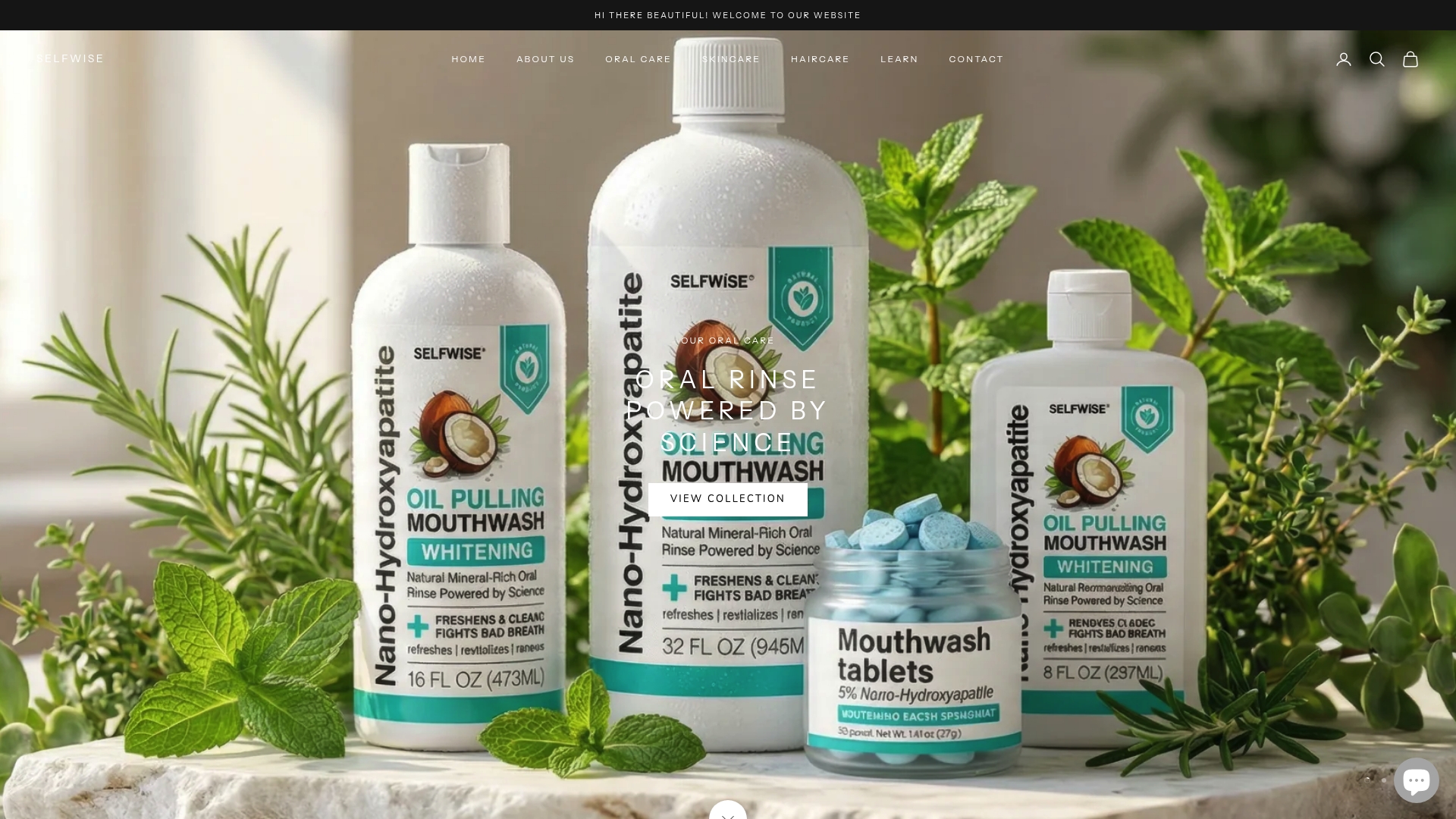
The nano hydroxyapatite oil pulling mouthwash combines MCT oil with nano hydroxyapatite for a formula that addresses both biofilm and enamel remineralization in one step. It’s fluoride-free, which matters if you’re building a cleaner routine without harsh chemicals. For a tablet-based option, the nano hydroxyapatite mouthwash tablets offer enamel support in a portable, minimal-waste format. Browse the full mouthwash collection to find the format that fits your routine best. Simple ingredients, real function, and nothing you don’t need.
FAQ
What makes MCT oil different from coconut oil for oral care?
MCT oil contains primarily C8 and C10 fatty acids with negligible lauric acid, while coconut oil is roughly 50% lauric acid. Since most of coconut oil’s antimicrobial benefits in oral care come from lauric acid, purified MCT oil works through a different and less documented mechanism.
Is there clinical evidence for MCT oil pulling?
Direct clinical evidence for purified MCT oil in oral hygiene is very limited. Most available studies focus on coconut oil, and MCT-specific oral care efficacy has not been established in robust randomized controlled trials as of 2026.
How long should you pull with MCT oil?
Based on adapted oil pulling protocols, 10 mL pulled for 2 to 10 minutes once daily is a reasonable starting point. No standardized MCT-specific protocol currently exists, so these guidelines are adapted from coconut oil studies.
Can MCT oil protect your oral microbiome better than coconut oil?
MCT oil appears to loosen and restructure biofilm more gently than coconut oil, potentially preserving more beneficial bacteria. This makes it a reasonable option for users focused on microbiome balance, though direct comparative microbiome data is limited.
Should you floss before or after MCT oil pulling?
Floss before oil pulling. Breaking up interproximal plaque first allows the oil to penetrate spaces it otherwise cannot reach, improving overall efficacy of the rinse.