Research Backed Xylitol Mouthwash Paired With Nano Hydroxyapatite
Xylitol mouthwash offers real but modest oral-health benefits, mainly by cutting levels of Streptococcus mutans, the bacteria most responsible for cavities. The evidence is stronger for xylitol delivered through gum and toothpaste than through rinses, and most mouthwash trials are small. Used consistently as a daily adjunct, a xylitol rinse such as Selfwise’s Xylitol Mouthwash with Nano Hydroxyapatite can support a lower-risk mouth environment, but it will not reverse existing decay.
TL;DR:
- Xylitol mouthwash provides a modest antibacterial effect mainly by reducing Streptococcus mutans and supporting saliva flow, but it does not actively remineralize enamel.
- Most evidence supports xylitol’s benefits through gum and toothpaste, with mouthwash effects shown in small, short-term studies that prioritize bacterial reduction over long-term cavity prevention.
- Optimal use involves swishing a low-concentration, alcohol-free rinse once or twice daily for a minute or two, combined with regular chewing gum or lozenges for continuous exposure.
- Xylitol is safe for humans at mouthwash doses but is highly toxic to dogs, requiring careful storage out of pet reach, and proper spitting to avoid systemic intake.
- It serves best as an adjunct in routines for dry mouth, frequent snackers, or those seeking a natural antimicrobial, but it cannot reverse existing cavities or replace fluoride or professional dental care.
Table of Contents
- How Does Xylitol Work in the Mouth?
- What Does the Clinical Evidence Actually Say?
- How Should You Use Xylitol Mouthwash for Best Results?
- Is Xylitol Mouthwash Safe? Side Effects to Know
- Where Xylitol Mouthwash Fits in Your Routine
- How Selfwise Applies the Science
- An Editorial Take on the Evidence
- Ready to Try a Xylitol Mouthwash That Does More
- Sources
- FAQ
How Does Xylitol Work in the Mouth?
Xylitol is a sugar alcohol that looks like sugar to bacteria but can’t be metabolized the way sugar can. Streptococcus mutans absorbs it anyway, then wastes energy trying to process it. Over repeated exposure, this starves the bacteria’s normal fermentation pathway and reduces their ability to produce the acid that erodes enamel. It also interferes with how these bacteria stick to tooth surfaces and to each other, which thins out the sticky biofilm that becomes plaque.
There’s a second mechanism at play, and it’s often overlooked: saliva. Xylitol has a mildly sweet taste that triggers salivary flow, and saliva does a lot of quiet work in the mouth. It buffers acid, washes away food debris, and carries calcium and phosphate ions that help stabilize enamel’s mineral surface. This saliva effect is part of why xylitol chewing gum tends to outperform other delivery methods in trials. Chewing itself stimulates flow, and the repeated, spaced-out exposure across the day gives bacteria less time to recover between doses.
It’s worth being precise about what xylitol does not do. Xylitol does not directly remineralize enamel the way fluoride or nano-hydroxyapatite does. Those ingredients supply mineral building blocks that integrate into the enamel’s crystal structure. Practitioner-level guidance is consistent on this point: xylitol’s job is antimicrobial suppression and saliva support, not active repair.
That distinction matters for how you think about a mouthwash formula. A rinse built only on xylitol is playing defense against bacteria. A rinse that pairs xylitol with a remineralizing agent is playing both defense and offense, which is the logic behind combination formulas gaining traction in newer research.
What Does the Clinical Evidence Actually Say?
The single most cited piece of evidence on xylitol and cavity prevention comes from a Cochrane review that pooled data from thousands of children. Fluoride toothpaste containing xylitol reduced caries in permanent teeth modestly over a period of several years compared to fluoride-only toothpaste, across a large dataset of participants. That’s a real effect, but Cochrane rated the underlying evidence as low quality, and the review found insufficient evidence to draw firm conclusions about other xylitol formats, including mouthwash specifically.
That gap matters because it’s the one people skip past. The strongest data point on xylitol’s caries benefit comes from toothpaste, not rinse, and reviewers were explicit that mouthwash hasn’t been studied with the same rigor.
Mouthwash-specific research does exist, and it points in a promising direction even if it’s thinner. A pilot randomized controlled trial testing a xylitol plus 920 ppm fluoride mouthwash against 0.2% chlorhexidine found the xylitol combination produced significant reductions in salivary S. mutans counts, performing comparably to chlorhexidine in that small sample. Chlorhexidine is the clinical gold standard for antimicrobial rinses, so a natural formulation landing in the same range, even in a pilot-scale trial, is a meaningful signal.
A separate randomized trial comparing xylitol, probiotic, and chlorhexidine mouth rinses in children and elderly participants found the same pattern: xylitol produced significant S. mutans reductions, and the difference between xylitol and chlorhexidine groups wasn’t statistically significant. Again, small sample sizes limit how much confidence you can place in that non-difference, but two independent trials landing on similar results is more reassuring than one.
Where the evidence gets shakier is scale and consistency. Systematic reviews synthesizing decades of xylitol research note heavy heterogeneity across delivery methods, dosing schedules, trial durations, and populations studied. Chewing gum shows the most consistent benefit, largely because of repeated low-dose exposure paired with saliva stimulation throughout the day. Mouthwash trials tend to be shorter, smaller, and less standardized, which is exactly the kind of risk-of-bias issue that keeps evidence grades low even when individual results look encouraging.
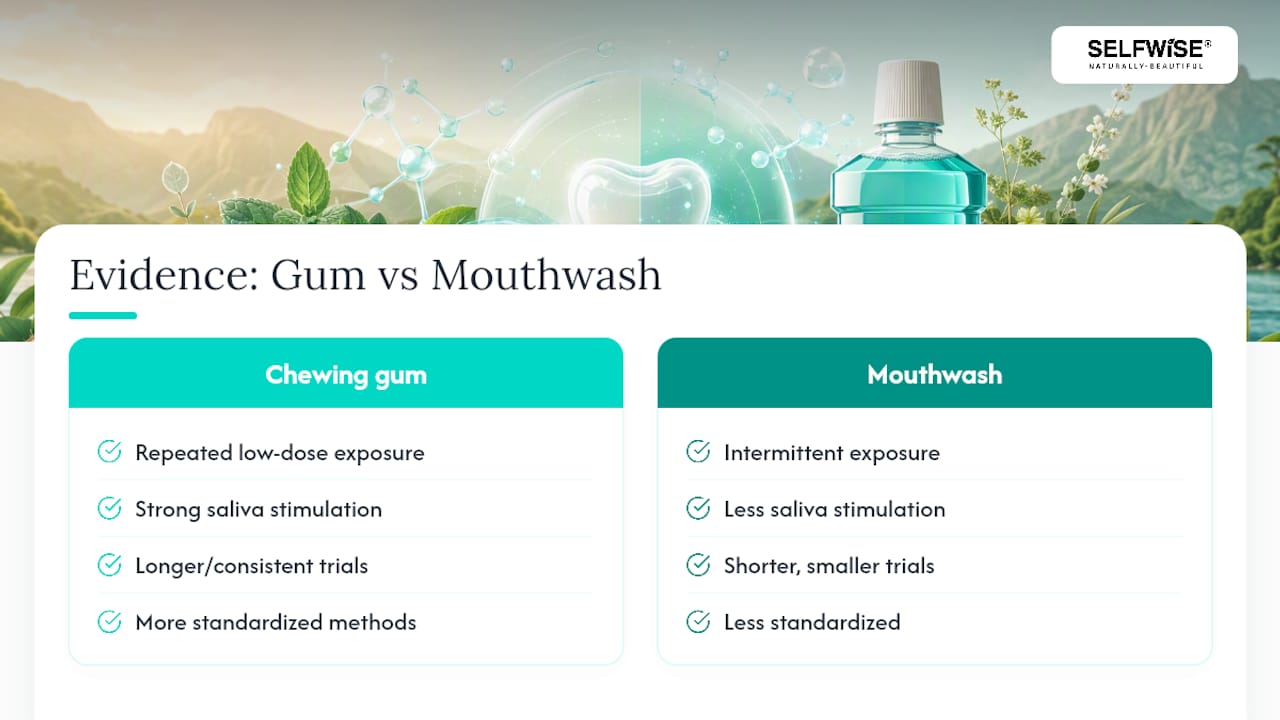
The realistic takeaway: xylitol mouthwash likely delivers a modest antimicrobial benefit as part of a broader routine. It is not a substitute for the caries-reduction data behind xylitol toothpaste, and it is not yet backed by large, long-term trials the way fluoride rinses are. Promising, not proven at scale.
How Should You Use Xylitol Mouthwash for Best Results?
Consistency beats intensity with xylitol. Trials generally use small daily doses, and most of the meaningful research on total-body xylitol exposure points to spreading intake across the day rather than one large dose.
- Rinse with a small dose of xylitol mouthwash once or twice daily, swishing for a full minute or two rather than a quick rinse.
- Check the label for xylitol concentration; many formulated rinses fall in a low single-digit percentage range, since a high concentration isn’t necessary for the antimicrobial effect to work.
- Look for whether the product also lists fluoride or nano-hydroxyapatite. If you’re avoiding fluoride, confirm the label states the formula is fluoride-free rather than assuming it.
- Choose an alcohol-free formula if you have a sensitive mouth, dry mouth, or are prone to irritation, since alcohol-based rinses can worsen both.
- Spit, don’t swallow. Rinses aren’t formulated for ingestion, and swallowing regularly adds unnecessary systemic xylitol intake for no added dental benefit.
If your goal is broader all-day protection rather than just a rinse routine, xylitol gum or lozenges have an edge, since they let you space out low doses of xylitol every couple of hours and stimulate saliva flow throughout the day. A mouthwash is a concentrated, convenient dose at set times; gum spreads exposure out. Many people get the best result using both.
Is Xylitol Mouthwash Safe? Side Effects to Know
At the doses used in mouthwash, xylitol is well tolerated. Clinical trials testing xylitol rinses report few adverse events in humans. Gastrointestinal upset, bloating, and a laxative effect show up mainly with large systemic doses, the kind you’d get from eating handfuls of xylitol-sweetened candy, not from swishing and spitting a rinse.
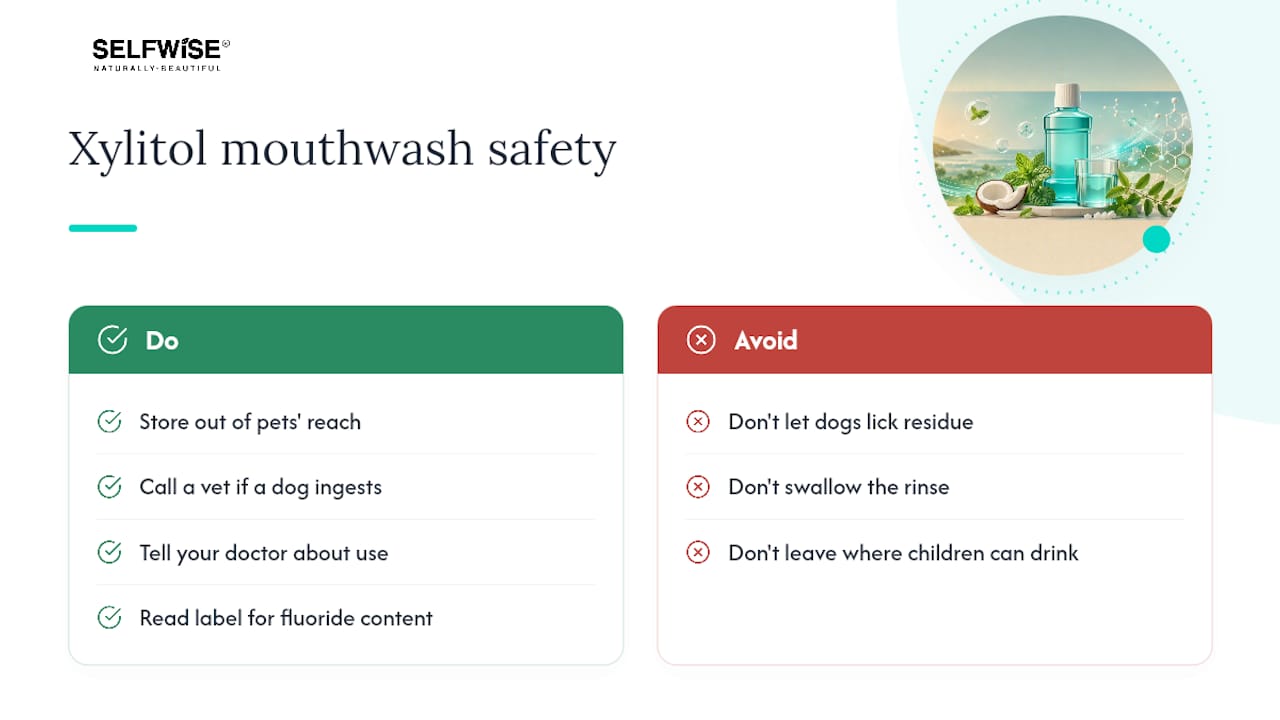
There is one warning that deserves to be stated plainly and without hedging: xylitol is highly toxic to dogs, even in small amounts. According to the Merck Veterinary Manual, xylitol ingestion in dogs can trigger severe hypoglycemia and liver failure, sometimes from quantities far smaller than a human would consider notable. Store xylitol mouthwash somewhere pets can’t reach it, and don’t let a dog lick a rinsed sink, a dropped cap, or a used cup. If a dog does ingest any xylitol product, treat it as a veterinary emergency and call your vet immediately.
For people, the main precautions are simpler: don’t swallow the rinse, keep it away from young children who might drink it out of curiosity, and if you have a medical condition affecting blood sugar or digestion, mention xylitol use to your doctor since it is a sugar alcohol. If you’re specifically avoiding fluoride for personal or medical reasons, read the label carefully. Some xylitol mouthwashes include fluoride and some don’t, and that distinction is easy to miss if you’re scanning for the word “xylitol” alone.
Where Xylitol Mouthwash Fits in Your Routine
Xylitol mouthwash works as an adjunct, not a replacement for brushing, flossing, or fluoride treatment where your dentist recommends it. Think of it as one more layer of defense rather than the whole defense system.
It earns its place most clearly in a few specific situations: people with dry mouth who need extra saliva support, frequent snackers whose teeth face more acid exposure throughout the day, and anyone caries-prone who wants a natural-leaning antimicrobial option instead of leaning solely on synthetic rinses, such as those found in organic lip balm from Feared Beard.
What it cannot do is fix a cavity that already exists. Xylitol suppresses bacteria and supports saliva; it doesn’t rebuild enamel that’s already broken down structurally. If you have active decay, that requires a dentist, not a rinse. Where xylitol mouthwash gets genuinely interesting is in combination: pairing it with a fluoride toothpaste, or with a nano-hydroxyapatite rinse that supplies the mineral component xylitol lacks on its own. That combination addresses both sides of the problem: fewer cavity-causing bacteria, and stronger raw material for enamel to draw on.
How Selfwise Applies the Science
Selfwise’s Xylitol Mouthwash with Nano Hydroxyapatite is built around that exact pairing. Xylitol handles the antimicrobial and saliva-support side; nano-hydroxyapatite supplies the mineral particles that support enamel’s surface. That division of labor mirrors what formulation research on combination rinses has been testing: antimicrobial suppression paired with an enamel-supporting agent, without the harsh taste or tissue irritation that comes with chlorhexidine.
When you’re comparing formulas, a few features are worth checking:
- Alcohol-free, so the rinse doesn’t dry out or irritate the mouth over daily use.
- A clearly labeled xylitol percentage and a stated position on fluoride, so you know exactly what you’re using.
- No harsh synthetic additives that can offset the gentleness xylitol is supposed to bring to a routine.
Pro Tip: Pair your mouthwash with an oil-pulling routine a few times a week rather than daily. Oil pulling works on a different mechanism (mechanical bacterial pull-out through swishing oil), so it complements a xylitol rinse instead of duplicating it.
An Editorial Take on the Evidence
The gap between what xylitol marketing implies and what the data supports is real, and it’s worth sitting with. The strongest evidence backs xylitol toothpaste and gum. Mouthwash evidence is smaller, promising, and not yet definitive. That’s not a reason to skip it. It’s a reason to use it with realistic expectations: a helpful daily habit that nudges bacterial counts down, not a cure for cavities you already have.
If you’re caries-prone, have dry mouth, or just want a gentler daily rinse than chlorhexidine, xylitol mouthwash is a reasonable, low-risk addition. If you have active decay or a high-risk history, talk to your dentist before assuming any rinse will do the heavy lifting. And keep it locked away from pets. That warning isn’t boilerplate. It’s the one part of this evidence base with zero ambiguity.
— Viktor
Ready to Try a Xylitol Mouthwash That Does More
Most xylitol rinses stop at antimicrobial support and leave enamel out of the equation entirely. Selfwise’s Xylitol Mouthwash with Nano Hydroxyapatite pairs the bacteria-fighting side of xylitol with a mineral ingredient that supports enamel strength, in a formula that skips alcohol and harsh chemicals entirely.
If you’re building a natural routine from the ground up, browse the full mouthwash collection to compare formulas, or check the natural oral care guide for how to sequence xylitol rinse, brushing, and flossing into one routine. And if you have dogs or small kids at home, store the bottle somewhere out of reach. Ready to switch? Add the xylitol and nano-hydroxyapatite rinse to your cart and give it a full two to three weeks of daily use before judging results. That’s roughly how long saliva and bacterial-count changes take to become noticeable.
Sources
- Cochrane evidence summary: Can xylitol used in products help prevent tooth decay in children?
- Comparison of the effect of 0.2% chlorhexidine and xylitol plus 920 ppm fluoride mouthwashes on salivary Streptococcus mutans (PMC)
- Antimicrobial efficacy of Xylitol, Probiotic and Chlorhexidine mouth rinses among children and elderly — RCT (PubMed)
- Antimicrobial activity, biocompatibility and anti-inflammatory properties of CPC-based mouthwash containing sodium fluoride and xylitol (PubMed)
FAQ
Is Xylitol in Mouthwash Actually Good for Your Teeth?
Yes, within limits. Clinical trials show xylitol rinses can meaningfully reduce S. mutans bacteria levels, though the evidence for mouthwash specifically is smaller and less conclusive than the data behind xylitol gum and toothpaste.
Does Xylitol Mouthwash Rebuild Your Teeth?
No. Xylitol suppresses cavity-causing bacteria and supports saliva flow, but it doesn’t remineralize enamel the way fluoride or nano-hydroxyapatite does, according to practitioner-level guidance on xylitol’s mechanism.
What Are the Side Effects of Xylitol Mouthwash?
At mouthwash doses, human side effects are minimal, with trials reporting few adverse events. The one non-negotiable warning is pet safety: xylitol is severely toxic to dogs, per the Merck Veterinary Manual, so store any xylitol rinse well out of reach.
What Are the Downsides of Xylitol in General?
The main downside is digestive: large systemic doses, typically from eating a lot of xylitol-sweetened food rather than rinsing with mouthwash, can cause bloating or a laxative effect. The mouthwash-specific downside is that the supporting evidence is still thinner than for xylitol gum or toothpaste.
Is Xylitol Safe to Use in a Daily Mouthwash?
Yes, for most adults and older children who won’t swallow it. Spit rather than swallow, keep it away from pets and young kids, and mention xylitol use to your doctor if you have a condition affecting blood sugar.