What is hydroxyapatite made of? Your oral care guide
Most people assume that anything described as a “mineral” in a dental product is some lab-engineered chemical they’d rather avoid. The reality is almost the opposite. Hydroxyapatite is a mineral your body already knows intimately — it forms the very structure of your teeth and bones. Understanding exactly what it’s made of, where it comes from, and how it compares to the ingredients typically found in conventional oral care products gives you a real foundation for making smarter, cleaner choices for your mouth.
Table of Contents
- What is hydroxyapatite? The basics
- The chemical composition of hydroxyapatite
- Natural versus synthetic: Variations and substitutions
- Hydroxyapatite in your teeth: Real-world composition
- Choosing truly natural oral care: Why composition matters
- The truth most oral care guides miss about hydroxyapatite’s “natural” label
- Elevate your oral care with natural hydroxyapatite solutions
- Frequently asked questions
Key Takeaways
| Point | Details |
|---|---|
| Natural mineral makeup | Hydroxyapatite consists of calcium, phosphate, and hydroxide found in human teeth and bones. |
| Minor variations matter | Trace elements and ion substitutions mean no two hydroxyapatite sources are exactly alike. |
| Check product labels | Look for hydroxyapatite or Ca5(PO4)3(OH) on ingredient lists for authentic natural oral care. |
| Highly biocompatible | Hydroxyapatite matches your teeth’s own mineral structure, making it a safe, effective choice. |
What is hydroxyapatite? The basics
Hydroxyapatite has roots that go far deeper than any oral care trend. It’s a calcium phosphate mineral found abundantly in nature, in rocks, soil, and most importantly inside your own body. Your teeth and bones are built from it. That’s not a marketing claim — it’s basic biology.
What makes hydroxyapatite unique among oral care minerals is exactly this body-identical quality. When you apply it to your teeth, you’re essentially offering your enamel the same raw material it’s constructed from. It doesn’t need to be converted or processed by your body to do its job. It’s recognized, absorbed into the enamel surface, and used directly.
As a naturally occurring calcium phosphate mineral, hydroxyapatite carries the chemical formula Ca5(PO4)3(OH), sometimes written as Ca10(PO4)6(OH)2 when representing the full unit cell. Those letters and numbers aren’t intimidating once you break them down: calcium (Ca), phosphate (PO4), and a hydroxide group (OH). That’s it. No exotic compounds. No petroleum derivatives. Just minerals.
Here’s why this matters for your oral care routine:
- Hydroxyapatite is biocompatible, meaning your body doesn’t treat it as foreign
- It integrates directly with your existing enamel structure
- It naturally supports the remineralization process your teeth undergo every day
- It doesn’t require synthetic activators or carriers to work
- It positions itself as a natural solution for stronger teeth without relying on fluoride
“Hydroxyapatite stands apart from most oral care ingredients because it’s not trying to create a new chemical reaction in your mouth — it’s simply giving your teeth back what they’re already made of.”
When you see the word “mineral” on an oral care label, hydroxyapatite is the kind of mineral that deserves your trust. Unlike many synthetic chemical compounds found in conventional products, hydroxyapatite has a structural relationship to your body. That’s a distinction worth understanding, and it’s also one reason Selfwise leans on it as a core ingredient alongside other natural skincare ingredients that prioritize body-compatible chemistry.
The chemical composition of hydroxyapatite
Now that we’ve set the stage for why hydroxyapatite is important for oral health, let’s break down exactly what it’s made of.
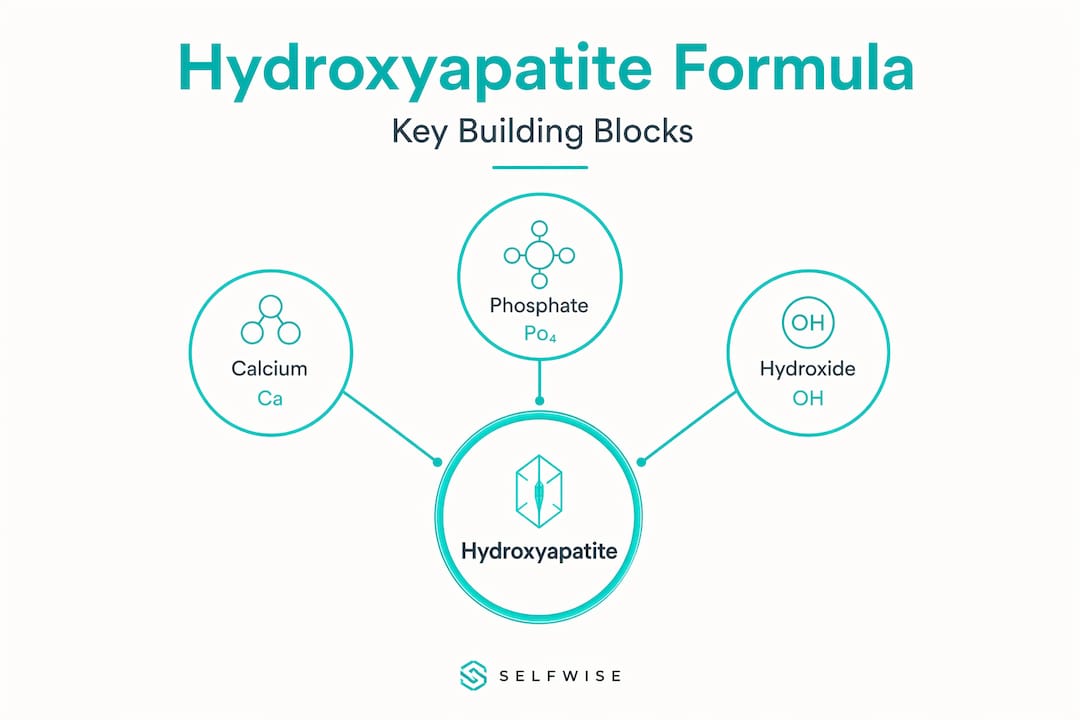
The chemical formula Ca5(PO4)3(OH), with a corresponding molecular formula of Ca5HO13P3, tells a precise story. Each element plays a distinct role in what makes this mineral so effective.
| Component | Chemical symbol | Role in the mineral |
|---|---|---|
| Calcium | Ca | Provides structural strength and hardness |
| Phosphate | PO4 | Bonds with calcium to form the mineral lattice |
| Hydroxide | OH | Stabilizes the crystal structure |
| Full unit cell | Ca10(PO4)6(OH)2 | Represents two formula units stacked together |
What’s striking about this table is how recognizable everything is. Calcium is the same mineral in milk and leafy greens. Phosphate is in almost every food you eat. Hydroxide is simply oxygen bonded to hydrogen. There are no mystery compounds here. Nothing on this list would alarm a clean-ingredient advocate.
This clarity is exactly what makes how hydroxyapatite is used in skincare and oral care such an interesting story. The same ingredient that supports enamel can also appear in skin-care formulations because it’s that well-tolerated by the body.
Understanding the formula also gives you a practical superpower when shopping: you can identify real hydroxyapatite on a label without needing a chemistry degree. Look for “hydroxyapatite,” “nano-hydroxyapatite,” “Ca5(PO4)3(OH),” or “hydroxylapatite.” Any of these confirms the real thing.
Pro Tip: When reading oral care product ingredient lists, search specifically for “nano-hydroxyapatite” or the formula Ca5(PO4)3(OH). This tells you the product contains a true remineralizing agent that your enamel can actually use, not just a calcium additive with limited clinical backing.
Understanding its chemical foundation sets the stage for appreciating how small variations can occur — let’s examine how hydroxyapatite can differ in real life.
Natural versus synthetic: Variations and substitutions
Pure hydroxyapatite, as written in a textbook, has a fixed formula. But nature doesn’t always follow the textbook. The hydroxide (OH−) part of hydroxyapatite can be partially replaced by other ions, such as fluoride or chloride, forming related minerals like fluorapatite or chlorapatite. This is called ionic substitution, and it happens both in nature and during manufacturing.
Variations in ion substitutions and manufacturing stoichiometry mean that different samples of hydroxyapatite can differ slightly even when they share the same name. This isn’t a flaw — it’s a feature of how minerals behave in living systems and how the body works with them.
Here’s a breakdown of the most common substitutions and what they mean:
- Fluoride (F−) replacing OH−: Creates fluorapatite, which is harder and more acid-resistant. It’s what fluoride toothpaste aims to create in the mouth.
- Chloride (Cl−) replacing OH−: Creates chlorapatite, found in trace amounts in natural enamel.
- Carbonate (CO3²−) replacing phosphate: Very common in biological apatite, it makes the mineral slightly more soluble.
- Magnesium (Mg²+) replacing calcium: Present in bone and dentin; affects crystal size and dissolution rate.
- Sodium (Na+) replacing calcium: Small amounts appear naturally in enamel.
| Type | Key substitution | Found in teeth? | Common in products? |
|---|---|---|---|
| Pure hydroxyapatite | None | Rare | Yes (lab-made) |
| Carbonated apatite | Carbonate for phosphate | Yes | Sometimes |
| Fluorapatite | Fluoride for hydroxide | Yes (surface) | Yes (fluoride products) |
| Magnesium-substituted | Magnesium for calcium | Yes (dentin) | Rare |
This is where the nature of tooth minerals gets genuinely fascinating. The hydroxyapatite in your mouth right now isn’t the idealized, perfectly pure version from a chemistry textbook. It’s a biologically impure, trace-element-rich version that forms during how tooth enamel forms through a process called biomineralization.
That biological “impurity” is actually part of why hydroxyapatite works so well as an oral care ingredient. Lab-produced nano-hydroxyapatite can be tuned to closely mimic this natural profile, making it far more compatible with existing enamel than a one-size-fits-all synthetic approach.
With a grasp of hydroxyapatite’s variations, you’re now ready to see how it actually makes up your teeth.
Hydroxyapatite in your teeth: Real-world composition
Here’s the number that puts everything in perspective: mature tooth enamel is 95 to 97% hydroxyapatite by weight. The remaining fraction consists of less than 1% organic material (primarily proteins) and 2 to 4% water. Your teeth are overwhelmingly mineral, and that mineral is hydroxyapatite.
In teeth and enamel, hydroxyapatite is the dominant mineral phase, and the apatite fraction includes trace substitutions such as carbonate, magnesium, and fluorine. These trace elements aren’t contaminants — they’re integral to how enamel functions, how it handles acid exposure, and how it repairs itself through remineralization.
How does enamel actually form? Here’s a simplified look at the process:
- Ameloblast cells secrete proteins that create a soft, flexible matrix in developing teeth
- Calcium and phosphate ions migrate into this matrix from surrounding fluids
- Hydroxyapatite crystals nucleate (begin forming) around the protein scaffold
- Crystals grow and pack together, progressively mineralizing the enamel
- Proteins are gradually removed, leaving a tightly packed mineral structure
- Trace elements integrate into the crystal lattice during and after formation, adding biological variation
This sequence helps explain why nano-hydroxyapatite is so compatible with tooth enamel structure. When you use it in a mouthwash or toothpaste, you’re not forcing a foreign substance onto your enamel. You’re providing the same mineral building blocks the enamel used during its original formation.
Real-world enamel apatite isn’t perfectly pure. It’s slightly carbonated, slightly substituted with magnesium and sodium, and traces of fluoride appear particularly at the enamel surface. This makes it more soluble than pure lab hydroxyapatite — which sounds like a negative, but it actually means enamel can participate dynamically in remineralization cycles with the saliva and the oral environment every single day.
Choosing truly natural oral care: Why composition matters
Now that you know what hydroxyapatite is made of — both in the lab and in your body — let’s clear up what this means for choosing truly natural, effective oral care ingredients.
Knowing the composition of an ingredient isn’t just a science exercise. It gives you genuine leverage as a consumer. When you understand that hydroxyapatite is calcium, phosphate, and hydroxide — all naturally occurring, all body-compatible — it becomes easier to evaluate claims on packaging with a clear head rather than relying on buzzwords.
Here’s a practical checklist for identifying genuine hydroxyapatite in natural oral care options:
- Check the full ingredient name: Look for “hydroxyapatite,” “nano-hydroxyapatite,” or “hydroxylapatite”
- Look for the formula: Ca5(PO4)3(OH) on a label confirms it’s the real compound
- Verify it’s listed early: Ingredients are listed by concentration, so placement matters
- Avoid vague “calcium mineral” claims: Without a specific name or formula, the ingredient may not be effective hydroxyapatite
- Consider particle size: Nano-hydroxyapatite (nano-HAp) is specifically formulated for enamel compatibility and deeper integration
Beyond identifying the ingredient, pairing hydroxyapatite with complementary natural compounds amplifies its effectiveness. Xylitol, for example, inhibits the bacteria that produce the acids responsible for enamel erosion — giving hydroxyapatite a cleaner environment in which to remineralize.
Pro Tip: For the most effective natural remineralization routine, combine nano-hydroxyapatite with xylitol. The xylitol reduces bacterial acid load while the hydroxyapatite deposits directly into softened enamel. Check out these natural dental product tips to find combinations that work together instead of against each other.
Hydroxyapatite also supports a fluoride-free approach without sacrificing science. Clinical studies consistently show it equals fluoride for remineralization when used in nano form. For health-conscious people who want to reduce their chemical exposure without abandoning effective enamel support, this is a meaningful distinction.
The truth most oral care guides miss about hydroxyapatite’s “natural” label
Here’s what most guides don’t say out loud: lab-made nano-hydroxyapatite is not identical to what’s in your teeth, and that’s actually fine. The obsession with “100% natural” can sometimes lead people away from ingredients that are genuinely body-compatible, simply because they were produced in a controlled environment rather than mined from a rock.
The real question is not whether an ingredient was touched by human hands in a lab. The real question is whether it matches your body’s own chemistry closely enough to be useful and safe. On that measure, nano-hydroxyapatite scores exceptionally well. Its crystal structure mirrors biological apatite. Its elemental composition is identical. Its behavior on the enamel surface is well-documented by clinical research.
What we’ve seen in natural oral care is a tendency to treat “natural” as if it means untouched and unprocessed. But the most effective version of hydroxyapatite for oral care — nano-HAp — is precisely engineered to a particle size that allows deep integration into enamel pores. That precision doesn’t make it less natural. It makes it more effective.
The ingredient transparency that truly matters isn’t about whether something was extracted from a mineral spring or synthesized in a lab. It’s about whether you know what the ingredient is, what it does, and whether it’s appropriate for your body. Hydroxyapatite, in all its forms, passes that test.
Our natural oral care guidance has always been built on this principle: choose ingredients that are body-aligned, science-backed, and free of unnecessary additives — not just ingredients that sound natural. Hydroxyapatite is a rare case where those two things converge completely. It sounds like nature because it is nature, and it works because the science confirms it.
Elevate your oral care with natural hydroxyapatite solutions
If this article has shifted how you think about what goes into your oral care routine, the next step is simpler than you’d expect.
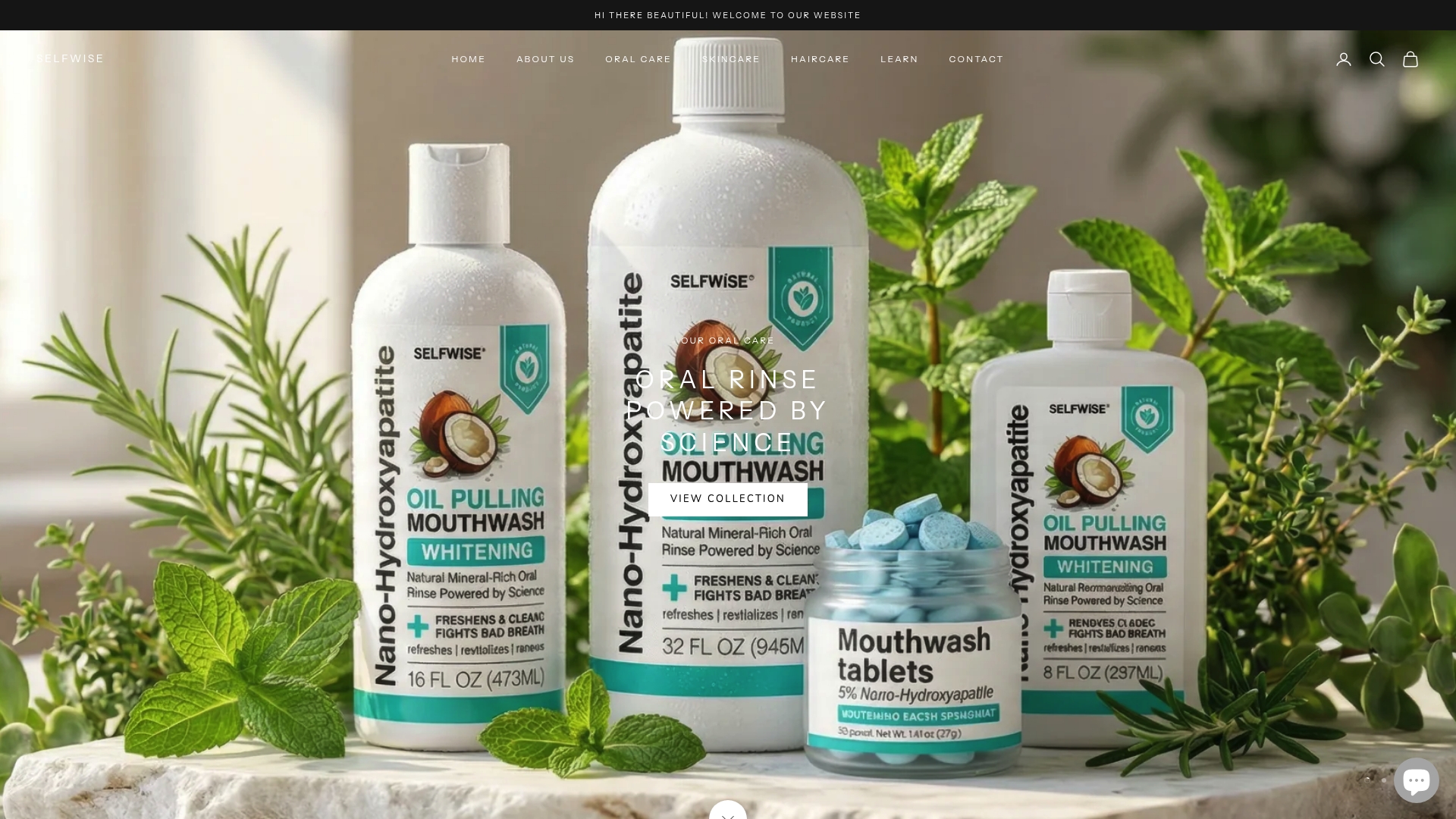
At Selfwise, every product we formulate starts with ingredient transparency and body-compatible chemistry. Our nano hydroxyapatite mouthwash tablets deliver concentrated remineralization in a zero-waste, travel-friendly format. For those who prefer a traditional liquid experience with a functional twist, our hydroxyapatite oil pulling mouthwash combines the ancient practice of oil pulling with nano-hydroxyapatite for a genuinely modern natural routine. If you’re building a complete routine away from synthetic fluoride, explore our full range of fluoride-free oral care options designed for health-conscious people who want real results from simple ingredients.
Frequently asked questions
Is hydroxyapatite naturally found in the human body?
Yes — hydroxyapatite is the dominant mineral phase in human teeth and bones, making it one of the most body-compatible minerals used in oral care.
What elements make up hydroxyapatite?
Hydroxyapatite is made of calcium, phosphate, and hydroxide ions, as confirmed by its chemical formula Ca5(PO4)3(OH). These are all naturally occurring, body-compatible elements.
Can hydroxyapatite contain fluoride like in toothpaste?
Yes — the hydroxide part of hydroxyapatite can be replaced by fluoride ions, forming fluorapatite, which is also found naturally in tooth enamel, particularly at the surface layer.
How can I identify real hydroxyapatite in oral care products?
Look for “hydroxyapatite,” “nano-hydroxyapatite,” or the formula Ca5(PO4)3(OH) on the ingredients list — these confirm you’re getting a genuine, clinically recognized remineralizing agent.
Is hydroxyapatite safe and effective for remineralizing teeth?
Clinical evidence consistently shows hydroxyapatite is biocompatible, well-tolerated, and effective at supporting enamel remineralization, with a growing body of research indicating it performs comparably to fluoride in certain applications.