Hydroxyapatite: A natural solution for stronger teeth
Most people assume fluoride is the only proven way to protect their enamel. But here’s what’s rarely mentioned: your teeth are already built from a mineral called hydroxyapatite, which makes up the majority of enamel and dentin. Now, scientists and oral care brands are harnessing this same mineral in a synthetic form to rebuild and protect teeth naturally. This guide breaks down exactly what hydroxyapatite is, how it works in your mouth, and why it’s becoming the ingredient that health-conscious oral care routines are built around.
Table of Contents
- What is hydroxyapatite? The science behind your smile
- How hydroxyapatite works in your mouth
- Hydroxyapatite vs fluoride: Benefits, risks, and key differences
- How to use hydroxyapatite in your oral care routine
- Our take: Why hydroxyapatite matters more than you think
- Upgrade your oral care with hydroxyapatite-based solutions
- Frequently asked questions
Key Takeaways
| Point | Details |
|---|---|
| Natural tooth mineral | Hydroxyapatite is the main mineral found in enamel and dentin, making it a natural choice for oral care. |
| Clinically proven results | HA-based products can effectively remineralize teeth, reduce sensitivity, and prevent cavities, rivaling fluoride’s benefits. |
| Safety and compatibility | Nano-hydroxyapatite is non-toxic, biocompatible, and safe for children and those avoiding fluoride. |
| Simple to use | Switching to HA products is easy—just replace your toothpaste or mouthwash for advanced, natural protection. |
What is hydroxyapatite? The science behind your smile
Hydroxyapatite (HA) is a naturally occurring calcium phosphate mineral. It’s not a lab invention or a trendy supplement. It’s the same mineral your body uses to construct your teeth and bones. In fact, enamel is 95–98% mineral by weight, primarily hydroxyapatite, arranged in tightly packed crystalline rods that make enamel the hardest tissue in the human body.
The specific ratio varies by location in the tooth. Hydroxyapatite forms 96% of enamel by weight and 70–80% of dentin, the layer beneath the enamel. That difference matters because enamel is almost entirely mineral while dentin contains more protein fibers, which gives it a slightly more flexible quality.
Here’s a quick look at how HA compares across tooth structures:
| Tooth structure | Hydroxyapatite content | Other components |
|---|---|---|
| Enamel | 96% by weight | Water, proteins |
| Dentin | 70–80% by weight | Collagen fibers, water |
| Cementum | ~65% by weight | Organic matrix, water |
| Bone | ~60–70% by weight | Collagen, marrow |
What makes HA so effective as a structural mineral is its crystalline arrangement. In enamel, crystals align in rods that run perpendicular to the tooth surface. This orientation distributes bite force efficiently and resists fracture better than a random arrangement would.
Key characteristics of hydroxyapatite that matter for oral health:
- Biocompatibility: Your body naturally produces and integrates HA, so it doesn’t trigger immune responses or irritation
- Mineral density: Its high calcium and phosphate content makes it naturally hard and resistant to wear
- Ion exchange: HA can absorb and release calcium and phosphate ions, which supports ongoing remineralization
- Biological HA variation: Natural HA in your body contains trace elements like carbonate and magnesium, which slightly increases solubility compared to pure synthetic HA
For a broader context on building a routine around ingredients like this, the natural oral care guide from Selfwise is a great starting point.
Understanding HA as a mineral means understanding what’s actually at stake when acids from food, bacteria, and plaque attack your enamel. You’re not just losing “protective coating.” You’re losing the very material your teeth are made of, crystal by crystal.
How hydroxyapatite works in your mouth
Knowing what HA is made of only tells part of the story. The more interesting question is what it does once you apply it topically, in the form of toothpaste, mouthwash, or other oral care products.
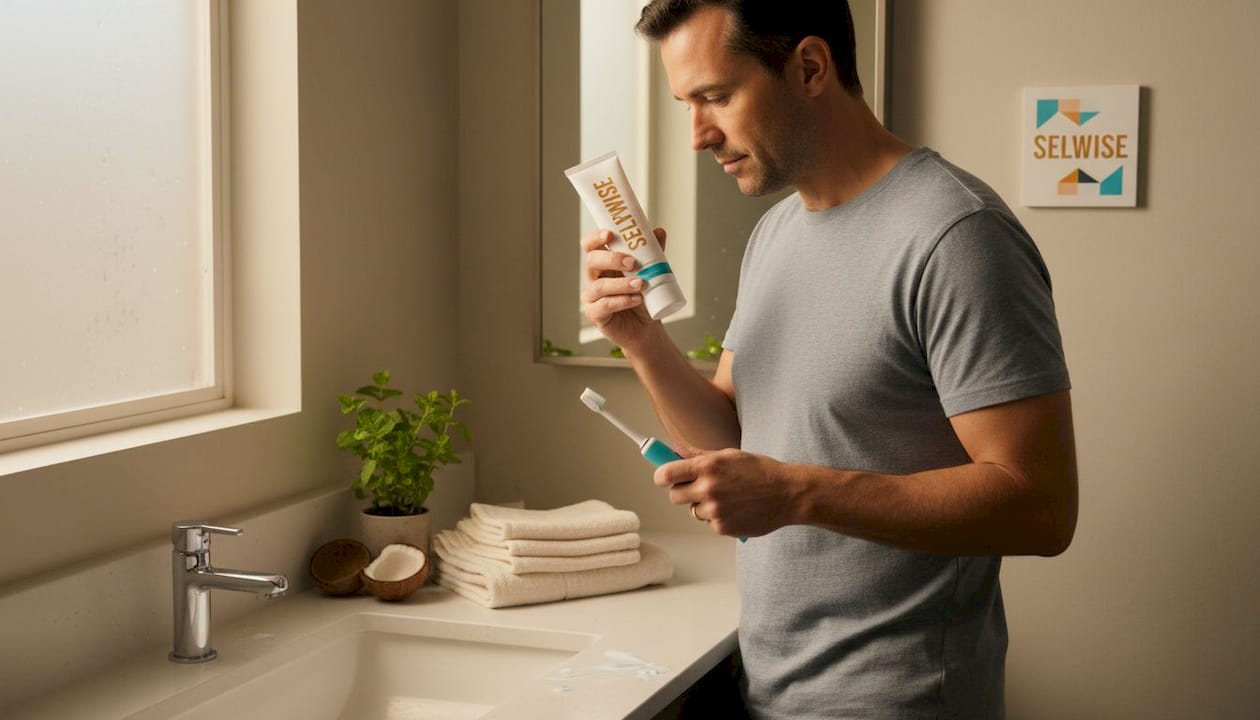
The key is particle size. Nano-hydroxyapatite (nHA) refers to HA particles engineered at the nanometer scale, small enough to physically enter microcracks and surface pores in enamel. When you brush with an nHA toothpaste, those particles settle into weakened areas and deposit calcium and phosphate directly onto the enamel surface.
Here’s how the remineralization process works step by step:
- Acid attack: Bacteria in plaque produce acids that dissolve calcium and phosphate from enamel, creating microscopic defects
- nHA contact: nHA particles in your toothpaste or mouthwash reach the tooth surface and come into contact with demineralized zones
- Crystal integration: The nHA particles physically plug microdefects and provide a mineral scaffold for new crystal growth
- Surface restoration: Over repeated applications, mineral density increases and the surface becomes smoother and more reflective (a key sign of healthy enamel)
- Ongoing protection: A thin layer of adsorbed HA on the tooth surface acts as a buffer against future acid attacks
Synthetic nano-HA biomimetically remineralizes enamel, reduces sensitivity, and prevents caries, according to a scientific opinion from the European Commission’s Scientific Committee on Consumer Safety. This is significant. It confirms what many smaller studies had already suggested: nHA isn’t just a feel-good ingredient. It has real clinical backing.
“Nano-hydroxyapatite works because it mimics the exact mineral your enamel is trying to rebuild itself with. It’s not a workaround. It’s giving your teeth exactly what they need.”
Tooth sensitivity is another area where nHA excels. Sensitivity typically occurs when dentin tubules (tiny channels that connect the inner pulp to the outer surface) are exposed due to enamel erosion or gum recession. nHA particles are small enough to physically block these tubules, reducing the nerve signals that cause that sharp, wincing pain from cold drinks or sweet foods.
Pro Tip: For maximum sensitivity relief, apply your nHA toothpaste, let it sit on the teeth for 60 seconds before rinsing, and avoid eating or drinking for 30 minutes. This gives the particles more time to settle into tubule openings.
For people looking to expand beyond toothpaste, nHA mouthwash tablets offer a convenient way to get remineralizing contact across all surfaces, including the hard-to-reach areas between teeth. Those who prefer an oil-based format can explore the nHA oil pulling mouthwash, which pairs the ancient practice of oil pulling with modern remineralizing science.
Hydroxyapatite vs fluoride: Benefits, risks, and key differences
Here’s where the conversation usually gets heated. Fluoride has dominated oral care for decades, and for good reason. It works. But HA is no longer just the “natural alternative” for those who prefer to avoid conventional ingredients. It’s now supported by serious clinical evidence.
Meta-analyses show HA toothpastes are comparable to fluoride in remineralization and cavity prevention, without any associated toxicity risk. That’s a meaningful finding, particularly for populations where fluoride exposure needs careful management.
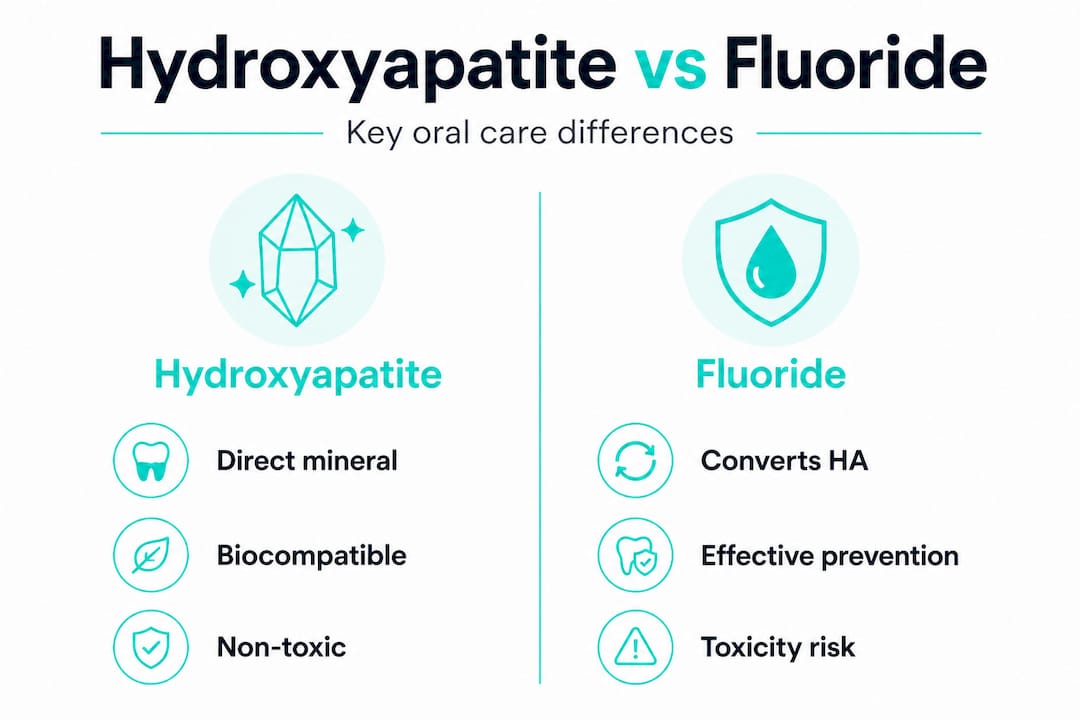
Here’s a direct comparison:
| Factor | Hydroxyapatite | Fluoride |
|---|---|---|
| Mechanism | Deposits mineral directly onto enamel | Converts HA to more acid-resistant fluorapatite |
| Remineralization | Yes, biomimetic crystal deposition | Yes, ion exchange at enamel surface |
| Cavity prevention | Clinically comparable | Well-established, long track record |
| Toxicity risk | None at oral care concentrations | Risk at high ingestion doses (fluorosis in children) |
| Safe for children | Yes, no ingestion concern | Requires careful dosing by age |
| Safe for pregnancy | Yes | Generally yes, but some prefer to limit exposure |
| Biocompatibility | Extremely high (natural to body) | Good, but external mineral |
| Sensitivity relief | Strong (physical tubule occlusion) | Limited direct effect |
The key practical differences come down to two areas. First, safety profile. Fluoride is effective, but excess ingestion during childhood can cause dental fluorosis (white spots or streaks on developing teeth). Hydroxyapatite carries no such risk, even if a child swallows toothpaste. Second, mechanism. Fluoride works by chemically converting HA into fluorapatite, which is slightly harder and more acid-resistant. HA simply restores the original mineral directly.
Some important points worth knowing:
- Neither HA nor fluoride can rebuild deeply cavitated teeth. Both work best on early-stage lesions and as prevention
- HA appears particularly effective at reducing Streptococcus mutans adhesion, the primary cavity-causing bacteria, which may add an antimicrobial dimension to its benefits
- Hybrid toothpastes combining HA and low-dose fluoride are emerging and may offer the broadest spectrum of protection
Pro Tip: If you’re not ready to go fully fluoride-free but want the added benefits of HA, look for products that list nano-hydroxyapatite alongside a low fluoride concentration. You get the biomimetic remineralization and the chemical strengthening from fluorapatite formation.
For those committed to avoiding fluoride entirely, our fluoride-free oral care collection and this overview of natural toothpaste options are practical places to start building your routine.
How to use hydroxyapatite in your oral care routine
Knowing the science is useful. Applying it is what actually protects your teeth. Here’s how to integrate HA effectively into your daily routine, regardless of where you’re starting from.
European and international safety authorities confirm that nHA is safe and effective for daily use, with best practices recommending rod-shaped particles with an aspect ratio of no more than 9. This means the particle shape is not uniform across products, so the formulation matters, not just the ingredient.
Step-by-step guide to using HA products:
- Start with an nHA toothpaste as your primary brushing product. Brush for two full minutes, twice daily
- Don’t rinse immediately. Spitting is fine, but avoid rinsing with water for at least 30 minutes after brushing to allow the mineral particles to remain in contact with the enamel
- Add an nHA mouthwash to your routine, ideally at a separate time from brushing (midday or after lunch works well) for extended mineral exposure
- Check the ingredient label. Look for “nano-hydroxyapatite” or “nHA” specifically. Some products list “calcium phosphate” broadly, which is not the same thing
- Be consistent. Remineralization is a gradual process. Most people notice reduced sensitivity within two to four weeks and enamel improvement over one to three months
Who benefits most from hydroxyapatite products:
- Children and teens whose enamel is still developing and who may swallow toothpaste accidentally
- Pregnant people who prefer to minimize fluoride exposure during pregnancy
- Anyone with high cavity risk who wants remineralization support between dental visits
- People with sensitive teeth who haven’t found relief from standard sensitivity toothpastes
- Those avoiding fluoride for personal, cultural, or health-related reasons
For a full look at where HA products fit into a broader routine, browse the oral care collection or read through the natural oral care page for context on how each product fits together. The healthy dental products guide also offers a helpful breakdown of what to look for and what to avoid.
Our take: Why hydroxyapatite matters more than you think
We’ve been paying close attention to the hydroxyapatite conversation for a while now, and there’s something that often gets lost in the fluoride vs. HA debate. People treat it like a rivalry, when really it’s a signal that oral care science is evolving.
Most people don’t realize that their teeth already are hydroxyapatite. When you apply nHA topically, you’re not introducing something foreign. You’re giving your body the exact material it uses to build and maintain enamel. That’s a fundamentally different relationship than most ingredients in conventional oral care have with your biology.
The evidence confirms equivalence and sometimes superiority of HA to fluoride for remineralization, though no major body has issued a formal recommendation to replace fluoride outright. That nuance is important. It doesn’t mean HA is unproven. It means the research is still catching up with decades of fluoride infrastructure in public health systems.
Contrasting views in the clinical literature highlight HA’s non-toxicity and exceptional biocompatibility. Some trials already favor hybrid formulations that blend the two. Our read on this: the future of oral care is not either/or. It’s choosing ingredients that work with your body’s natural biology rather than around it.
For health-conscious people, the most significant thing about HA is not that it replaces fluoride. It’s that it finally gives those who don’t want fluoride a genuinely effective alternative, not a compromise. If you’ve been using fluoride-free products and feeling like you’re sacrificing protection, that calculation has changed. You can read more about building that kind of routine through our editorial on natural oral care.
Watch this space too. Hybrid HA and fluoride formulas are actively being developed, and early trial data is promising. The next generation of remineralizing products may well offer what neither ingredient achieves alone.
Upgrade your oral care with hydroxyapatite-based solutions
Ready to put hydroxyapatite to work? Making the switch is simpler than most people expect, and you don’t have to overhaul your entire routine overnight.
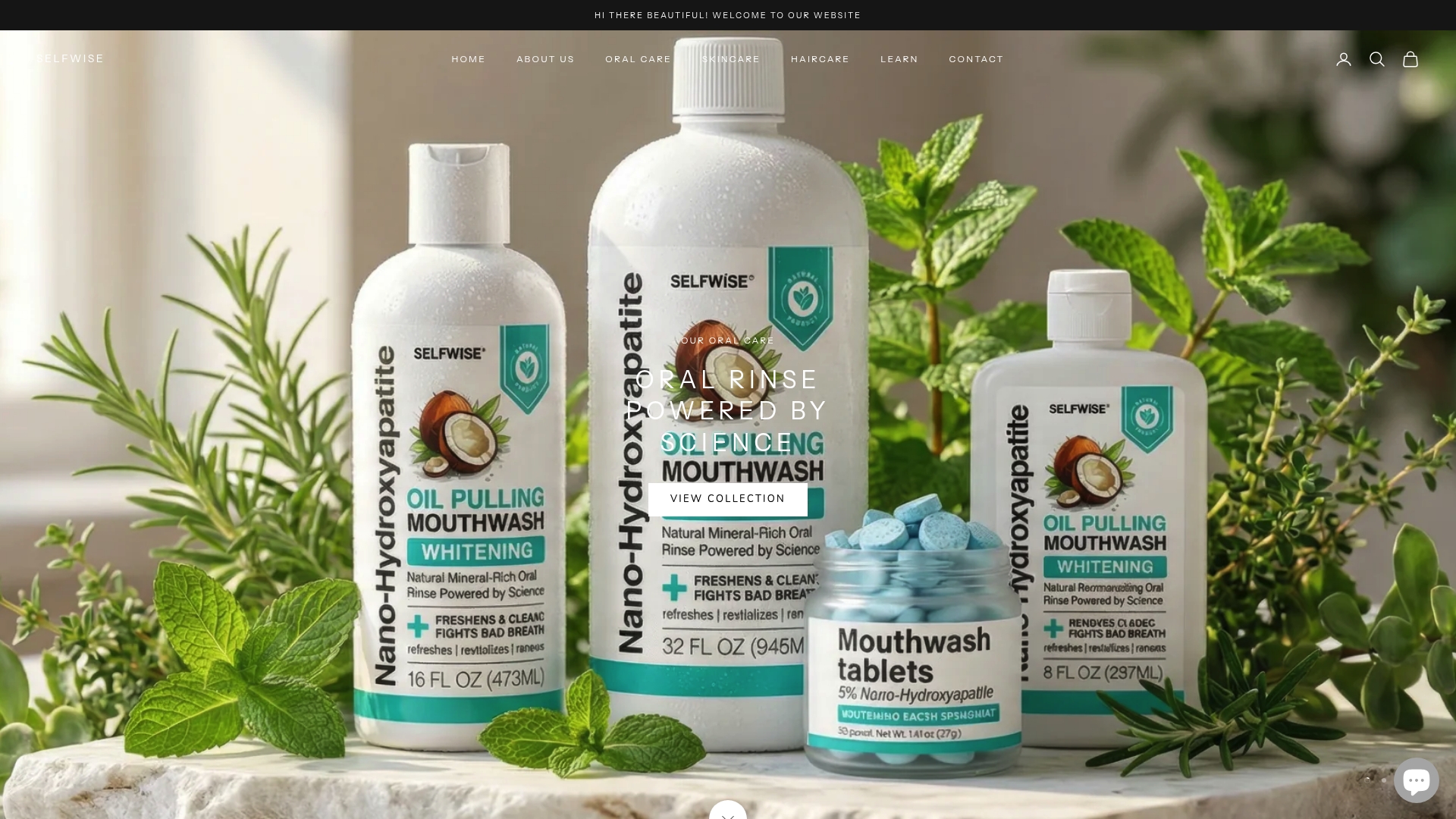
Selfwise offers a range of nHA-formulated products designed for exactly this kind of transition. The nano hydroxyapatite mouthwash tablets are a great first step if you want remineralizing coverage without switching your toothpaste right away. Simply dissolve, swish, and let the mineral particles do their work on every surface of your mouth. For a more immersive experience that pairs remineralization with the detoxifying benefits of oil pulling, the nHA oil pulling mouthwash brings tradition and science together in one step. Browse all fluoride-free options to find the right fit for where you are right now.
Frequently asked questions
Is hydroxyapatite as effective as fluoride for cavities?
Meta-analyses confirm HA toothpastes prevent caries at rates comparable to fluoride, with some studies showing even greater benefits for early lesion arrest. For many people, HA is a fully effective alternative.
Can children safely use hydroxyapatite toothpaste?
Yes. Safety data confirms nHA is highly biocompatible and well-tolerated in children, with no risk of fluorosis or toxicity from accidental swallowing.
Does hydroxyapatite cause any side effects or toxicity?
No. SCCS found no mutagenicity or cytotoxicity for nano-hydroxyapatite. It’s considered safe for daily use in oral care products at the concentrations found in consumer products.
Who should choose hydroxyapatite over fluoride?
Anyone seeking a fluoride-free option with strong clinical backing can benefit from HA, and it’s especially recommended for children, pregnant people, and individuals who are sensitive to fluoride or have concerns about long-term fluoride exposure.
Recommended
- Natural dental products for healthier teeth & gums
- Nano Hydroxyapatite Mouthwash Tablets | Fluoride-Free Solid Mouthwash | Selfwise
- How to remineralize teeth naturally: step-by-step guide
- Nano Hydroxyapatite Oil Pulling Mouthwash | Fluoride-Free Enamel Support | Selfwise
Related Selfwise oral care
For Selfwise hydroxyapatite oral care, start here:
- Nano Hydroxyapatite Mouthwash Tablets
- Nano Hydroxyapatite Oil Pulling Mouthwash
- Fluoride-free oral care
- Nano hydroxyapatite benefits and evidence
Note: Selfwise oral care products are designed for daily personal care routines and are not a replacement for dental diagnosis or treatment.