
Gentle Evidence Backed Rinses: Salt Water vs Mouthwash
Use warm salt water when you need short-term soothing, help healing after a dental procedure, or relief from a canker sore. Reach for a therapeutic mouthwash when your goal is daily plaque control, cavity prevention, or fixing chronic bad breath. Neither one replaces brushing and flossing, and neither substitutes for a dentist when something feels seriously wrong.
TL;DR:
- Salt water effectively supports healing after dental procedures and soothes mouth sores, but it does not rebuild enamel or remove tartar.
- Therapeutic mouthwashes are best for ongoing cavity prevention, plaque control, and managing gum disease, especially when combined with brushing and flossing.
- Using salt water daily can help maintain oral comfort, but for cavity prevention and enamel strengthening, fluoride or remineralizing rinses are more suitable long-term.
- Salt water rinses are inexpensive, gentle, and well-tolerated, while commercial mouthwashes vary in purpose, with alcohol-based formulas potentially irritating sensitive tissue.
- It’s recommended to space salt water rinses and mouthwash routines at least 30 minutes apart to enhance their benefits without interference.
Table of Contents
- Salt Water vs Mouthwash: A Quick Situational Guide
- Salt Water: How It Works, Benefits, and Limits
- Mouthwash: Types, Roles, and What to Watch For
- What ADA Guidance and Clinical Research Actually Say
- How to Rinse With Salt Water and Choose a Mouthwash Safely
- When a Rinse Isn’t Enough
- Comparison of Taste and User Experience
- Impact on Oral Microbiome Health
- Suitability for Different Age Groups
- Cost Comparison Between Salt Water and Commercial Mouthwashes
- Why Selfwise Leans Toward Gentle, Natural Prevention
- A Gentler Everyday Rinse Worth Trying
- Sources
- FAQ
Salt Water vs Mouthwash: A Quick Situational Guide
The right rinse depends entirely on what’s happening in your mouth right now, not on which product sounds more advanced. Match the situation to the tool:
- Post-extraction or oral surgery site: Salt water, since it won’t sting like alcohol-based rinses and supports the healing tissue.
- Canker sores, bitten cheek, or lip irritation: Salt water for comfort. It cleans the area without the burn of an antiseptic mouthwash.
- High cavity risk or weakened enamel: A fluoride or remineralizing mouthwash, because salt water contributes nothing toward rebuilding enamel.
- Persistent bad breath or plaque buildup despite regular brushing: A therapeutic mouthwash used as an add-on to your routine, not a replacement for it.
If you’re recovering from a procedure and also dealing with a cavity risk, you may genuinely need both, just used at different times of day rather than mixed together.
Salt Water: How It Works, Benefits, and Limits
Salt water works through simple physics, not chemistry. Dissolved salt raises the osmotic pressure around irritated tissue, which pulls out excess fluid, calms swelling, and creates a mildly alkaline environment that’s inhospitable to some bacteria. It’s not a disinfectant in the way alcohol or chlorhexidine is. It’s closer to a gentle assist for your body’s own healing process.
By the numbers: Systematic-review research on saline and salt-based rinses found they reduce plaque and gingival inflammation when used alongside regular brushing, with tolerability that often beats chemical antiseptics.
That’s a meaningful finding, but salt water has real ceilings:
- No fluoride, so it does nothing to remineralize weakened enamel.
- Limited reach into periodontal pockets, where plaque hides below the gumline.
- Can’t dissolve or remove hardened tartar once it forms.
The standard mix is approximately half a teaspoon of salt fully dissolved in about a glass of warm water, used as a gentle rinse rather than a treatment. People on salt-restricted diets or those with significant dry mouth should ask a dentist before rinsing frequently, since excess sodium exposure or overly frequent rinsing can aggravate dryness.
Pro Tip: Let the water cool to a comfortable warm, not hot. Hot water on already-inflamed tissue can make swelling worse instead of better.
Mouthwash: Types, Roles, and What to Watch For
“Mouthwash” covers three very different products, and mixing them up is the most common mistake people make. Cosmetic rinses mask odor temporarily and do little else. Antimicrobial formulas, including chlorhexidine and essential-oil blends, target bacteria directly. Fluoride and remineralizing rinses, like those built around nano hydroxyapatite, work to strengthen enamel over time.
Mouthwash earns its place when you’re dealing with high cavity risk, ongoing gingivitis that needs an extra layer of defense, or new orthodontic hardware that traps food and plaque. Used correctly, it’s a real preventive layer, not a marketing add-on.
It comes with caveats worth knowing:
- Alcohol-based formulas can dry out and irritate soft tissue, especially for people already prone to canker sores.
- Chlorhexidine, while effective short-term, stains teeth and dulls taste perception with prolonged use, which is why dentists rarely prescribe it indefinitely.
- No mouthwash removes plaque mechanically. Swishing is never a substitute for the physical scrubbing action of a toothbrush and floss.
Pro Tip: Rinse after brushing and flossing, not before. You want the active ingredients reaching a clean surface, not fighting through the debris you just loosened.
What ADA Guidance and Clinical Research Actually Say
The American Dental Association is clear that mouthrinses serve distinct therapeutic purposes and aren’t interchangeable with saline rinses. That single distinction resolves most of the confusion around this topic.
Saline rinses function as a supportive, well-tolerated adjunct to mechanical cleaning. They help with gingival inflammation and post-procedure comfort, but they were never designed to replace the targeted antimicrobial or remineralizing action that therapeutic mouthwash provides.
The clinical evidence backs a nuanced middle ground rather than a winner-take-all verdict:
- Warm saline rinses show outcomes comparable to 0.12% chlorhexidine for specific short-term endpoints, particularly around wound healing after extractions.
- Saline is generally better tolerated over longer stretches of use, while chlorhexidine’s side effects limit how long dentists recommend it.
- Systematic review findings suggest saline is a reasonable option for people who can’t tolerate chemical antiseptics at all.
The practical takeaway: use saline for the healing window, then switch to a targeted mouthwash once the acute issue resolves.
How to Rinse With Salt Water and Choose a Mouthwash Safely
Salt water rinse, step by step:
- Dissolve ½ teaspoon of fine salt completely in 8 ounces of warm water.
- Swish gently for 20 to 30 seconds, reaching all sides of your mouth.
- Spit it out. Never swallow a saline rinse.
- Repeat 2 to 3 times daily for up to about two weeks after a procedure, or once daily for general maintenance, according to typical advice.
- Follow your dentist’s specific instructions if you’re recovering from surgery. Some cases call for a different schedule entirely.
Choosing a mouthwash: Look for a “therapeutic” label if you need active plaque or gingivitis control, check the fluoride or remineralizing ingredient list if enamel strength is your goal, and go alcohol-free if you have sensitive tissue or dry mouth. A saltwater rinse routine and a mouthwash routine can coexist. Just space them at least 30 minutes apart so one doesn’t cancel out the other.
Pro Tip: If your gums bleed lightly during brushing but you’re not in acute pain, that’s usually a mouthwash-and-better-flossing problem, not a salt water problem.
When a Rinse Isn’t Enough
Home rinses buy you time and comfort. They don’t fix underlying disease. Call your dentist if you notice:
- Bleeding that persists more than a few days or worsens instead of improving.
- Swelling that continues to grow rather than subside.
- Pain that isn’t easing with either rinse after 48 to 72 hours.
- Bad breath that returns immediately after brushing, rinsing, and flossing.
Most healthy gum irritation improves within a week of consistent home care. If it doesn’t, that delay is often what allows early gum disease to progress into something that needs professional treatment instead of a home fix.
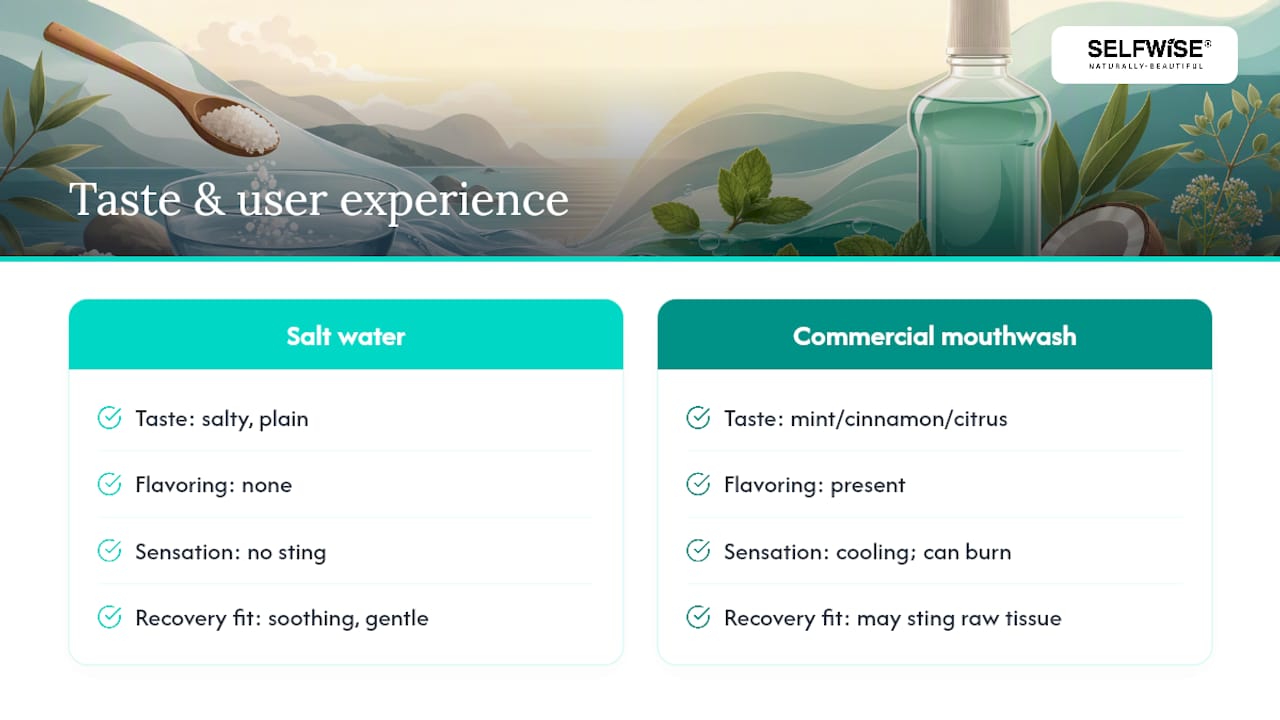
Comparison of Taste and User Experience
Salt water tastes exactly like what it is: salty, a little unpleasant, and something most people tolerate rather than enjoy. There’s no flavoring, no cooling menthol finish, nothing to make the moment pleasant. For a lot of people recovering from a procedure, that plainness is actually reassuring. It doesn’t sting, it doesn’t burn broken tissue, and it doesn’t leave the sharp chemical aftertaste that alcohol-based rinses do on a raw canker sore.
Commercial mouthwash was built around the opposite goal: making the rinse experience something people actually want to repeat twice a day. Mint, cinnamon, and citrus flavor profiles, cooling sensations, and satisfying color all serve a real purpose, since a product nobody enjoys using gets skipped. That’s part of why alcohol-based mouthwash became the default for decades, even though the alcohol itself contributes little to its antimicrobial action and a lot to the burning sensation people associate with “working.”
The gap matters most for kids, people with sensitive tissue, or anyone recovering from oral surgery. A rinse that stings gets used inconsistently, and an inconsistent routine is worse than no routine at all. This is where alcohol-free formulas change the calculus. A gentle, flavored, alcohol-free mouthwash gets the antimicrobial or remineralizing benefit without the wince, which means people actually stick with it. Taste isn’t a cosmetic afterthought here. It’s the difference between a rinse someone uses daily and one they quietly stop using after a week.
Impact on Oral Microbiome Health
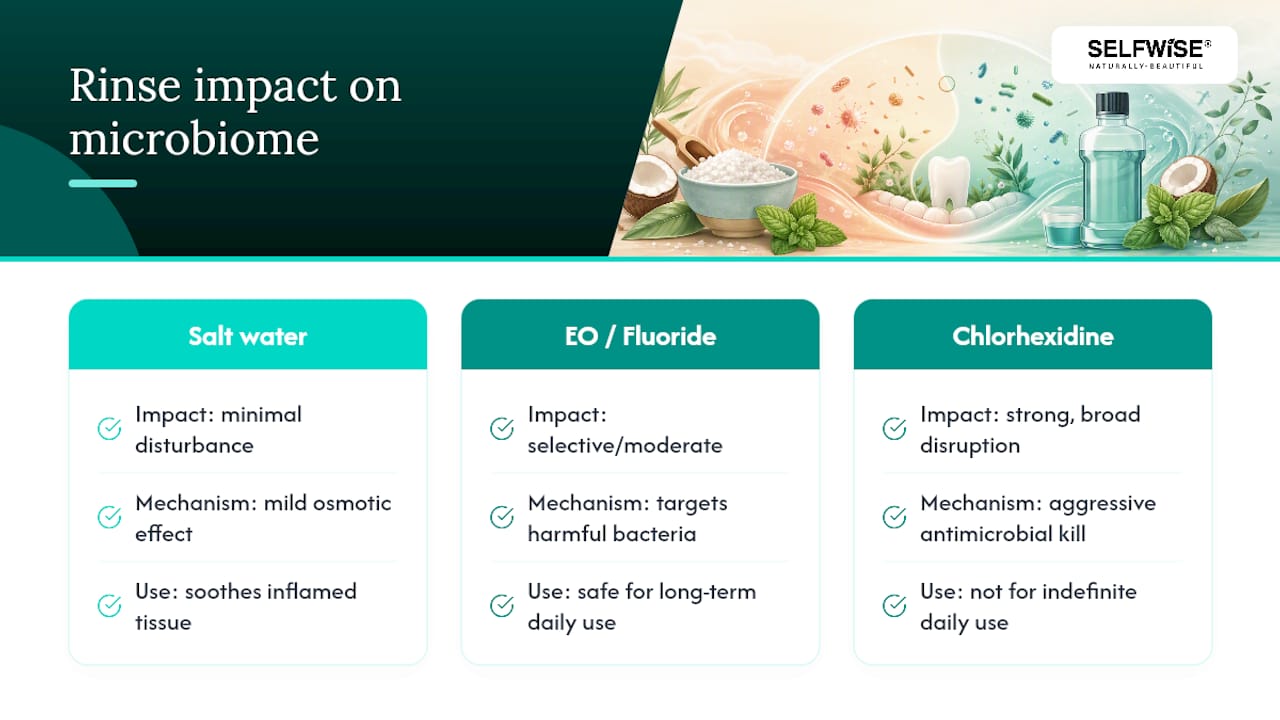
Your mouth hosts hundreds of bacterial species, most of them harmless or actively beneficial, and the goal of any rinse should be balance, not annihilation. Salt water doesn’t wipe out bacteria broadly. Its osmotic action mildly disrupts the environment without functioning as a targeted kill mechanism, which means it tends to leave the broader microbial community relatively undisturbed while still helping calm inflamed tissue.
Strong antimicrobial mouthwashes, particularly chlorhexidine, work differently. They’re effective specifically because they’re aggressive against a wide range of bacteria, including some of the beneficial species that help regulate pH and crowd out harmful strains. That’s part of the reason dentists don’t recommend chlorhexidine for indefinite daily use. Long-term disruption of the oral microbiome has been linked in broader microbiome research to issues ranging from bad breath rebound to altered taste perception, both of which chlorhexidine users report.
Essential-oil and fluoride or remineralizing formulas sit somewhere in between. They target specific harmful bacteria and support enamel strength without the blunt-force approach of chlorhexidine, which is one reason dentists are more comfortable recommending them for daily long-term use. If you’re thinking about your mouth as an ecosystem rather than a battlefield, gentler, more selective formulas make more long-term sense than a rinse strong enough to leave a temporary metallic taste behind.
Suitability for Different Age Groups
Children under six generally shouldn’t use any rinse unsupervised, salt water or mouthwash, because of swallowing risk. Salt water is safe for older children who can reliably spit rather than swallow, and it’s often what pediatric dentists suggest for a sore spot from a new tooth or minor mouth injury. Mouthwash designed for kids typically comes alcohol-free and fluoride-adjusted for their smaller body size, and it should only be introduced once a child has mastered spitting consistently, usually around age six or seven.
Adults have the widest range of safe options, though anyone with a dry mouth condition, whether from medication, age, or an underlying health issue, should lean toward alcohol-free mouthwash or salt water over a stronger alcohol-based formula that will worsen dryness.
Older adults face a specific set of considerations. Reduced saliva production, more common with age and certain medications, makes gum tissue more vulnerable to irritation from harsh rinses. Salt water tends to be well tolerated in this group, and gentle remineralizing mouthwash without alcohol is usually a better long-term daily fit than a strong antimicrobial rinse. Anyone managing high blood pressure or kidney conditions that require sodium restriction should ask a doctor before making salt water rinsing a daily habit, since even a spit-out rinse involves some incidental sodium exposure through the tissue.
Cost Comparison Between Salt Water and Commercial Mouthwashes
Salt water is close to free. A box of table salt costs a few dollars and lasts for months of daily rinsing, since each use requires only half a teaspoon. There’s no ongoing subscription, no bottle to replace, and no brand loyalty required. It is, without question, the cheapest oral rinse option that exists.
Commercial mouthwash runs a wide range depending on the formula. Basic cosmetic rinses sit at the low end, while therapeutic and remineralizing formulas cost more because of the active ingredients they carry, whether that’s fluoride, nano hydroxyapatite, or xylitol. The cost difference isn’t really a fair comparison, though, because the two products aren’t interchangeable purchases. You’re not choosing the cheaper version of the same thing. You’re choosing between a wound-care tool and a preventive-care product, and paying for a mouthwash gets you enamel support or antimicrobial action that salt water was never designed to provide.
The more useful cost question is whether a daily mouthwash habit is worth the price compared to the alternative: more cavities, more gum treatment, or more frequent dental visits. Viewed that way, a modestly priced remineralizing mouthwash used consistently is often the cheaper long-term option, even though the bottle itself costs more than a box of salt.
Why Selfwise Leans Toward Gentle, Natural Prevention
Salt water earns its place as a short-term ally, cheap, gentle, and genuinely useful after a procedure or a sore. But daily prevention needs more than salt can offer. Some natural oral care brands build their rinses around nano hydroxyapatite and xylitol instead of alcohol, aiming for the antimicrobial and remineralizing benefit without the sting. Use salt water for the flare-up. Use a formulated rinse for the long game, and check with your dentist when something doesn’t improve.
— Viktor
A Gentler Everyday Rinse Worth Trying
If you’ve been reaching for whatever mouthwash was on sale, or skipping rinsing altogether because the burn isn’t worth it, there’s a real gap between what’s available and what your mouth actually wants. Some brands offer alcohol-free formulas built to support enamel and fight bacteria without the harsh aftertaste that makes people quit their routine after a week.
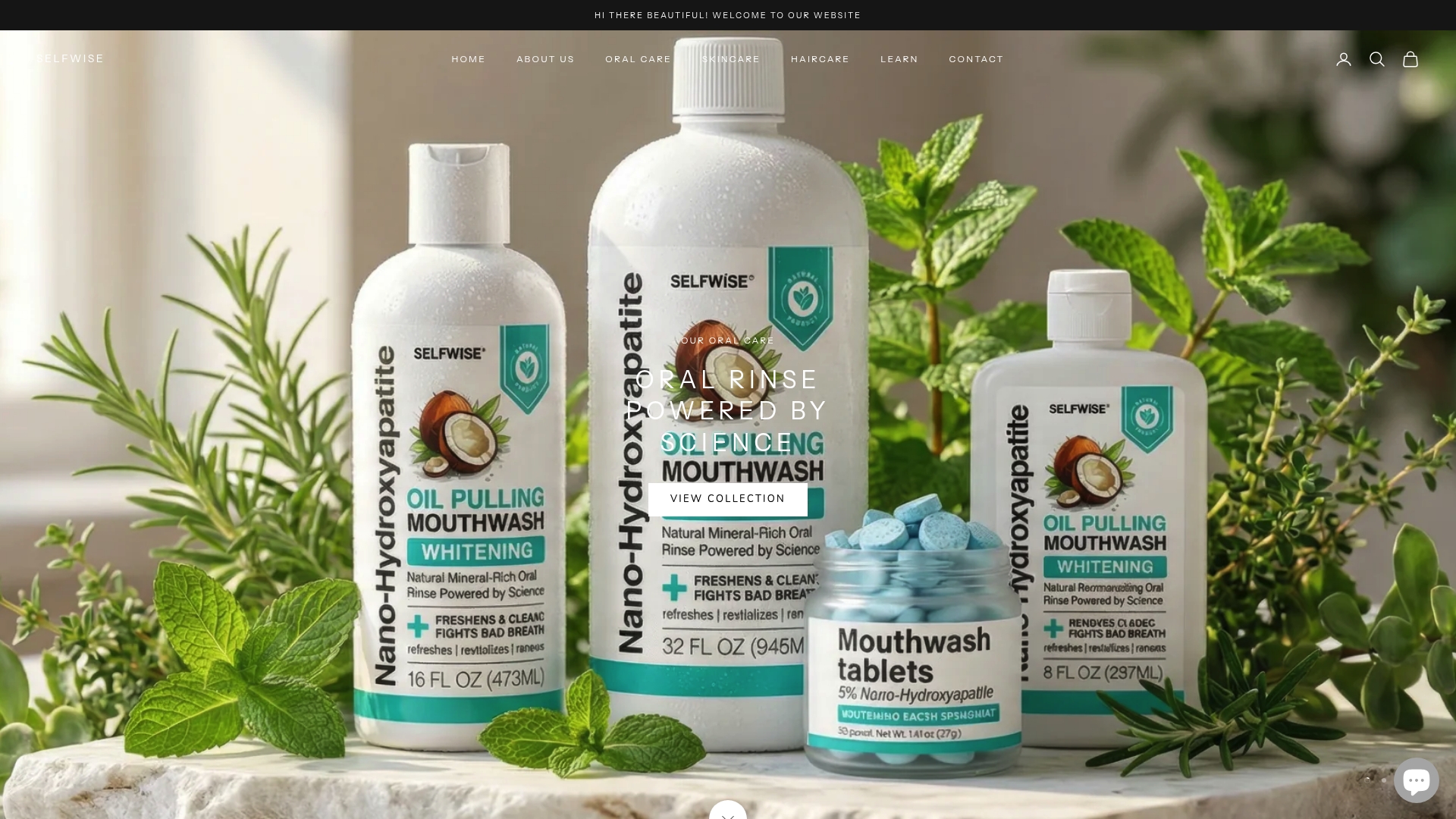
The Selfwise mouthwash collection covers a few distinct needs. The nano hydroxyapatite mouthwash tablets give you a fluoride-free, solid format for remineralizing support without a bulky bottle. The nano hydroxyapatite oil pulling mouthwash combines a traditional oil pulling approach with modern enamel support for people who want both in one step. Anyone dealing with sensitive tissue, dry mouth, or just tired of the sting can start with an alcohol-free rinse and build from there. Browse the collection, read the product pages, and check with your dentist if you have specific concerns before switching your daily routine.
Sources
- American Dental Association — Mouthrinses (mouthwash)
- Systematic review on saline/salt-based mouthrinses (Braz Dent Sci / SciELO)
- PubMed — systematic reviews and trial summaries on chlorhexidine vs saline outcomes
- Healthline — Salt water rinse benefits and safety
FAQ
Is Gargling Salt Water Better Than Mouthwash?
Neither is universally better. Salt water wins for short-term soothing and healing, while therapeutic mouthwash wins for daily plaque control and cavity prevention.
Why Do Dentists Say Not to Use Mouthwash?
Dentists caution against certain mouthwashes, particularly alcohol-based or chlorhexidine formulas, because of tissue irritation, staining, or the risk that people rely on rinsing instead of brushing and flossing properly.
Should I Use Salt Water as Mouthwash Every Day?
Salt water is fine for daily maintenance rinsing for most people, but those with dry mouth or salt-restricted diets should check with a dentist first, and it shouldn’t fully replace a fluoride or remineralizing mouthwash if cavity prevention is a concern.
What Are the Disadvantages of a Salt Water Mouth Rinse?
Salt water contains no fluoride, can’t reach deep into gum pockets, won’t remove hardened tartar, and can irritate tissue or worsen dryness if used too frequently or at too high a concentration.
Can Salt Water and Mouthwash Be Used Together?
Yes, but space them at least 30 minutes apart. Many people use salt water after a procedure for comfort and healing, then return to a formulated mouthwash like Selfwisebrand’s alcohol-free options for daily prevention once tissue has healed.