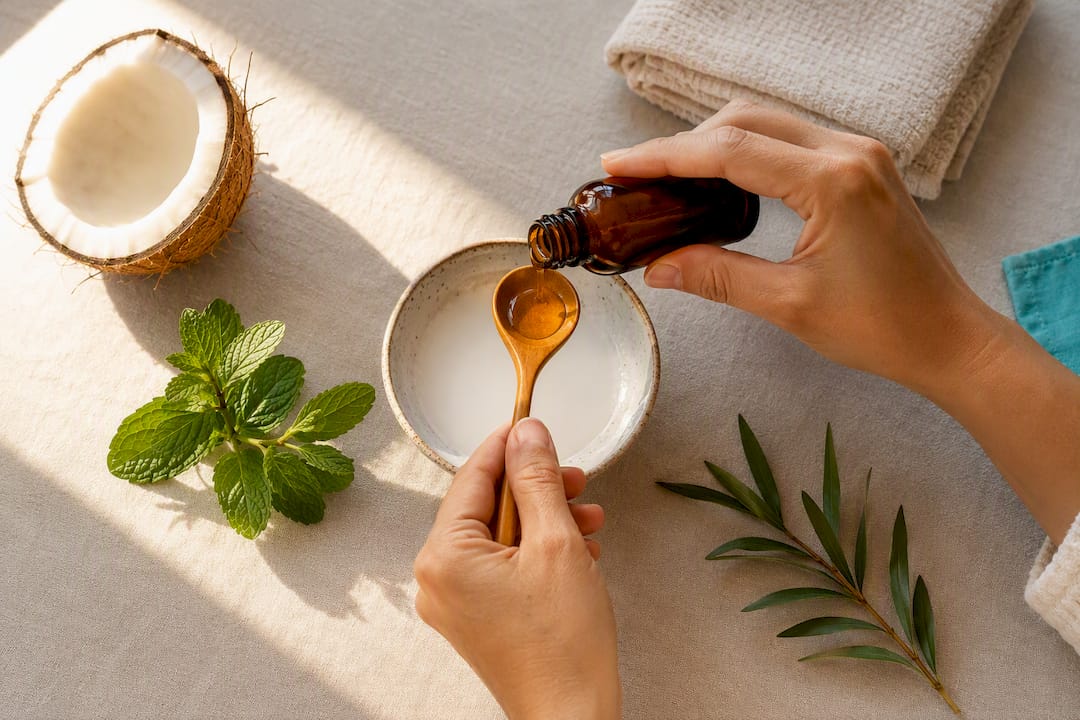
Castor Oil for Dandruff: Dilute 1:2 and Use Once Weekly
Castor oil can ease dry, flaky scalp through its moisturizing and mild anti-inflammatory effects, but it is not a proven cure for the fungal dandruff most people actually have. If your scalp is dry and tight rather than greasy, a short trial is reasonable; if flakes come with itching, redness, or oiliness, stop and see a clinician if it persists. For a formulated option instead of DIY mixing, Selfwisebrand makes a diluted castor oil product designed for exactly this kind of cautious, at-home use.
TL;DR:
- Castor oil mainly moistens dry scalp areas and offers only modest anti-inflammatory benefits, with little proven antifungal activity against Malassezia.
- It is effective for dry, flaky scalp issues but falls short for greasy flakes or persistent fungal dandruff, which require medicated antifungal shampoos like ketoconazole.
- Proper application involves diluting castor oil, targeted spot use, gentle massage, and rinsing thoroughly, with a maximum one-time weekly use to prevent buildup or hair felting.
- Common side effects include contact dermatitis and scalp buildup, especially on oily or seborrheic scalps, making patch testing and careful monitoring essential.
- Natural antifungal oils such as tea tree or rosemary are stronger options for fungal dandruff, while castor oil supports dryness but should not replace medicated treatments when yeast overgrowth is present.
Table of Contents
- What Castor Oil Actually Does for Dandruff
- How to Use Castor Oil on a Flaky Scalp Without Wrecking Your Hair
- Side Effects and Red Flags: When Castor Oil Backfires
- Antifungal Shampoos and Essential Oils: What Actually Clears Fungal Dandruff
- Why Selfwisebrand Treats Castor Oil as a Supporting Tool, Not a Cure
- A Formulated Option If You’d Rather Skip the Guesswork
- Sources
- FAQ
What Castor Oil Actually Does for Dandruff
Dandruff has two common drivers, and they respond to completely different treatments. One is simple dryness, where the scalp loses moisture and flakes off skin the way chapped hands do. The other, far more common cause, is overgrowth of Malassezia, a yeast that lives on everyone’s scalp but triggers inflammation and flaking when it multiplies unchecked. Castor oil addresses the first problem reasonably well and the second one barely at all.
The oil works mainly as an emollient. It’s thick and rich in ricinoleic acid, a fatty acid that coats the hair shaft and scalp surface, sealing in moisture and softening built-up flakes so they lift away more easily. Dermatological reviews describe castor oil’s anti-inflammatory and antimicrobial properties as real but modest, and note that high-quality clinical trials proving a direct antifungal effect against Malassezia are still lacking.
That gap matters more than most castor oil enthusiasts admit. Ricinoleic acid has some documented antimicrobial activity in lab settings, but “some activity in a petri dish” is a long way from “clears a yeast overgrowth on a living scalp.” Reviews of essential oils and dandruff treatment consistently point out that ingredients with actual antifungal mechanisms against Malassezia look different from castor oil’s moisturizing profile entirely.
There’s also a real risk of masking the problem instead of solving it. If your flaking is fungal and you slick on a heavy oil, the oil can temporarily smooth the surface and make flakes less visible while the underlying yeast overgrowth continues unaddressed. Systematic review data on hair oils in general reinforces this: the benefit is largely about coating the shaft and reducing breakage, not about treating scalp conditions at the follicle level.
Where castor oil tends to help:
- Dry, tight-feeling scalps with fine, white, powdery flakes
- Scalp irritation from harsh shampoos or over-washing
- Mild flaking that worsens in cold, dry weather
Where it tends to fall short:
- Greasy, yellowish flakes typical of seborrheic dermatitis
- Persistent dandruff that returns within days of washing
- Flaking accompanied by redness, burning, or visible inflammation
One frequently cited finding worth sitting with: reviewers note that castor oil’s real-world popularity for scalp care runs well ahead of the clinical evidence backing it. That’s not a reason to dismiss it outright. It’s a reason to treat it as a supportive moisturizer, not a substitute for antifungal treatment when yeast is the actual driver.
How to Use Castor Oil on a Flaky Scalp Without Wrecking Your Hair
Used carelessly, castor oil causes more problems than it solves. Used carefully, it’s low risk. The difference comes down to dilution, amount, and how thoroughly you wash it out.
Start with a patch test, always. Apply a small amount of diluted castor oil to the inside of your forearm or behind your ear, and wait 24 to 48 hours. Redness, itching, swelling, or small bumps mean you should not apply it to your scalp. This step matters more than people assume; castor oil allergy is uncommon but not rare, and a scalp reaction is much harder to manage than a forearm one.
Once you’ve cleared the patch test, follow this routine:
- Dilute it first. Mix one part castor oil with two to three parts of a lighter carrier oil, such as jojoba or fractionated coconut oil. Undiluted castor oil is thick and sticky, and that viscosity is precisely what raises the risk of the hair matting problem covered in the next section.
- Section your hair. Part your hair into rows so you can apply oil directly to the scalp rather than saturating the strands, which just wastes product and makes washing harder.
- Apply to targeted, flaky patches only. You don’t need to coat the entire scalp if the dryness is concentrated in a few areas.
- Massage gently for two to three minutes. This helps distribute the oil evenly and may improve circulation, though there’s no strong evidence that massage alone changes dandruff outcomes.
- Leave it on for 30 to 60 minutes. Overnight application is sometimes recommended online, but given the felting risk with viscous oils, shorter leave times are the more cautious choice, especially the first few times you try this.
- Shampoo thoroughly, twice if needed. A clarifying shampoo cuts through the oil more effectively than a gentle daily formula. One rinse rarely removes all of it; check that hair doesn’t feel coated or greasy afterward.
Limit this to once a week at most. Daily or even every-other-day use raises the odds of buildup, clogged follicles, and the exact flaking rebound you’re trying to avoid. If you notice increased itching, greasiness, or flaking after a few sessions, stop. That’s your scalp telling you the oil is adding to the problem rather than solving it.
Pro Tip: Keep a small notebook or phone note tracking when you apply castor oil and how your scalp responds over the next 48 hours. Dandruff causes are easy to confuse, and a simple log will show you fast whether the oil is helping or quietly making things worse.
Side Effects and Red Flags: When Castor Oil Backfires
Most people tolerate topical castor oil without incident, but the failure modes that do occur deserve real attention, not a footnote.
Contact dermatitis is the most common issue. It shows up as redness, itching, small bumps, or a burning sensation at the application site, sometimes hours after use rather than immediately. If this happens, wash the oil out right away with a mild shampoo, avoid reapplying, and consider a low-strength topical hydrocortisone if your usual approach to skin irritation includes one. See a clinician if the reaction spreads, blisters, or doesn’t settle within a few days.
Buildup on oily or seborrheic scalps is the second common problem. Heavy oils sit on top of already excess sebum, and for scalps prone to seborrheic dermatitis, that combination tends to feed the Malassezia overgrowth rather than calm it. If your dandruff has any greasy component at all, castor oil is a poor first choice.
Hair felting is rarer but far more disruptive. This is when strands of hair mat together into a dense, matted clump, almost like felt fabric, and it’s been documented in case reports following heavy, undiluted oil use. Castor oil’s thick viscosity is a specific risk factor here, which is exactly why dilution and targeted application, not full-length saturation, are non-negotiable parts of the routine above.
Stop using castor oil and get a dermatologist’s evaluation if you notice any of the following:
- Scaling or flaking that persists past three to four weeks of consistent, careful use
- Painful inflammation, swelling, or pus-filled bumps on the scalp
- Sudden or patchy hair loss
- Flaking that worsens rather than improves
Dermatology guidance is consistent that persistent scalp symptoms can stem from causes well beyond simple dandruff, including eczema and allergic contact reactions, which is exactly why self-treating for weeks on end isn’t the right call once symptoms stall or worsen.
Antifungal Shampoos and Essential Oils: What Actually Clears Fungal Dandruff
When Malassezia overgrowth is driving your flaking, the treatments with the strongest track record aren’t oils at all. They’re medicated antifungals.
Ketoconazole, zinc pyrithione, and selenium sulfide shampoos remain the standard of care for fungal dandruff and mild seborrheic dermatitis. Expert consensus in dermatology continues to point to these as first-line treatments because they directly target the yeast overgrowth rather than just managing symptoms on the surface. Ketoconazole in particular has the deepest evidence base, working by disrupting fungal cell membranes.
Among natural options, essential oils have a meaningfully stronger antifungal case than castor oil does. A review of essential oils in dandruff management found that oils including tea tree, lemongrass, and rosemary disrupt fungal cell membranes and inhibit fungal lipases, the enzymes Malassezia uses to feed on scalp oils. Several formulations tested in clinical and experimental settings showed measurable reductions in dandruff severity, a mechanism castor oil simply doesn’t share.
Where each option fits:
- Dry, non-greasy flaking with no inflammation: a castor oil trial, diluted and limited to once weekly, is reasonable
- Greasy, recurring flakes with visible redness: move to a medicated antifungal shampoo and consider a clinician visit if it doesn’t improve within two to three weeks
- Mild fungal dandruff, natural preference: essential oil blends with tea tree or rosemary carry more direct antifungal support than castor oil alone
Combining approaches is sometimes reasonable. Using a diluted castor oil for dryness between antifungal shampoo washes is a common, low-risk pattern, though you should space them out rather than layering both in a single session, and stop the oil altogether if flaking increases.
Why Selfwisebrand Treats Castor Oil as a Supporting Tool, Not a Cure
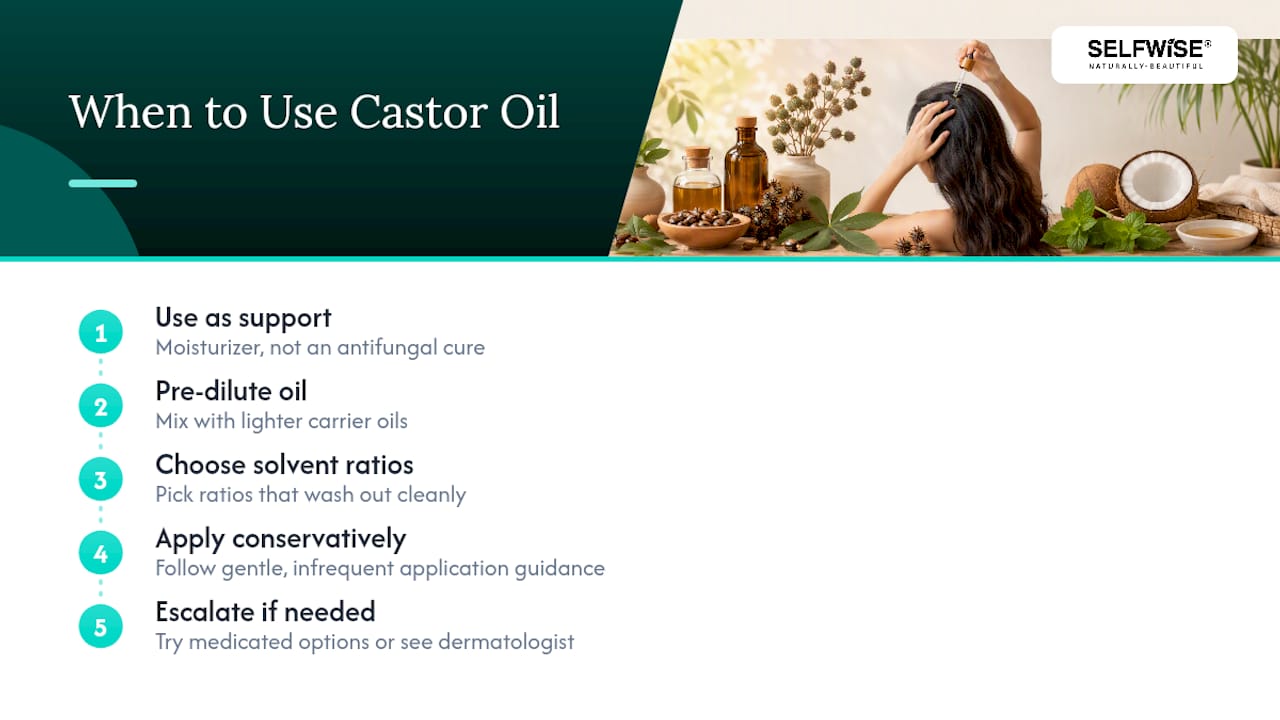
Selfwisebrand built its name on formulating natural ingredients honestly, from oil pulling mouthwash to castor oil hair blends, and that means being upfront about what an ingredient can and can’t do. Castor oil earns a place in a scalp care routine for its moisturizing strength, not as a stand-in for antifungal treatment.
Our approach to formulation reflects that distinction. Pre-diluting castor oil with lighter carrier oils, choosing solvent ratios that wash out cleanly, and keeping application guidance conservative all reduce the practical risks readers face when mixing oils at home. None of that replaces a dermatologist’s evaluation for scalp conditions that aren’t improving. Evidence-first thinking means using castor oil where it fits and stepping back to medicated options, or a clinician, when it doesn’t.
— Viktor
A Formulated Option If You’d Rather Skip the Guesswork
Mixing your own dilution ratios and hoping you got the jojoba-to-castor ratio right is one path. A pre-diluted, ready-to-use formula is the other, and it removes the trial-and-error entirely. Selfwisebrand’s scalp care line is built for readers who want the moisturizing benefit of castor oil without measuring carrier oils in a kitchen bowl.
The formula is designed for people managing dry, flaky scalp who want a product that washes out cleanly rather than sitting heavy on strands. If you’re also dealing with dry or damaged hair alongside the flaking, the brand’s dry and damaged hair collection rounds out a full routine. Whichever product you choose, patch test it first, follow the label’s frequency guidance, and stop use if you notice irritation. Check the current lineup and find the formula that matches your scalp type on the Selfwisebrand scalp care page.
Primary Sources and Further Reading
- Dermatological applications and safety profile of castor oil — covers moisturizing and anti-inflammatory effects alongside rare adverse events like contact dermatitis.
- Essential oils in dandruff management — reviews antifungal mechanisms of tea tree, rosemary, and lemongrass against Malassezia.
- Etiology, Treatment Challenges, and the Role of Scalp and Haircare in Managing Dandruff — expert consensus supporting antifungal shampoos as first-line treatment.
- Case reports on hair felting and heavy-oil complications — documents dilution strategies that reduce matting risk.
- Is castor oil safe and effective? — HealthyWomen — clinician-quoted cautions on pore-clogging and buildup.
Sources
- Dermatological applications and safety profile of castor oil (review)
- Essential oils in dandruff management: pharmacological mechanisms, therapeutic efficacy, and prospects for natural scalp care
- Etiology, Treatment Challenges, and the Role of Scalp and Haircare in Managing Dandruff (J Drugs Dermatol, expert consensus)
- Is castor oil safe and effective? - HealthyWomen
- Case reports and clinical notes on hair felting and heavy-oil complications
FAQ
Can castor oil reduce dandruff?
Castor oil can reduce flaking caused by dryness through its moisturizing effect, but reviews show limited clinical evidence that it clears fungal dandruff driven by Malassezia overgrowth.
How do you use castor oil for dandruff?
Dilute it with a lighter carrier oil at roughly a 1:2 or 1:3 ratio, apply it to targeted dry patches, leave it on for 30 to 60 minutes, then wash thoroughly with a clarifying shampoo, no more than once a week.
What kills dandruff faster?
Medicated shampoos containing ketoconazole, zinc pyrithione, or selenium sulfide act faster on fungal dandruff than any oil-based remedy because they target the Malassezia yeast directly rather than just softening flakes. See this source.
What oil is best for dandruff?
For dry, non-greasy flaking, diluted castor oil works as a moisturizer; for fungal dandruff, essential oils like tea tree and rosemary carry stronger antifungal evidence, and a pre-diluted formula such as Selfwisebrand’s scalp care line offers a tested middle ground for readers who want both moisture and a cleaner washout.