Xylitol After Meals: Chewing Gum vs Mouthwash
For everyday post-meal acid control and fresh breath on the go, sugar-free xylitol gum usually wins. For targeted plaque and gingivitis control, a therapeutic mouthwash does the job gum cannot. Neither one replaces brushing and flossing, and each carries its own caveat: skip gum if you have jaw or TMJ issues, and don’t lean on chlorhexidine rinses long term without a dentist’s say.
TL;DR:
- Chewing gum, especially xylitol variants, provides prolonged saliva stimulation that buffers acids and supports enamel remineralization, requiring consistent use over at least a month to show measurable benefits.
- Chlorhexidine mouthwash offers quick, targeted antibacterial effects and is most effective in short courses after dental procedures, but long-term daily use risks bacterial resistance, staining, and taste changes.
- The effectiveness of gum versus mouthwash depends heavily on timing and consistency, with gum being ideal immediately after meals and mouthwash suited for specific short-term needs.
- Both tools serve different purposes: gum supports daily acid neutralization and drop-in plaque control, while mouthwash handles rapid antibacterial or fluoride applications during targeted moments.
- Regular use of alcohol-free, microbiome-friendly rinses and sugar-free xylitol gum aligned with evidence helps optimize oral health without risking long-term complications from overuse of antiseptic mouthwashes.
Table of Contents
- How Do Chewing Gum and Mouthwash Actually Work?
- What Does the Clinical Evidence Actually Show?
- When Should You Reach for Gum or Mouthwash?
- Can Mouthwash or Gum Hurt Your Mouth?
- Building a Routine That Uses Both Tools Correctly
- What I’d Actually Tell a Health-Conscious Reader
- Try Selfwise’s Natural Oral Care Line
- Sources
- FAQ
How Do Chewing Gum and Mouthwash Actually Work?
The two work on almost opposite mechanisms, and that’s the whole reason this comparison exists. Gum is mechanical and slow. Mouthwash is chemical and fast.
Chewing sugar-free gum ramps up saliva flow to roughly 10 to 12 times the unstimulated rate, and that flood of saliva does two jobs at once. It buffers the acids bacteria produce after you eat, and it carries dissolved calcium and phosphate back toward tooth enamel to support remineralization. Chew for several minutes after a meal and you’re giving your mouth a natural acid-neutralizing window it wouldn’t otherwise get until your next brushing.
Xylitol adds a second mechanism on top of the saliva effect. Unlike sugar, it can’t be fermented by Streptococcus mutans, the main bacteria behind cavities, and repeated exposure appears to reduce how well that bacteria colonizes the mouth over time, according to a review in Frontiers in Oral Health. That’s a slow, cumulative effect, not an instant kill.
Mouthwash splits into two very different categories that get lumped together constantly:
- Cosmetic rinses mask odor temporarily and offer little beyond a fresh taste.
- Therapeutic rinses contain active agents chosen for a specific job: chlorhexidine (CHX) for antibacterial plaque control, cetylpyridinium chloride (CPC) for plaque and gingivitis, essential oils (thymol, eucalyptol, menthol) for antimicrobial action, and fluoride for enamel strengthening.
The delivery difference matters as much as the ingredient. Gum delivers a prolonged, low-intensity dose over minutes; mouthwash delivers a brief, high-concentration dose over seconds. That distinction shows up again and again in how each performs in clinical trials, and it’s why medicated gums (delivering agents like xylitol or CPP-ACP through slow release) sometimes tolerate better than an equivalent mouthwash dose, per a 2024 study in Nature.
What Does the Clinical Evidence Actually Show?
Here’s where a lot of comparison articles get lazy. The honest answer is: it depends heavily on what outcome you’re measuring and how long the study ran.
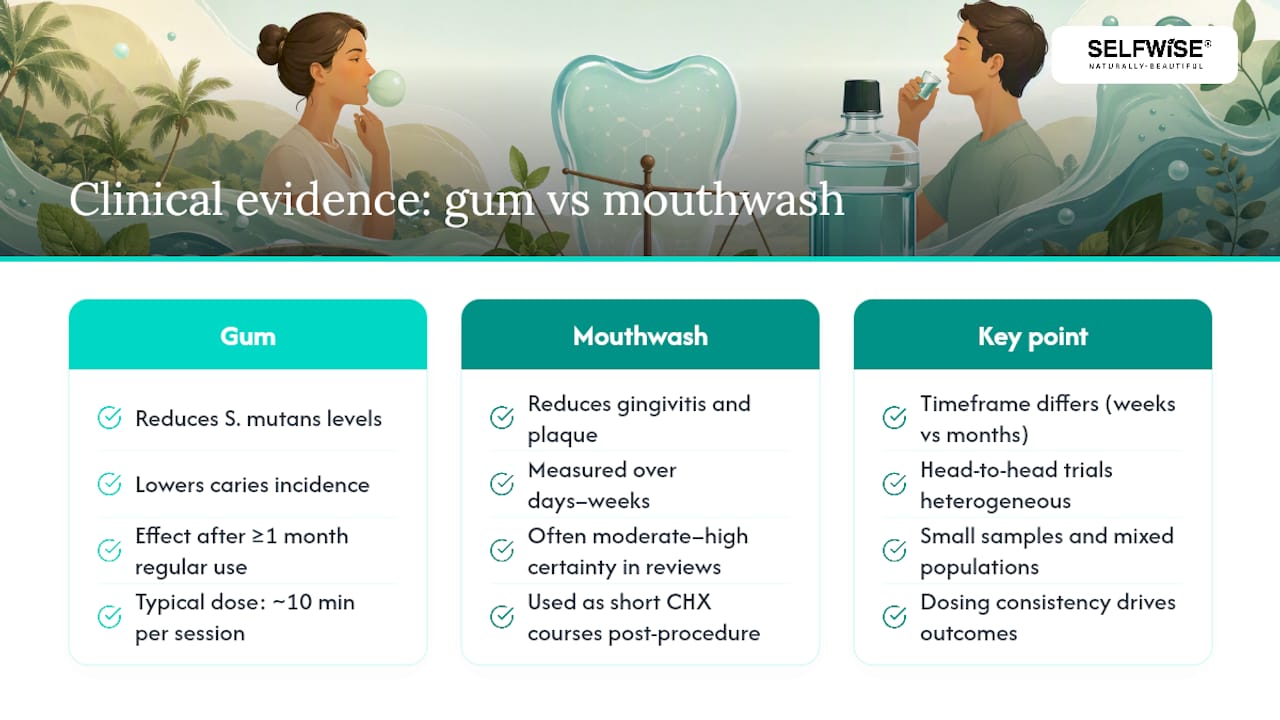
For caries and bacterial load, sugar-free and xylitol gum have a solid track record. Meta-analyses cited in the Frontiers in Oral Health review found statistically significant reductions in S. mutans levels and lower caries incidence when gum was chewed consistently after meals. That word “consistently” is doing a lot of work. Trials generally need at least a month of regular use, chewing roughly 10 minutes per session, before measurable changes in oral indices show up, according to a systematic review on sugar-free chewing gum.
For gingivitis and plaque, chlorhexidine mouthwash has the stronger short-term evidence. Reviews summarized in an International Dental Journal supplement rate CHX as moderate-to-high certainty for reducing gingivitis and plaque over a matter of weeks. That’s a real, well-documented effect, and it’s why dentists still prescribe short CHX courses after periodontal procedures.
The gap between gum and mouthwash isn’t which one “wins.” It’s timeframe: mouthwash trials tend to measure fast plaque and gingival index changes over days to weeks, while gum trials measure slower bacterial and caries shifts over a month or more.
Head-to-head trials don’t settle the argument cleanly, either. A study comparing propolis-based chewing gum against propolis mouthwash found the two performed similarly on some plaque measures, while other trials with different formulations found mouthwash pulling ahead on short-term plaque indices. The heterogeneity comes from small sample sizes, mixed populations (orthodontic patients skew results one way, general adult populations another), and wildly different dosing protocols. Reviewers consistently flag this as the biggest limitation in the literature: you’re rarely comparing apples to apples.
One pattern holds across nearly every trial worth citing, though: outcomes track dosing pattern more than product category. A person who chews gum religiously after every meal often beats a person who rinses with mouthwash sporadically, and vice versa. Consistency outperforms the product on the label.
When Should You Reach for Gum or Mouthwash?
Match the tool to the moment instead of picking a permanent favorite. Here’s how that plays out in a normal week.
- Right after lunch at your desk. No toothbrush available. Chew sugar-free xylitol gum for 5 to 20 minutes to buffer acid and rinse food debris mechanically. This is the single best real-world use case for gum.
- Dry mouth, whether from medication, age, or just talking all day. Gum’s saliva stimulation directly counters the problem mouthwash can’t touch, and some alcohol-based rinses make dry mouth worse.
- After a dental procedure your dentist flagged for infection risk. A short, prescribed course of chlorhexidine mouthwash is the right call here, used exactly as long as directed and no longer.
- General daily plaque and halitosis maintenance. A fluoride or CPC-based rinse used at a separate time from brushing, not as a replacement for brushing.
That last point on timing trips people up constantly. Rinsing with mouthwash immediately after brushing can wash away the concentrated fluoride your toothpaste just deposited. The NHS recommends using mouthwash at a different time of day entirely, or waiting about 30 minutes if you’re set on doing both back to back.
Pro Tip: Keep a pack of sugar-free gum at your desk and a bottle of alcohol-free rinse at home for the evening. Splitting the two by time of day, rather than trying to pick one winner, covers more ground than either alone.
A few contraindications matter enough to flag directly. Skip gum if you have TMJ disorder or chronic jaw pain. Skip daily mouthwash for children under the age recommended on the label, since swallowing risk is real at that age. And don’t extend a chlorhexidine course past what your dentist prescribed. Alcohol-free formulas are the safer daily default if you deal with dry mouth or general sensitivity.
Can Mouthwash or Gum Hurt Your Mouth?
Both products carry real, documented downsides, and glossing over them is how people end up using the wrong one for months.
Chlorhexidine is the biggest offender on the mouthwash side. Beyond the staining and taste disturbance that show up with extended use, there’s a broader concern researchers keep raising: routine antiseptic rinsing doesn’t discriminate between harmful bacteria and the commensal bacteria your mouth actually needs, and some plaque organisms may adapt to repeated antiseptic exposure over time. That’s not a reason to panic about a single prescribed course. It’s a reason to treat “daily antiseptic mouthwash forever” as a habit worth questioning.
Gum’s risks are more mechanical than chemical:
- Prolonged or aggressive chewing can aggravate TMJ symptoms or general jaw fatigue.
- Sugar-containing gum defeats the entire purpose and actively feeds cariogenic bacteria.
- Gum isn’t appropriate for young children who might swallow or aspirate it.
The practical fix for most of this is rotation, not elimination. Use sugar-free xylitol gum as your default daily habit, save chlorhexidine for dentist-recommended windows only, and choose alcohol-free, ingredient-transparent rinses for anything you plan to use every day. That combination gets you the antibacterial benefit when you need it without the microbiome cost of using it constantly.
Building a Routine That Uses Both Tools Correctly
A genuinely evidence-based routine treats gum and mouthwash as two different tools in the same kit, not competitors for the same job.
- Baseline, every day, no exceptions. Brush twice daily with fluoride toothpaste, clean between teeth once a day, and scrape your tongue. This is the foundation nothing else replaces.
- On the go. When brushing isn’t an option after a meal, chew one piece of sugar-free xylitol gum for 5 to 20 minutes instead of reaching for mints or skipping cleaning altogether.
- Targeted, as needed. Use a fluoride rinse or a xylitol and nano-hydroxyapatite-friendly rinse when your risk profile calls for it, or a short CHX course only if a dentist prescribes one.
Picture two common scenarios. An office worker who eats lunch at their desk keeps gum in a drawer and chews it right after eating, hitting the acid-buffering window brushing can’t reach until evening. Someone recovering from a periodontal procedure follows the dentist’s exact CHX protocol for the prescribed number of days, then switches back to an alcohol-free rinse once that window closes.
Pro Tip: Don’t stack gum and mouthwash back to back expecting a bigger effect. Space them out. Gum after lunch, rinse in the evening, brushing morning and night. Layering everything at once doesn’t multiply the benefit and can just wash the taste and residue of one product into the other.
What I’d Actually Tell a Health-Conscious Reader
The evidence doesn’t crown one universal winner, and treating this as a rivalry misses the point entirely. Sugar-free xylitol gum earns its place as the better everyday habit: it’s portable, it stimulates saliva you’d otherwise lose after a meal, and the caries-reduction evidence for consistent use is genuinely solid. Mouthwash earns its place as the better precision tool: fast, concentrated, and appropriate when you need targeted antibacterial or fluoride action a piece of gum can’t deliver.
What Selfwisebrand’s ingredient focus gets right is treating that distinction as real rather than marketing noise. Xylitol gum and alcohol-free, nano-hydroxyapatite-friendly rinses map cleanly onto what the research actually supports: gentle, consistent, microbiome-conscious habits over aggressive daily antiseptic use. If you’re dealing with persistent bad breath, bleeding gums, or anything that feels like more than routine maintenance, that’s a conversation for a dentist, not a gum pack.
— Viktor
Try Selfwise’s Natural Oral Care Line
An effective approach to oral care leans directly into what the evidence supports: xylitol-friendly, alcohol-free formulas instead of harsh antiseptic overkill. The oral care collection includes rinses built around nano-hydroxyapatite and xylitol rather than fluoride-stripping alcohol bases, which fits the post-meal, daily-use role this article just laid out.
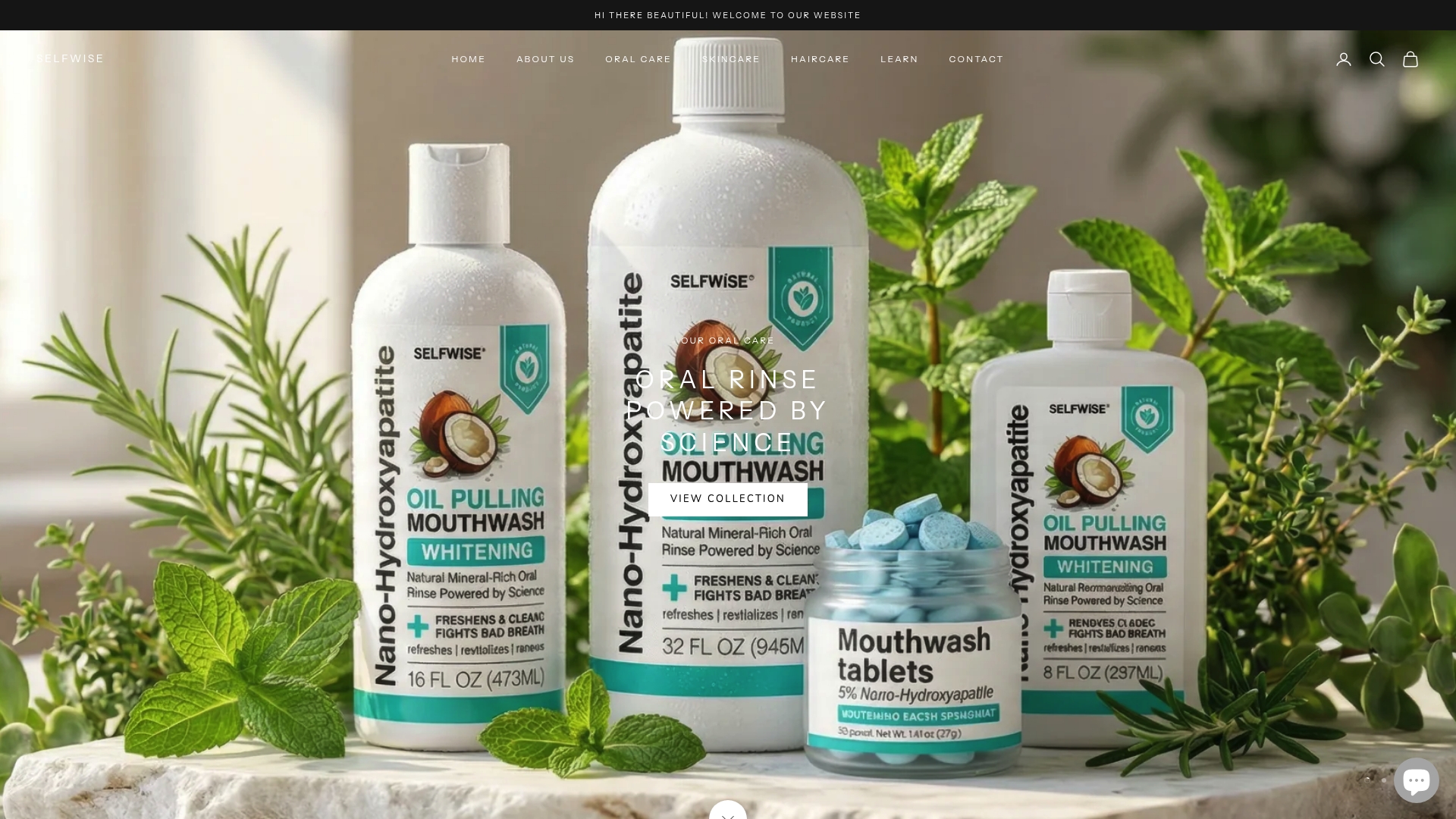
If your routine already includes sugar-free gum after meals, an alcohol-free rinse rounds out the evening half of that habit without the staining or taste disruption that comes with chlorhexidine-heavy products. The fresh breath and oral health collection is built for exactly that daily use case, not the short-term clinical one. Browse the Selfwisebrand storefront to see current formulations and find the rinse that fits your routine.
Sources
- Chewing Gum | American Dental Association
- The role of sugar-free chewing gum in dental caries: a review (Frontiers in Oral Health, 2023)
- How to keep your teeth clean - NHS
This article is general information, not a substitute for advice from a qualified doctor. Consult a qualified healthcare professional about your own circumstances before acting on anything here.
FAQ
Why Do Some Dentists Caution Against Daily Mouthwash Use?
The concern isn’t mouthwash itself but daily antiseptic use over the long haul, which can disrupt the balance of bacteria your mouth needs and, in the case of chlorhexidine, cause staining and taste changes with prolonged use. Dentists generally reserve strong antiseptic rinses for short, targeted windows rather than everyday habits.
Why Do Some Dentists Discourage Chewing Gum?
The caution applies mainly to sugar-containing gum, which feeds cavity-causing bacteria, and to anyone with TMJ or jaw issues who could aggravate that condition with frequent chewing. Sugar-free xylitol gum used in moderation doesn’t carry that same concern and is recognized by the ADA as a supportive adjunct.
Can You Tell if Someone Has Gingivitis by Smell?
Persistent bad breath that doesn’t clear with brushing or mouthwash can be a sign of gum disease, since bacteria in inflamed gum pockets produce sulfur compounds with a distinct odor. Mouthwash temporarily masks this smell without addressing the underlying gum inflammation, so persistent odor is worth a dental visit rather than a stronger rinse.
Does Chewing Gum Replace the Need for Mouthwash, or Vice Versa?
Neither replaces the other, and both are adjuncts to brushing and flossing rather than substitutes for them. Gum handles everyday saliva stimulation and acid buffering, while therapeutic mouthwash handles targeted plaque, gingivitis, or fluoride needs that gum alone can’t cover.
Is Mouthwash Better Than Gum for Fresh Breath?
Mouthwash gives faster, stronger masking of bad breath in the moment, but it doesn’t fix the root cause the way saliva stimulation from gum can. For lasting freshness after a meal, chewing sugar-free gum for 5 to 20 minutes often outperforms a quick rinse because it addresses the dry mouth and bacterial buildup causing the odor in the first place.