Why sensitive skin needs gentle products for oral care
If you have sensitive skin, you have probably assumed that “natural” or “foamy” products are automatically safe. That misconception is exactly why sensitive skin needs gentle products, especially in oral care where the skin around your lips, gums, and mouth gets daily exposure to cleansers, mouthwash, and toothpaste. The skin in this area is thinner, more reactive, and quicker to show redness or dryness when the wrong product strips its defenses. Understanding the biology behind your sensitivity changes everything about the products you choose and the results you get.
Table of Contents
- Understanding sensitive skin and the skin barrier
- Why harsh products worsen sensitive skin
- How gentle, fragrance-free products protect sensitive skin
- Comparing cleansing options for sensitive skin
- Building a gentle oral care routine for sensitive skin
- A fresh perspective: why less is more with sensitive skin care
- Explore gentle, natural oral care products from Selfwise
- Frequently asked questions
Understanding sensitive skin and the skin barrier
Sensitive skin is not a single condition. It is a reaction pattern. The underlying cause in almost every case is a weakened skin barrier, the outermost layer of skin cells and lipids (natural fats) that keeps moisture in and irritants out. When that barrier is functioning well, most ingredients simply sit on the surface. When it is compromised, those same ingredients penetrate deeper and trigger reactions your immune system has to manage.
Sensitive skin reacts when the barrier is compromised, allowing moisture to escape and irritants to penetrate, which produces burning, redness, and dryness. That cycle reinforces itself. Moisture loss makes the barrier weaker, which lets in more irritants, which causes more inflammation, which slows repair. Breaking that cycle requires products that do not push the barrier further into damage.
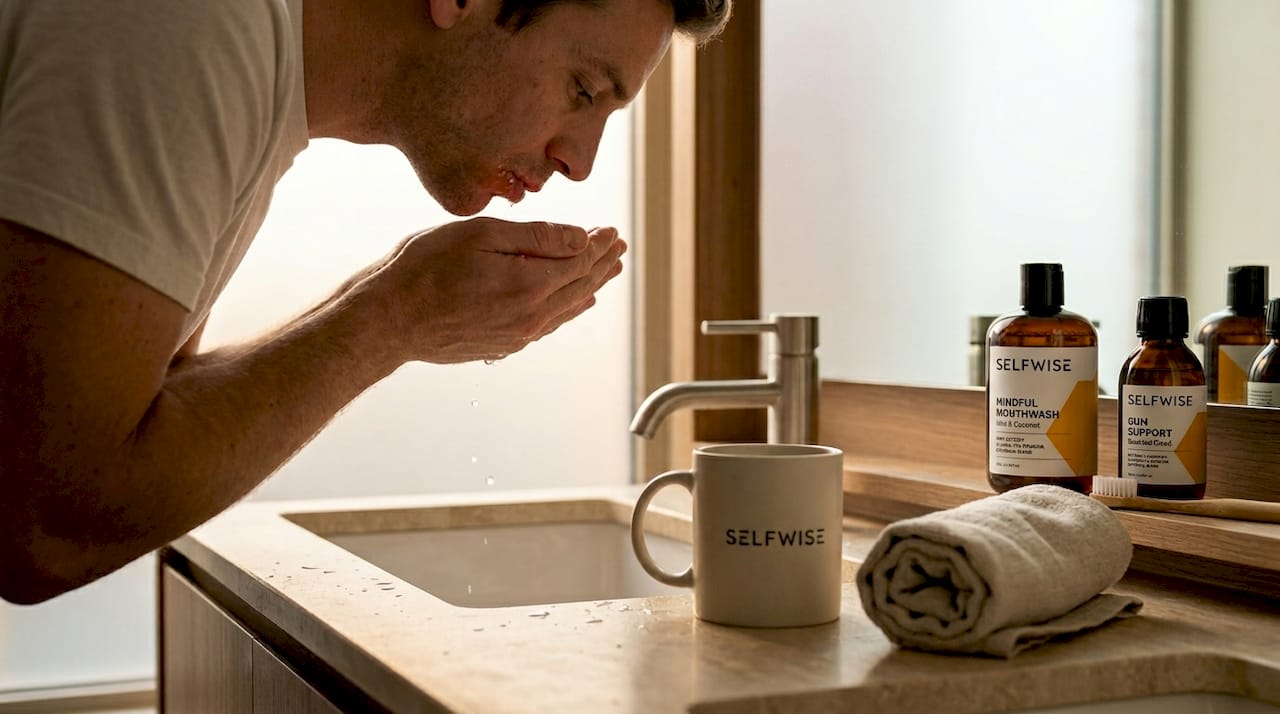
The area around your mouth is particularly vulnerable. The skin near your lips is thinner than facial skin elsewhere, and it contacts oral care products every single day. Mouthwash that lingers on the skin, toothpaste foam that touches the corners of your mouth, even the act of rinsing repeatedly can all disrupt that local barrier if the products contain the wrong ingredients.
Common symptoms to recognize in sensitive skin around the mouth and face include:
- Burning or stinging during or after product use
- Persistent dryness or flaking around the lips and chin
- Redness or flushing that appears after washing or rinsing
- Eczema or rosacea flares triggered by new products
- Tightness after cleansing that does not resolve quickly
If you recognize these, the products you are using are likely affecting dry and sensitive skin in ways that compound over time rather than resolve.
Why harsh products worsen sensitive skin
The ingredient categories that do the most damage are not the obscure ones. They are in most mainstream cleansers, mouthwashes, and toothpastes sitting on drugstore shelves right now.
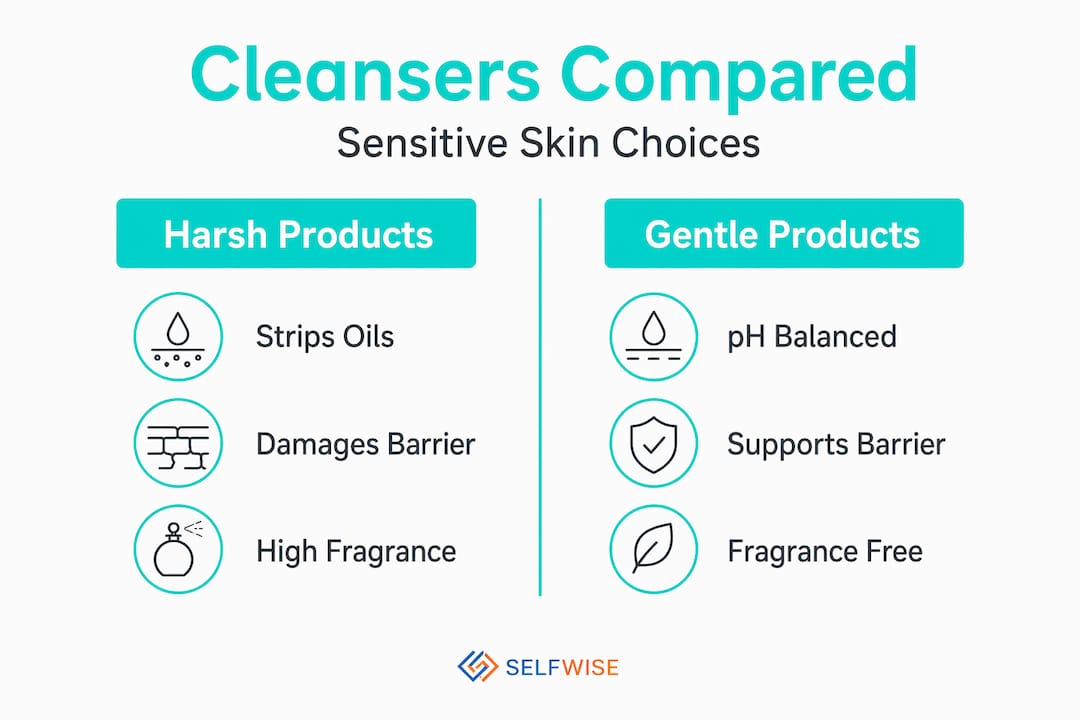
Harsh cleansers strip natural oils and damage the skin barrier, worsening sensitivity with every use. The problem with foaming cleansers specifically is that sodium lauryl sulfate (SLS), the ingredient responsible for that thick lather, is genuinely aggressive on the skin’s lipid layer. It does not differentiate between the oils that need to be cleaned off and the ones your barrier depends on. It removes both.
Fragrance is equally problematic and often more surprising to people. You might reach for something labeled “natural lavender” or “botanical citrus” and assume it is skin-safe. But fragrance causes contact dermatitis even in products labeled natural. The molecule that gives lavender its scent is the same molecule that triggers a reaction in reactive skin. Natural origin does not equal non-reactive.
Fragrance-free hydrating cleansers actively avoid the stripping and reduce sensitivity over time. This is why the fragrance-free category exists at all. It is not a marketing angle. It reflects a clinical reality.
Over-exfoliation belongs in this list too. Scrubbing around the mouth with abrasive toothpastes or rough rinse routines creates micro-damage that compounds into persistent sensitivity. Physical friction breaks down barrier cells faster than they can regenerate.
Key damage triggers to cut from your routine:
- SLS and similar sulfate-based foaming agents
- Fragrances, whether synthetic or botanical
- Alcohol-based mouthwashes that dry the oral skin tissue
- Abrasive whitening toothpastes used daily
- Multiple new products introduced at once
Pro Tip: When you switch to a gentler skincare routine, change one product at a time and wait at least two weeks before adding the next. It is the only reliable way to know what is helping and what is not. Switching five things simultaneously makes identifying the problem ingredient nearly impossible.
How gentle, fragrance-free products protect sensitive skin
The reason gentle skincare for sensitive skin works is not vague or philosophical. It is measurable. When you remove the triggers and replace them with barrier-supportive ingredients, the skin repairs itself because that is what it is designed to do. Your job is to stop disrupting that process.
After one week using a fragrance-free calming cream, 100% of users showed improvement in skin barrier function and 90% showed reduced redness. One week. That is not an unusual result when you actually remove the irritants and give the skin what it needs to rebuild.
The characteristics that make a product genuinely supportive for sensitive skin include:
- Fragrance-free formulation to eliminate the most common contact trigger
- Low or no foam to preserve natural skin oils during cleansing
- pH-balanced at roughly 4.5 to 5.5, matching the skin’s natural acidity
- Short ingredient lists with fewer variables that could cause reactions
- Moisturizing agents like hyaluronic acid or xylitol that support hydration
For natural oral care, these principles translate directly. A mouthwash formulated for sensitive skin avoids alcohol, SLS, and synthetic fragrance. Nano hydroxyapatite (a calcium-based mineral identical to what your teeth are made of) supports enamel without aggressive chemistry. Xylitol supports a balanced oral environment without harsh preservatives. These are not compromises. They are better choices by design.
The skin around your mouth benefits from the same thinking that guides facial oil choices for sensitive types. Simpler. Calmer. Ingredient-first.
Comparing cleansing options for sensitive skin
Not all cleansers are equally harmful or equally safe. This comparison gives you a direct view of what to use and what to replace.
| Cleanser type | Foaming level | Barrier impact | Fragrance risk | Best for sensitive skin? |
|---|---|---|---|---|
| SLS-based foaming cleanser | High | High damage | Often present | No |
| Micellar water | None | Low impact | Sometimes present | Yes, if fragrance-free |
| Oil-based cleanser | None | Supportive | Low | Yes |
| Gel cleanser (pH-balanced) | Low | Minimal damage | Varies | Yes, if fragrance-free |
| Alcohol-based mouthwash | N/A | Drying | Often present | No |
| Natural oil-pulling formulas | N/A | Neutral to supportive | Low | Yes |
| SLS-free toothpaste | Low | Minimal | Varies | Yes, if fragrance-free |
Gentle, pH-balanced cleansers preserve natural oils and reduce irritation during daily use. The practical takeaway here is that the best products for sensitive skin tend to be the quieter ones. No big lather. No strong scent. No aggressive actives.
For oral care specifically, fluoride-free options and gentle mouthwash formulations are worth exploring if you find conventional products leave your mouth or lips feeling dry and reactive after use.
Pro Tip: Before committing to any new oral care or skincare product, patch test it on the inside of your wrist for 48 hours. If you see no redness, stinging, or swelling, it is likely safe to use near your mouth and face. Never skip this step with a new formula.
Building a gentle oral care routine for sensitive skin
A routine built for sensitive skin does not need to be complicated. It needs to be consistent and free of known irritants. Here is a practical structure that works:
- Choose a fragrance-free cleanser for the face and mouth area, specifically one that is SLS-free and pH-balanced
- Use a pH-balanced, alcohol-free mouthwash that avoids synthetic fragrance and harsh preservatives
- Maintain hydration around the lips and chin with a simple, fragrance-free balm or oil after your oral care routine
- Avoid harsh scrubs near the mouth, including abrasive whitening toothpastes used more than once weekly
- Introduce products one at a time and track your skin’s response over two weeks before making further changes
Ingredients to seek in oral care for sensitive skin:
- Nano hydroxyapatite for gentle enamel remineralization
- Xylitol for microbial balance without alcohol
- Aloe vera for soothing irritated oral tissue
- Coconut or sesame oil in oil-pulling formulas for mechanical cleansing without harsh chemistry
Ingredients to avoid:
- Sodium lauryl sulfate in toothpastes and cleansers
- Synthetic or natural fragrance in any oral care product
- Ethanol or high-percentage alcohol in mouthwash
- Artificial sweeteners like saccharin that some people react to
Simplifying your routine with fragrance-free products gives the skin barrier time to heal and reduces cumulative irritation. That word “cumulative” matters. Sensitive skin does not always react to a single product once. It reacts to repeated small insults that stack up over days and weeks until the barrier cannot keep up. Simplifying removes that stack entirely.
Your oral health essentials and nano hydroxyapatite mouthwash tablets can be the foundation of a routine that actually calms the skin around your mouth rather than irritating it daily.
A fresh perspective: why less is more with sensitive skin care
Most beauty and oral care marketing pushes complexity. More steps. More actives. More products working synergistically. For sensitive skin, that logic is backwards.
Sensitive skin behaves as a reaction pattern, not a fixed type, so managing it requires supporting the barrier with minimal disruptive factors. The more products in a routine, the more variables there are to trigger a response. The harder it becomes to identify what is helping versus what is quietly causing low-grade inflammation every day.
There is also a patience problem. People switch products the moment their skin does not improve within days, then start over with another complex routine. The barrier does not heal in 72 hours. It needs weeks of reduced disruption to rebuild. Constantly resetting that process by introducing new things keeps the barrier in a permanent state of reaction.
The smartest move for sensitive skin is usually subtraction, not addition. Strip the routine back to two or three products. Use them consistently. Give your skin time to respond. That boring, minimal natural oral health routine you keep dismissing as too simple might be exactly what your skin has been waiting for.
Pro Tip: Keep a simple log for the first month of a new routine. Note what you used, any reactions, and how your skin felt the next morning. Patterns become visible fast when you write them down.
Explore gentle, natural oral care products from Selfwise
Now that you understand the biology behind sensitive skin reactions, you are in a position to make product choices that actually support your skin instead of slowly depleting it. The ingredients, the formulation approach, the absence of harsh chemicals all matter more than the label claiming “natural” on the front.
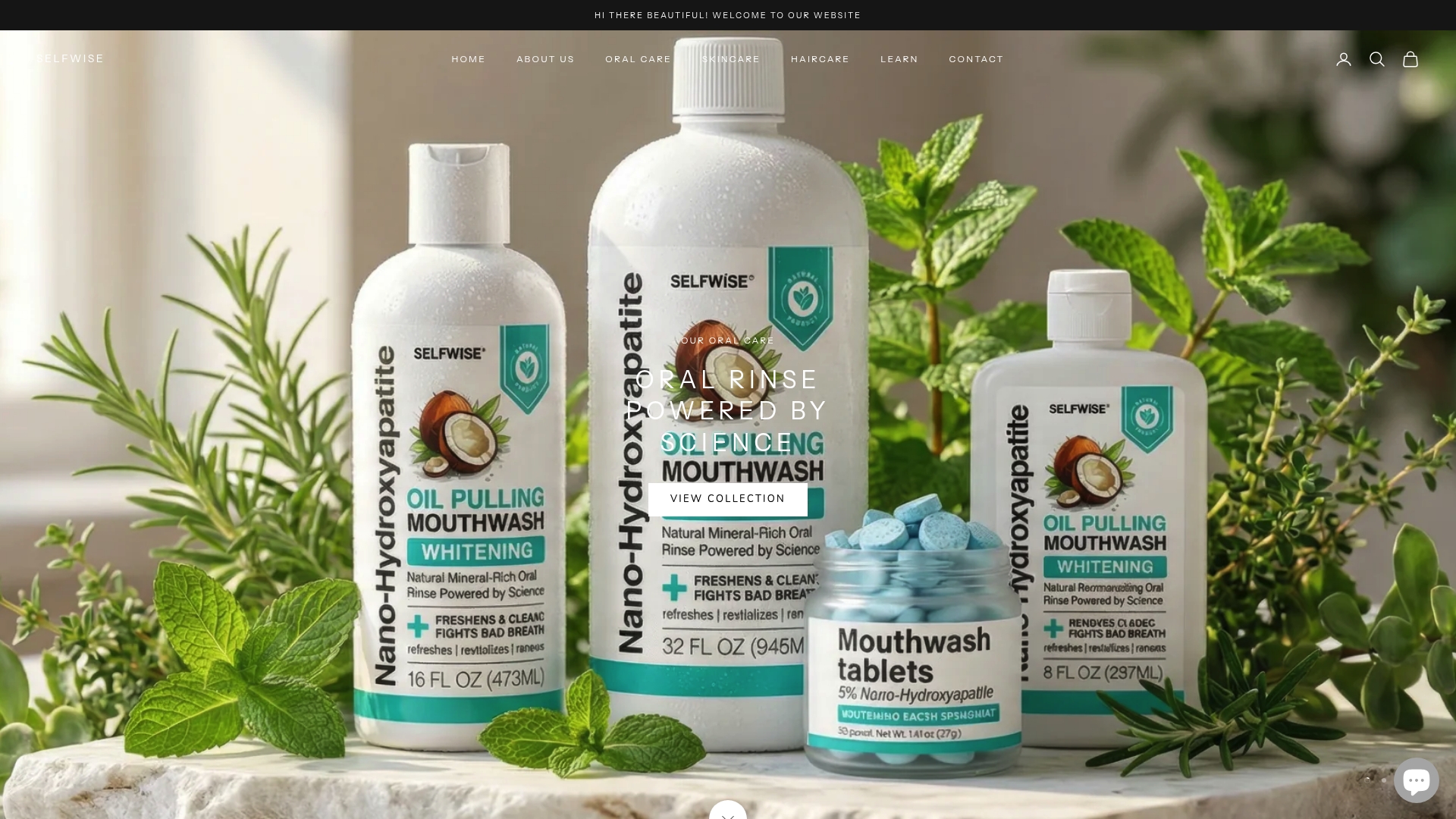
Selfwise builds its fluoride-free oral care products around exactly the principles covered in this article. No SLS. No synthetic fragrance. No alcohol in the mouthwash formulas. Instead, nano hydroxyapatite works with your enamel at a mineral level, xylitol supports a balanced oral environment, and oil-pulling options give your routine a gentle mechanical cleanse without aggressive chemistry. Explore the full range of gentle mouthwash formulations and oral health essentials from Selfwise and find a daily routine your skin can actually tolerate long-term.
Frequently asked questions
What causes sensitive skin to react strongly to some products?
Sensitive skin reactions occur mainly because a compromised barrier allows moisture to escape and irritants to penetrate more deeply, triggering burning, redness, and dryness. Products with SLS, fragrance, or alcohol accelerate that process.
Why should I avoid fragrance in products if I have sensitive skin?
Fragrance triggers contact dermatitis even in products labeled natural or mild, making fragrance-free formulations the reliable choice for anyone managing reactive skin.
Can natural oral care products be safe for sensitive skin?
Yes. Natural oral care products that are fragrance-free, pH-balanced, and built around gentle barrier-supportive ingredients can support sensitive skin without triggering the irritation cycles caused by conventional formulas.
How can I build a gentle oral care routine for my sensitive skin?
Start with fragrance-free, low-foam cleansers and alcohol-free mouthwash, moisturize around the mouth after brushing, and introduce each new product gradually with at least two weeks between changes to accurately track your skin’s response.