What Is Pure Body Lotion? Your 2026 Ingredient Guide
Most people assume “pure” on a lotion label just means it’s natural or organic. That’s not quite right. What is pure body lotion, really? It’s a formulation philosophy built around minimalism: fewer ingredients, no synthetic additives, and nothing your skin doesn’t actually need. You’ll find no parabens, no sulfates, no artificial fragrances. What you get instead are ingredients your skin can recognize and use. This guide breaks down what makes a lotion “pure,” which ingredients to look for, how to use it correctly, and whether it actually delivers results for your skin type.
Table of Contents
- Key takeaways
- What pure body lotion actually means
- Benefits of pure body lotion for skin health
- How to use pure body lotion effectively
- Pure lotion vs. conventional alternatives
- My take on pure skincare and minimalist care routines
- Clean body care from Selfwisebrand
- FAQ
Key takeaways
| Point | Details |
|---|---|
| “Pure” means minimalist | Pure body lotions use a short, clean ingredient list free from synthetic fragrances, parabens, and sulfates. |
| Not the same as “natural” | “Pure,” “natural,” and “organic” have distinct meanings. Pure focuses on formulation simplicity, not certification. |
| Skin barrier benefits | Regular use restores moisture, improves elasticity, and supports the skin’s natural protective barrier. |
| Application technique matters | Applying lotion to damp skin and massaging in upward strokes significantly improves absorption. |
| Best for sensitive skin | Pure formulas carry a lower risk of allergic reactions, making them ideal for reactive or compromised skin. |
What pure body lotion actually means
“Pure” is one of the most misused words in skincare. Walk down any pharmacy aisle and you’ll see it on products loaded with synthetic fillers. So let’s define it properly.
In skincare terms, pure formulations prioritize ingredient transparency and exclude common irritants like parabens, sulfates, synthetic fragrances, and artificial dyes. Some pure lotions go as far as containing a single ingredient. One well-known example is unscented tallow lotion, made from grass-fed beef tallow and nothing else. That’s about as pure as skincare gets.
How pure differs from natural and organic
These three terms feel interchangeable but they are not. “Natural” means ingredients came from natural sources, though the final product may still contain processing chemicals. “Organic” refers to how ingredients were grown and is governed by certification standards. “Pure” is about formulation simplicity, not origin or certification. A product can be pure without being certified organic, and a certified organic product can still contain dozens of ingredients.
Here’s a quick comparison to make this concrete:
| Term | What it means | Regulated? |
|---|---|---|
| Pure | Minimalist formula, no irritants | No |
| Natural | Derived from natural sources | Loosely |
| Organic | Grown without synthetic pesticides | Yes (USDA, EU) |
| Clean | No specific harmful chemicals | No |
Common ingredients in pure body lotions
Natural body lotions exclude synthetic fragrances, parabens, sulfates, and artificial dyes to keep the formula non-irritating. Instead, you’ll typically see:
- Glycerin: A humectant that draws moisture from the air into your skin.
- Hyaluronic acid: Holds up to 1,000 times its weight in water, ideal for deep hydration.
- Shea butter: Rich in fatty acids and vitamins, softens and protects the skin barrier.
- Cocoa butter: Creates a seal on the skin’s surface to reduce moisture loss.
- Beef tallow: An animal-derived fat close in composition to human sebum, used in single-ingredient formulas.
- Plant oils (jojoba, rosehip, argan): Deliver vitamins and antioxidants without synthetic carriers.
The shorter the ingredient list, the easier it is to identify what’s actually doing the work. That’s the whole point of going pure.
Benefits of pure body lotion for skin health
The skin barrier is the outermost layer of your skin. It keeps moisture in and irritants out. When it’s compromised, your skin feels dry, itchy, and reactive. This is where pure body lotion earns its place.

Regular lotion use restores the skin barrier, improves elasticity, and smooths rough patches. But conventional lotions loaded with synthetic chemicals can do the opposite over time. They may hydrate short-term while gradually degrading the barrier through cumulative irritant exposure. Natural body care products avoid this long-term damage and reduce environmental impact compared to chemical alternatives.
For people with sensitive, reactive, or eczema-prone skin, this difference is not subtle. It’s the difference between a lotion that actually helps and one that creates a frustrating cycle of temporary relief followed by more irritation.
Specific skin health benefits worth knowing
- Moisture retention: Pure lotions create a protective layer reducing water loss and shielding skin from environmental irritants.
- Skin barrier repair: Fatty acids in shea butter and tallow closely mimic the skin’s natural lipid structure, supporting barrier recovery.
- Anti-aging properties: Single-ingredient formulas like tallow lotion deliver vitamins A, D, E, and K alongside essential fatty acids that support skin cell renewal.
- Reduced allergic reactions: Fewer ingredients mean fewer potential triggers for people with contact dermatitis or fragrance sensitivities.
- Soothing rough or inflamed patches: Plant oils and natural butters calm irritated skin without the sting that alcohol-based lotions can cause.
Pro Tip: If you have eczema-prone skin, look for pure body lotions that contain no essential oils at all. Even “natural” essential oils are common irritants for reactive skin types.
Health-conscious consumers increasingly prefer pure body lotions to avoid cumulative chemical exposure on the skin barrier. This shift mirrors the same thinking behind switching to cleaner oral care products. Your skin absorbs what you put on it, and what you put on it daily adds up.
How to use pure body lotion effectively
Getting the application right is as important as choosing the right product. Most people use body lotion on completely dry skin. That’s a missed opportunity.
Here’s the most effective way to apply pure body lotion:
- Shower or bathe as usual. Pat your skin dry with a towel, but leave it slightly damp. Not soaking, just moist enough to feel cool to the touch.
- Apply the lotion within two to three minutes of stepping out. This is the window when your skin is still open and ready to absorb moisture. Waiting longer allows transepidermal water loss to begin.
- Use gentle upward strokes. Massaging in upward strokes on slightly damp skin enhances absorption and stimulates circulation. This is a technique that most basic instructions skip entirely.
- Focus on high-loss areas first. Elbows, knees, shins, and heels lose moisture fastest. Give these spots extra attention.
- Let the lotion absorb for two to three minutes before getting dressed. Rushing this step means the lotion transfers to your clothes rather than your skin.
Pro Tip: In winter, layer a pure body oil underneath your lotion to create a deeper moisture seal. Apply the oil first, then the lotion on top while the oil is still slightly tacky.
How often should you apply it?
Lotion frequency depends on skin type, climate, and conditions like eczema. There is no single rule that fits everyone. Most people with normal skin do well with once-daily application after bathing. Dry or eczema-prone skin may need twice-daily use, especially in low-humidity environments. Oily skin types often do fine with every other day application, focusing on dry zones only.
Seasonally, you will need a richer formula in winter when indoor heating strips moisture from the air. In summer, a lighter lotion or body oil formula works better since excessive richness can clog pores in heat and humidity. Dermatologists consistently emphasize tailoring lotion use to individual needs rather than following a rigid daily rule.
Pure lotion vs. conventional alternatives
Here is where the confusion usually lives. Consumers walk into stores and see dozens of body lotion options, all claiming moisturizing benefits. How does pure body lotion actually compare?
| Feature | Pure body lotion | Conventional lotion |
|---|---|---|
| Ingredient count | 1 to 10 | 20 to 40+ |
| Synthetic fragrances | None | Common |
| Preservatives | Minimal or none | Standard (parabens, etc.) |
| Skin barrier impact | Supportive | Potentially degrading over time |
| Best for | Sensitive, reactive skin | General use |
| Shelf life | Shorter | Longer |
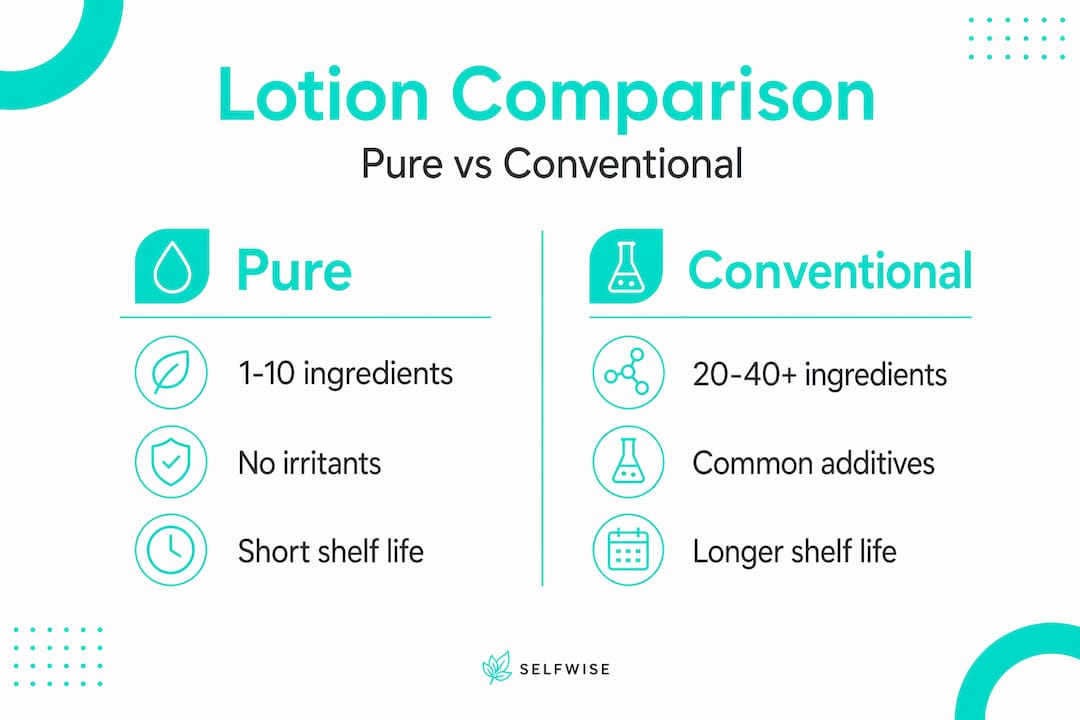
The shorter shelf life of pure lotions is worth accepting. Preservatives extend shelf life, but they are also a common cause of contact dermatitis. If you are buying a lotion with a two-year expiration date, ask yourself what is keeping it stable that long.
Common misconceptions about pure and natural lotions
Many consumers assume pure lotions are less effective because they have fewer ingredients. The logic goes: more active ingredients must mean better results. This is backwards. Selecting the right lotion texture and formulation for your skin type outperforms throwing a dozen actives at it. A single well-chosen ingredient like shea butter or beef tallow can outperform a complex formula for someone with sensitive skin.
Another misconception is that “fragrance-free” means “scent-free.” Fragrance-free means no added fragrance compounds. The product may still have a mild natural scent from its base ingredients. This matters because synthetic fragrance is one of the most common causes of allergic skin reactions, and its removal from a formula is a meaningful protective choice.
Who benefits most from switching to pure body lotions? People with sensitive or reactive skin, those who have experienced repeated reactions to conventional products, anyone managing eczema or psoriasis, and health-conscious consumers who apply the same clean-ingredient standard to their skin that they apply to their diet.
My take on pure skincare and minimalist care routines
I will be honest: when I first started paying attention to my skincare ingredients, I felt overwhelmed by the noise. Every brand claimed to be “pure” or “clean.” The labels meant almost nothing.
What changed my thinking was applying the same logic I use with oral care to everything else I put on my body. At Selfwisebrand, we work with a small number of ingredients that have proven track records. That same philosophy maps perfectly to what a good pure body lotion should be. If I cannot explain what an ingredient does and why it belongs, it should not be there.
I have found that people with reactive skin are often using too many products, not too few. Stripping back to a one or two-ingredient lotion is not settling for less. It is removing variables so your skin can actually stabilize. I have seen this work for dry skin, eczema-prone skin, and people who thought their skin just “ran hot” with irritation. Often, the irritation was the formula all along.
What most people miss is that skin health and overall wellness are connected. The same health-conscious reasoning that leads someone to look at natural skincare ingredients should lead them to examine what they put in their mouth, too. It is all the same system.
— Viktor
Clean body care from Selfwisebrand
If this guide has made you think differently about what goes on your skin, you are already asking the right questions. At Selfwisebrand, we apply the same minimalist, ingredient-first thinking to every product we make.
Our natural body oils collection is a great place to start for anyone exploring pure body care. These formulas are built around single and short-ingredient principles, with no synthetic fragrances or unnecessary fillers. If you are dealing with dry or sensitive skin, options like our tallow-based moisturizers offer the kind of nutrient-dense hydration that complex chemical formulas rarely match. Explore the full range and find what fits your skin and your lifestyle. Clean ingredients. Real results.
FAQ
What does “pure” mean in body lotion?
In skincare, “pure” refers to minimalist formulations that exclude synthetic fragrances, parabens, sulfates, and artificial dyes. Some pure lotions contain a single ingredient, like unscented beef tallow.
Is pure body lotion effective for dry skin?
Yes. Pure body lotion for dry skin works by locking in moisture and restoring the skin barrier using ingredients like shea butter, cocoa butter, and natural oils. These deliver lasting hydration without synthetic fillers.
How is pure body lotion different from natural body lotion?
“Pure” describes formulation simplicity and low ingredient count. “Natural” refers to the origin of ingredients. A lotion can be pure without being certified natural, and natural products are not always minimalist in formulation.
How often should you use pure body lotion?
Frequency depends on your skin type and climate. Most people apply it once daily after bathing, while those with dry or eczema-prone skin may need twice-daily use, especially in winter or low-humidity environments.
Can pure body lotion cause reactions?
Pure lotions carry a lower risk of reactions than conventional formulas because they exclude common irritants like synthetic fragrance. However, individual sensitivities to natural ingredients like nut-based oils are still possible. Always patch test a new product first.